





 Portuguese
  English
  Spanish
 7 min of reading
  0 comments


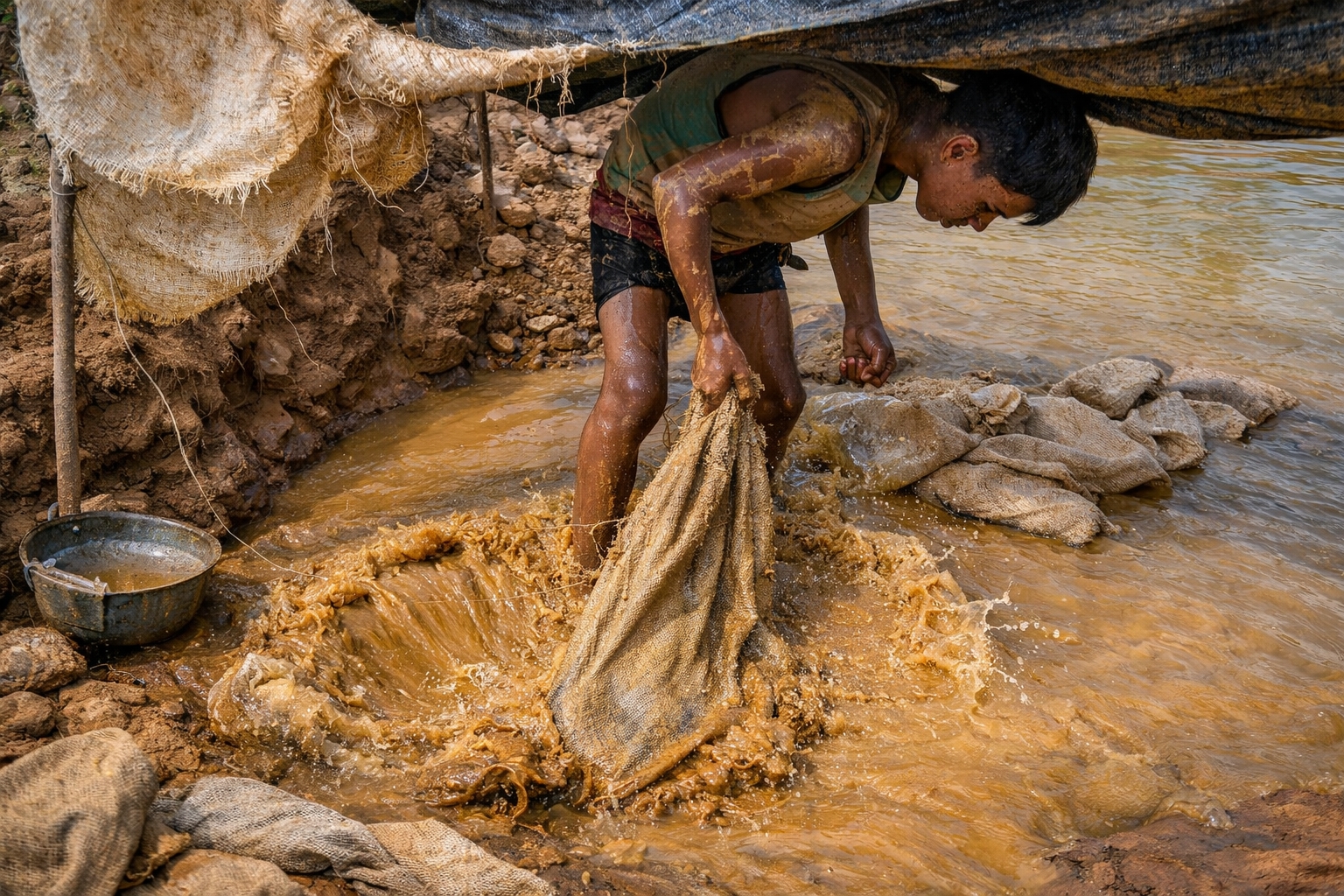
In Venezuela, the Trump Administration Launched an Offensive in Caracas on January 3 Aiming to Combat Drug Trafficking and Illegal Oil Trade, While Illegal Mining in the South of the Country Moves Billions, Uses Mercury, Fuels Organized Crime and Aggravates Violations Reported by the UN.
In June 2022, armed men shot Virgilio Trujillo Arana three times in the head in the capital of the Venezuelan state of Amazonas. He was a Uwottüja indigenous leader and dedicated years to defending the forest against illegal mining, which advanced and transformed environmental protection into a high-risk activity.
His murder was the 32nd documented case of the death of an indigenous or environmental defender in Venezuela in an eight-year period ending in 2022. With the expansion of illicit extraction, criminal groups began to target those who obstruct profit, and violence reached entire communities.
On January 3, the United States attacked Caracas and placed Venezuela’s oil reserves at the center of the geopolitical dispute. Outside of this focus, environmental and human rights crises that grew during Nicolás Maduro’s administration continue to affect indigenous peoples and protected regions.
-
“No one will make us change the Pix,” says Lula after the US report.

-
Lula responds directly to Trump and says that Pix is from Brazil and will not change under pressure from anyone, after a report from the United States pointed out the Brazilian payment system as an American trade barrier.

-
Amazon has just announced a new fee on all deliveries, and your online purchases will become more expensive starting April 17, including for those buying from the United States here in Brazil.

-
He sold his share for R$ 4 thousand, saw the company become a giant worth R$ 19 trillion, and missed the opportunity of a lifetime.


There are records of tens of thousands of oil spills that have contaminated rivers and drinking water, degraded ecosystems, and displaced communities. Meanwhile, illegal mining has become a key source of income for the regime and for criminal organizations, including Colombia’s National Liberation Army, the ELN.
Cristina Vollmer de Burelli, a Venezuelan and founder of SOS Orinoco, states that Venezuela has spent 27 years destroying the rule of law and violating human and environmental rights. According to her, the government not only tolerates illicit economies linked to environmental devastation, it directs and controls these activities.
Orinoco Mining Arc Expanded After Oil Decline in 2014 and Became Target for Transnational Groups
Oil revenue began to decline around 2014, and Nicolás Maduro sought another source of money. The answer came with the creation of the Orinoco Mining Arc, a huge strip of territory south of the Orinoco River, launched to attract foreign investment.
International companies stepped back due to the presence of transnational criminal organizations in the region. In 2018, according to Vollmer de Burelli, the government attempted to use the military to regain control of the area, but generals were reluctant to enter for fear of a bloody internal conflict.
The solution was to outsource control of the territory to the ELN. According to her, the group entered, killed people, took over the mines, and maintained command. The result surprised with the permanence of dominance: the ELN supposedly consolidated a control structure that remains active in the region.
Gold Extracted with Bombs and Mercury Poisons Rivers, Raises Diseases, and Destroys Forests on a Brutal Scale

Illegal mining in southern Venezuela primarily revolves around gold but also involves bauxite, diamonds, and other materials. To extract gold, high-pressure explosives and heavy machinery destroy riverbeds and dig craters. Then, the material is mixed with mercury to separate the precious metal.
Mercury goes into the air, the forest, and the rivers. The impact is immediate: entire ecosystems become contaminated, and communities lose safe water for drinking and fishing.
Studies indicate that up to 90 percent of indigenous women in the Orinoco Mining Arc have dangerously high levels of mercury, linked to neurological problems and other health issues.
In mining areas, economic pressure pushes residents into illegal chains, directly or indirectly. Those who try to stay out face a dilemma: in some places, money circulates in gold, and even simple purchases go through scales used to weigh powder or nuggets.
Violence and Abuse Have Become the Norm, Forced Prostitution, Child Labor, and Mutilations Spread
Around the mining sites, violence has escalated. Forced prostitution and sexual slavery have grown around mining camps. Children as young as 10 work in mines without protective gear.
Environmental destruction has also had health consequences. In some mining municipalities, cases of malaria have increased by more than 500 percent, according to reports from the region.
Those resisting illegal mining face a real risk of death. There are reports of people having hands, feet, or even whole limbs cut off with machetes, as well as other types of torture.
An international UN mission gathered testimonies and evidence about the dynamics of terror in mining areas. One worker reported seeing members of a criminal group accuse a boy named Manuel of not paying the fee to work. He placed his hand on a log and had his hand cut off. According to the report, this happened every two or three weeks.
Another case involves a 19-year-old accused of stealing gold. He suffered mutilation of his hands, eyes, and part of his tongue.
Sexual violence also appears as a recurring practice. A miner reported that when a gang member wanted a woman, she had no way to refuse, and mothers even pleaded to be taken in place of their daughters.
Amazonas Prohibits Mining, but National Park Was Invaded and a Tepuy Suffered Drilling in 2019
In the state of Amazonas, all mining is prohibited by law. Nonetheless, illegal mining advances in areas of national parks and territories considered sacred by indigenous peoples.
One of the most shocking cases involves Yapacana National Park, known for its tepuy, a table-shaped mountain that houses unique species evolved in isolation for millions of years.
In 2019, residents reported that miners drilled the top of the tepuy in search of gold. SOS Orinoco confirmed the damage with high-resolution satellite images from Maxar.
For those familiar with the region, the shock is visual. Open-pit mining on top of a tepuy changes the understanding of what is considered devastation in the Amazon.
UN Registered Nearly 2,000 Victims Between 2014 and 2022, Over 800 Possible Deaths and 1 Quarter Linked to State Agents

Venezuelan authorities blocked the entry of legal and human rights specialists linked to a UN investigation mission. Nevertheless, the group published a report in 2022 based on visits to border areas, interviews with victims and witnesses, documentary evidence, trade data, and other sources.
The survey indicated nearly 2,000 alleged victims of violations and crimes between 2014 and 2022. Within that total, there are over 800 possible violent deaths. Approximately a quarter of these deaths are believed to have been committed by government agents.
The combination of impunity, intimidation, and violence reinforces the perception that authorities and criminal organizations act together to control and profit from mining operations.
USAID Cuts and US Withdrawal from UN Bodies Heighten Concerns Over Indigenous Rights and International Oversight
International cooperation played a crucial role in documenting crimes, pressuring authorities, and combating criminal networks that cross borders in the forest. However, this support has been impacted by recent decisions from the Trump administration.
The Trump administration drained the United States Agency for International Development, USAID, which worked to reduce illegal mining and support affected communities. Last February, Trump once again withdrew the United States from the UN Human Rights Council, an organization that authorized the investigation mission on Venezuela.
On the Wednesday mentioned in the case, Trump announced the withdrawal of the United States from over 60 organizations and international treaties, many related to human rights, environmental protection, promoting democracy, and strengthening the rule of law.
The former special representative of the State Department for racial equity and justice, Desirée Cormier Smith, warned of the risk of deepening abuses in Venezuela and elsewhere. For her, international bodies act as a protective network when the government itself is a violator because they offer mechanisms to report crimes and preserve evidence that can aid accountability in the future.
She also warned of the risk of companies ignoring the rights of indigenous peoples to consultation on projects that affect their territories, especially when there is pressure for rapid extraction.
Among the institutions from which Trump announced withdrawal is the Economic and Social Council, which houses the UN Permanent Forum on Indigenous Issues, a central space for complaints and discussions about human rights, land, and development projects.
Cormier Smith also points out that withdrawals of this type may mean less recognition of international decisions and agreements, including the UN Declaration on the Rights of Indigenous Peoples.
Delcy Rodríguez Takes Over After Maduro’s Exit, and NGOs Fear Ecocide Will Continue and Worsen
With Nicolás Maduro’s removal, Delcy Rodríguez took over the leadership of the country. She is viewed as a historical ally of the former president, has been sanctioned by multiple countries, and maintains proximity to authorities accused of corruption and human rights violations.
SOS Orinoco states that Delcy Rodríguez helped transform southern Venezuela into a violent state-sponsored extraction machine. For the organization, the swap from Maduro to Rodríguez is a bad sign for the environment and heightens the fear that ecocide will continue and worsen.
Amid this scenario, the Pemón indigenous leader Lisa Henrito summarizes the crisis with a weighty phrase: when a government does not protect its citizens, it fails as a government.
She describes the pressure on indigenous communities, the migration to neighboring countries, internal displacement, and the loss of ties to lands where families were born and raised their children.
And she reminds that in the forest, there are rules, and those who come to take territory without respecting those rules create a conflict that will not end quickly.







-

-

-

7 pessoas reagiram a isso.