





 Portuguese
  English
  Spanish
  5 min of reading
  0 comments


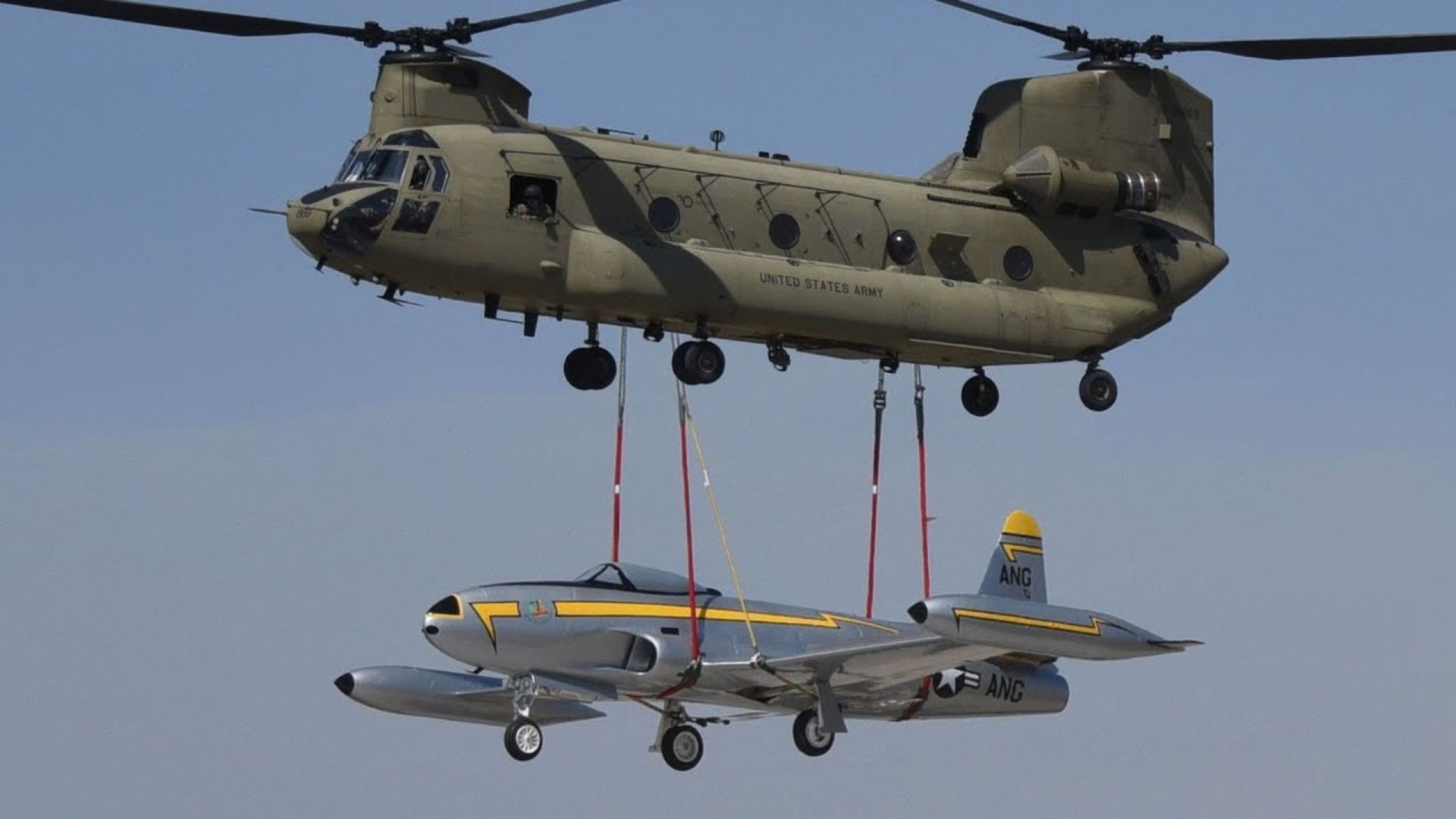
Military Operation Combined Heavy-Lift Helicopters, Combat Engineering, and Armored Vehicles to Quickly Assemble a Floating Bridge Over a Strategic River of the Korean Peninsula. Air-transported Modules Allowed for the Construction of a Crossing Capable of Supporting Extremely Heavy Vehicles in Minutes.
Heavy-lift CH-47 Chinook helicopters were employed to airlift more than 20 bridge modules to the Imjin River in South Korea, in a combined operation between South Korean and U.S. forces.
Each section weighed 12,000 pounds, about 5.4 tons, and was part of a temporary floating crossing designed to support the passage of M1A2 Abrams tanks described by the U.S. Army as armored vehicles weighing approximately 62 metric tons.
The activity brought together aviation, engineering, boats, and armored forces in one of the largest river crossing exercises conducted by the two countries in over a decade.
-
Sprinkling dry baking soda directly on the carpet neutralizes odors from sweat and food without wetting the fibers, allowing you to forget about the vacuum cleaner for weeks using a product that costs less than five reais.

-
A bottle thrown into the sea by two Australian soldiers in 1916 on their way to the trenches of World War I was buried in the sand for over 100 years, and the letters inside it were still legible when they were found.

-
China invests over R$ 4.2 trillion, builds the largest water network in the world with 95,000 reservoirs and 1 trillion m³, expands piped water access to 96% of rural areas, attracts R$ 565 billion in foreign investments, and advances with the “longevity gene” in rice.

-
Heineken’s factory in Brazil surprises the world by reducing water consumption for beer production from nearly 10 liters to just 2.2 liters per liter produced, achieving a 23% decrease with real-time technology.

According to the U.S. Army, the operation combined aerial assault, shore assault, sectional bridge use, assembly boats, and heavy vehicle movement, all in a region of significant military value on the Korean Peninsula.
Military Bridge Assembled Under Logistical Pressure
Instead of relying solely on ground routes to the shore, the forces involved divided the transportation of the infrastructure between adapted trucks and heavy-lift helicopters.
The Chinooks delivered some of the modules directly to the assembly point, which accelerated the arrival of the most critical sections and reduced intermediate steps in moving the material before installation over the water.
After arriving at the river, the pieces were moved by bridge erection boats, vessels designed to push, align, and connect pontoons.
The assembly required precise fitting between the modules, with no gaps compromising the stability of the structure, until the bridge covered the entire width necessary for the crossing in a stretch where the center was about 30 meters deep.
The U.S. Army reported that the bridge was completed after 45 minutes of intense work.
During that time, the teams had to synchronize the arrival of the modules, the positioning in the water, the mechanical locking of the sections, and the final release to receive combat vehicles, in a sequence that depended less on improvisation and more on meticulous coordination between different specialties.
Chinook Helicopter Acting as an Aerial Crane
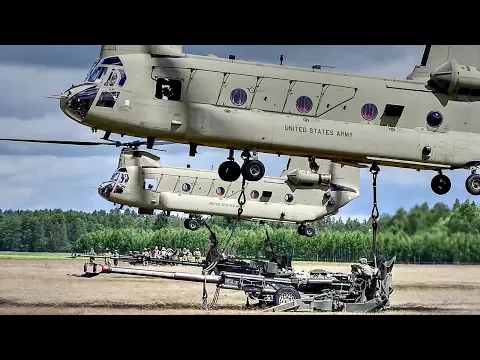

The use of the CH-47 Chinook garnered attention as it shifted the helicopter from its classic transport role to one resembling an aerial crane.
The aircraft is specifically designed for large-scale cargo and logistical support missions.
On Boeing’s official page, the H-47 family is presented as a multi-mission platform aimed at transporting troops, material, and heavy loads, with specifications that help explain its frequent use in lifting operations.
According to the manufacturer, the CH-47F Block II has a maximum gross weight of 54,000 pounds, a payload of 27,700 pounds, and a maximum speed of 302 kilometers per hour.
These figures do not describe the operation at the Imjin by themselves, but they help illustrate why the aircraft was employed to deliver bridge modules weighing several tons directly to the point where the structure would begin to close.
In practice, the helicopter shortened the time between transportation and assembly, increasing the engineering force’s flexibility on the ground during an exercise that required speed to establish a functional crossing line.
Imjin River and Its Strategic Importance
The scenario of the operation also explains the relevance of the training.
The Imjin River is described by the U.S. Army as the seventh largest in Korea, originating in North Korea, crossing the Demilitarized Zone, and flowing south to merge with the Han River south of Seoul.
This trajectory turns the watercourse into a natural obstacle of great importance for military mobility exercises in the region.
The U.S. force also notes that the Imjin became known as the “River of the Dead” due to the battles fought there during the Korean War.
The expression reinforces the historical and operational value of the watercourse, still regarded by military personnel as a relevant terrain element in troop and heavy vehicle movement scenarios on the peninsula.
According to the official report, the crossing of personnel and vehicles in this sector meets a training requirement linked to the U.S. 2nd Infantry Division.
Thus, the goal was not only to demonstrate the ability to erect a temporary bridge but to test the creation of a passage corridor for a mechanized force, with integration between aviation, engineers, and armored units.
Bradley Armored Vehicles and Abrams Tanks Test the Bridge
The bridge was not limited to an engineering demonstration.
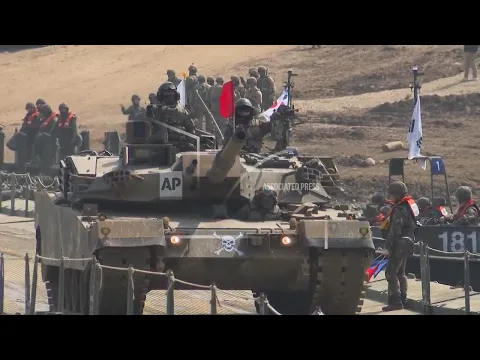
After assembly, the structure underwent real loading with the passage of 11 M2A3 Bradley infantry fighting vehicles and four M1A2 Abrams tanks.
This detail is important as it shows that the crossing was validated under the weight of some of the heaviest vehicles in the U.S. ground inventory, and was not just presented as theoretical capability.
The operation also highlighted the degree of integration between the military of both countries.
An engineer from the Republic of Korea’s 6th Engineer Brigade told the U.S. Army that he was working with a “T” wrench, used to connect and lock the different sections of the bridge.
This technical detail helps to understand that, although the flights of the Chinooks draw visual attention, the result depends on discrete and rigorous steps of coupling over the water.
Participating on the U.S. side were troops from the 1st Cavalry Division, the 74th Multi-Role Bridging Company, the 62nd Engineer Battalion, the 36th Engineer Brigade, and the 10th Combat Aviation Brigade.
From South Korea, the 6th Engineer Brigade played a central role in the assembly and conduct of the crossing.
One of the officers involved summarized the activity as “a complex mission with many moving parts”, a definition that compresses the requirement for coordination between aircraft, trucks, boats, armored vehicles, and engineering teams operating on the same axis.
The exercise showed with concrete data how military mobility depends on a logistics chain capable of transforming heavy modules into usable infrastructure in minutes.
More than just transporting cargo, the Chinooks acted as part of the mechanism that allowed for the conversion of scattered pieces into a functional crossing for heavy armored vehicles, at a sensitive point of the peninsula and under a standard of integration that unites speed, precision, and interoperability among allied forces.






-

Uma pessoa reagiu a isso.