





 Portuguese
  English
  Spanish
  4 min of reading
  3 comments


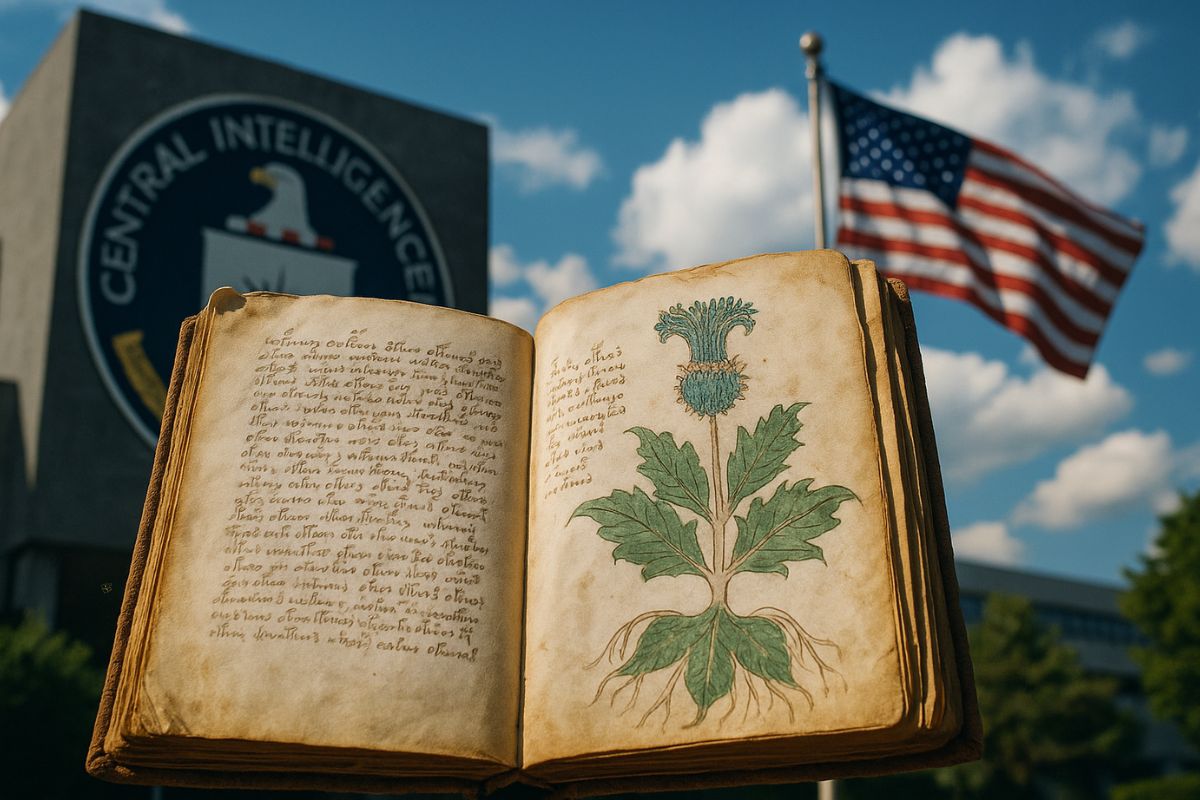


A 600-Year-Old Book Preserved at Yale Challenges Linguists, Cryptographers, and Even the CIA with an Unbreakable Text and Illustrations of “Impossible Plants”.
The most mysterious 600-year-old book in the world goes by one name: the Voynich Manuscript. Radiocarbon dated between 1404 and 1438, it consists of hundreds of pages written in an unknown alphabet, accompanied by botanical figures that do not match any cataloged species. Even the CIA has not been able to decipher the content, and the work continues to attract teams from universities, cryptanalysts, and curious minds from all over the planet.
More than a medieval curiosity, the Voynich has become a living laboratory of hypotheses. Some see it as a compendium of ancient medicine; others bet on alchemy; some suspect it to be a deliberately unbreakable code, and there are still those who claim it to be a sophisticated hoax. The puzzle persists, despite all modern methods, including those of artificial intelligence.
What Is the Voynich Manuscript and Where Is It?
The manuscript is named after Wilfrid Voynich, the rare book dealer who acquired it in 1912 from a Jesuit convent in Italy.
-
Attracting around 250,000 people a year, a lighthouse 200 meters from the sea, on a 60-meter high cliff, on the North Sea coast in Denmark, becomes one of the most impressive examples of how nature can threaten historical buildings.

-
The narrowest house in the world is only 63 centimeters wide, but inside it can accommodate a bathroom, kitchen, bedroom, office, and even two staircases.

-
In the middle of the sea, these enormous concrete and steel structures, built by the British Navy to protect strategic maritime routes, look like they came straight out of a Star Wars movie.

-
For years, no one could cross a neighborhood in Tokyo because of the tracks, but an impressive solution changed mobility and completely transformed the local routine.


After changing hands several times, the codex ended up in the Beinecke Library of Yale University, where it remains preserved and accessible to researchers.
Its materiality is unequivocal: authentic lambskin parchment, consistent calligraphy, and inks compatible with the medieval period.
What no one can explain is the content. The work consists of about 240 preserved pages (from a larger original total), organized into sections that seem thematic.
What the Book Shows: Plants, Stars, and Unexplained “Baths”
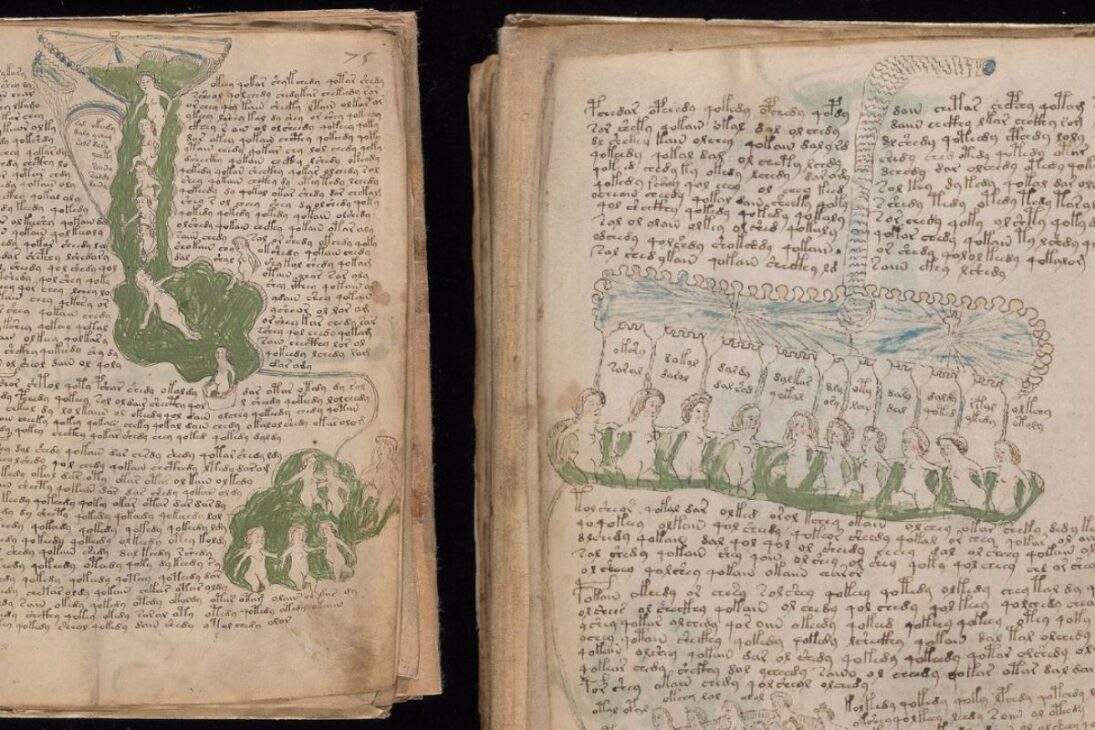
The most famous part is the botanical section, filled with plants drawn with graphic rigor, but whose morphology does not correspond to known species.
For this reason, many call them “impossible plants”. Often, the roots and leaves appear as collages of elements from different specimens.
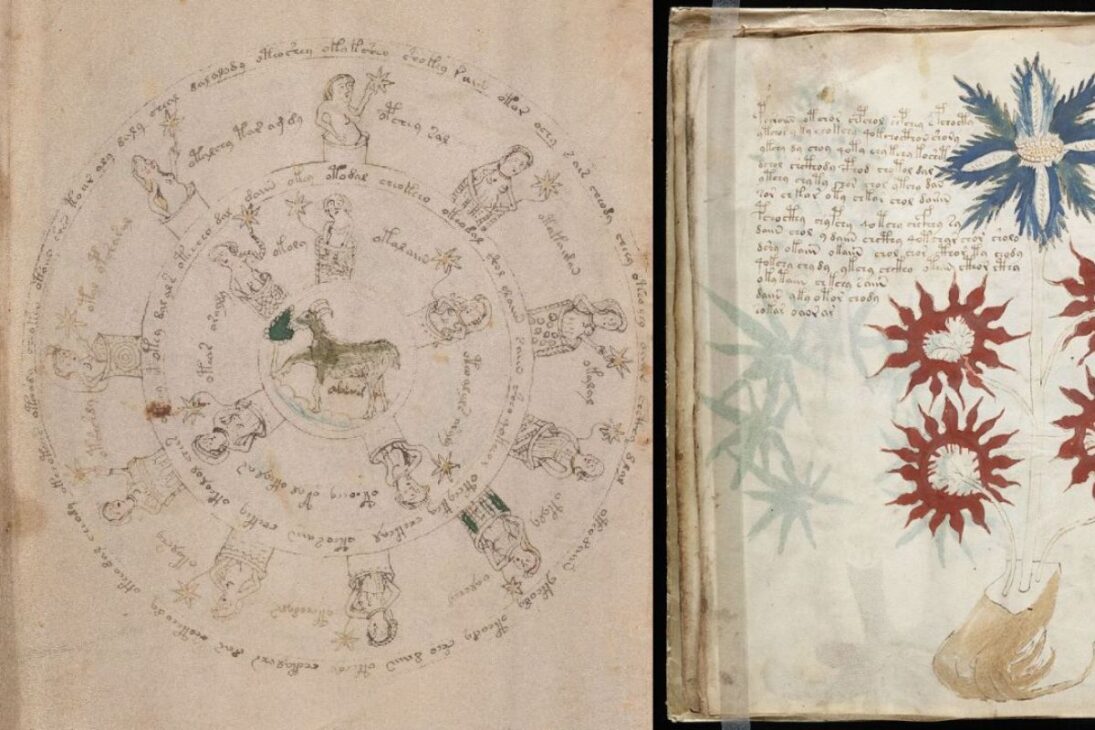
There are also diagrams of astronomy/astrology, with zodiacs and maps resembling celestial movements; “biological” pages with women immersed in bathtubs interconnected by conduits; pharmacological plates, with bottles and roots; and a cosmological block, filled with circles and mysterious maps. Each section seems to have internal logic, but no external key unlocks it.
The Unbreakable Writing: Language, Cipher, or Invention?
The text uses a unique alphabet and follows statistical patterns similar to those of natural languages: there is a typical distribution of words, repetitions, and a textual “rhythm”.
This supports the hypothesis that it is not pure nonsense. Even so, no one has consensually translated a single line.
Civil and military cryptographers, including teams linked to the CIA, have tried everything: substitutions, transpositions, frequency analysis, probabilistic modeling, comparisons with European and Middle Eastern languages, as well as AI methods.
The impasse remains, which fuels both fascination and skepticism.
Disputed Theories: From Medical Compendium to Perfect Hoax
One school of thought reads the Voynich as a manual of medicine/alchemy, combining botany, recipes, and hydrotherapy practices (the “baths”).
Another argues that the text is a cipher applied over a known medieval language, still without the “key”.
There is also the hypothesis of a constructed language, a private and coherent construction, only decipherable with the author’s “dictionary”.
The theory of hoax periodically resurfaces: a skillful work to deceive wealthy patrons (think of Emperor Rudolf II), using seductive images and a text that seems meaningless.
The problem is that the statistical consistency of the text and the scale of the project make this explanation less palatable: supporting so many pages of “nothing” with the regularity of a natural language would, in itself, be a monumental feat.
What Has Changed (and What Has Not Changed)
Recent attempts, including those using artificial intelligence, have identified patterns and even suggested internal “dialect” variations in the manuscript.
There have also been specific proposals for “deciphering”, such as the thesis of a medieval protoromance; none has withstood the scrutiny of medievalists and linguists.
There is no academic consensus; the Voynich remains undeciphered.
In parallel, studies of style and paleographic comparisons reinforce the temporal authenticity and material cohesion of the codex.
In other words, there is no “modern scam”: we have a genuine medieval artifact that is intelligible in form and impenetrable in content.
Why the Voynich Riddle Matters
First and foremost, because it tests the limits of the scientific method applied to texts: when context, bilingualism (a “Rosetta Stone”), and cross-references are lacking, even the best tools falter.
Secondly, because it exposes biases—we want so much elegant solutions that we may embrace fragile shortcuts.
There is also the cultural dimension. The 600-year-old book synthesizes human curiosity: plants that do not exist, maps of skies that we do not recognize, women in interconnected baths, a meticulously drawn parallel world, which forces us to admit what we rarely accept: we do not know.







Título foi de mais, claro que a CIA nunca irá decifrar isso não faz parte do escopo, a CIA é um órgão de segurança pública. O estudo de itens da história da humanidade é foco da ciência. Vamos qualificar os diretores desse jornal 📰🗞️
Sim amigo, a CIA, porque eles tem criptografia e outros técnicos avançados entre seus funcionários. Muito comum utilizarem os serviços deles pra coisas nesta ordem…
Isso aí é uma obra de arte, mas os textos nem nada tem significado, estão a procura pêlo em ovo.