





 Portuguese
  English
  Spanish
  4 min of reading
  1 comment


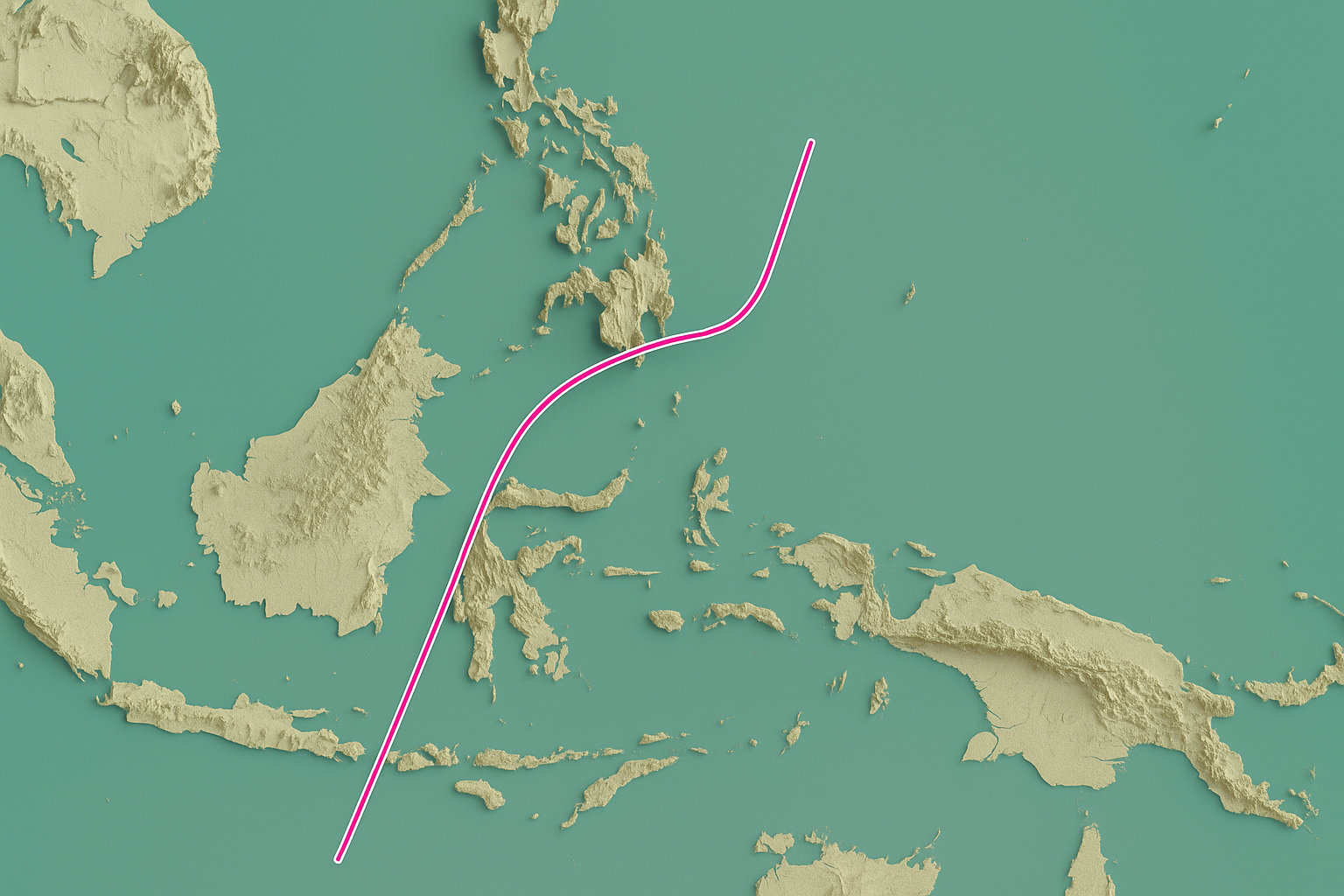


The Wallace Line Separates Species for Millions of Years. Discover How This Invisible Frontier Challenges Nature, Biogeography, and Evolution to This Day.
In a globalized world, where almost everything seems connected, there are still limits that nature insists on maintaining. One of them is practically invisible: the Wallace Line, a geographical division in Southeast Asia that separates, with almost surgical precision, animal species from Asia and Oceania — even where the distance between islands is just a few kilometers.
On one side of the line, tigers, elephants, monkeys, and other typical representatives of Asian fauna live. On the other, unique creatures such as kangaroos, cockatoos, and platypuses emerge, which have never crossed to the opposite side. The line exists only on maps — but the animals seem to have known it for millions of years.
Where Exactly Is This Frontier?
The so-called Wallace Line begins at the Lombok Strait in the Malay archipelago and heads north, cutting through Indonesia and clearly separating two biogeographical zones. On one side is the fauna of continental Asia, and on the other is the Australian fauna, with species that evolved in isolation.
-
Harvard scientists have created a tissue exoskeleton that does not look like an exoskeleton, with no rigid parts and reduced weight, using flexible cables and miniaturized motors to assist the ankle and hip, reducing the effort of walking by up to 23% in controlled tests.

-
The Caspian Sea intrigues scientists as it is neither officially a sea nor a lake: the largest lake on the planet holds a hybrid crust, submerged cities, mud volcanoes, and billions of barrels of oil hidden at the bottom.
-
Why did the sky turn blood red in the west of Australia and it wasn’t sunset? Discover what is behind the change that took over the horizon for miles.
-
The most feared warplane of the United States is over 70 years old, carries 32 tons of explosives, flies 14,000 kilometers nonstop, and has just been sent to the United Kingdom amid escalating tensions with Iran.



The most surprising thing is that the distance between some islands on opposite sides is minimal. Bali, for example, is only 35 km from Lombok, but between the two, the species change completely. There are no tigers in Lombok. There are no kangaroos in Bali.
The Geological Origin of an Invisible Boundary
To understand why this line exists, one must look deep into the past of the planet. About 30 million years ago, the Australian and Eurasian tectonic plates began to collide, shaping the archipelago that is now Indonesia.
During the Ice Ages, when sea levels dropped, various regions of the Earth formed temporary land bridges — including in northern Asia and Europe. But the Lombok Strait remained too deep, even in the driest periods. This prevented large animals from crossing from one island to the other.
The result was a process of independent evolution, isolated by deep waters. The line between these two faunas has remained, even with the geographical proximity.
The Discovery Behind the Idea
The Wallace Line is named after the naturalist Alfred Russel Wallace, a contemporary and collaborator of Charles Darwin. In the 19th century, Wallace traveled through the Malay archipelago and noticed something intriguing: the fauna of the neighboring islands changed drastically from one point to another — more than between countries separated by vast oceans.
While studying the animals of Bali and Lombok, he noted that there was no ecological continuity. It was as if an invisible boundary divided life into two worlds. Wallace then drew this line on the map, suggesting that the distribution of species was shaped by natural barriers not visible to the naked eye.
This realization was a landmark in the emergence of a new field of knowledge: biogeography — the study of the distribution of species on the planet.
What Does Modern Science Say About the Wallace Line?
With advances in genetics, satellites, and ecological mapping systems, scientists have been able to analyze distribution patterns in thousands of species. A recent study published in 2023 examined data from over 20,000 vertebrates and confirmed that the Wallace Line is still valid — although it is now considered more of a biological gradient than a rigid line.
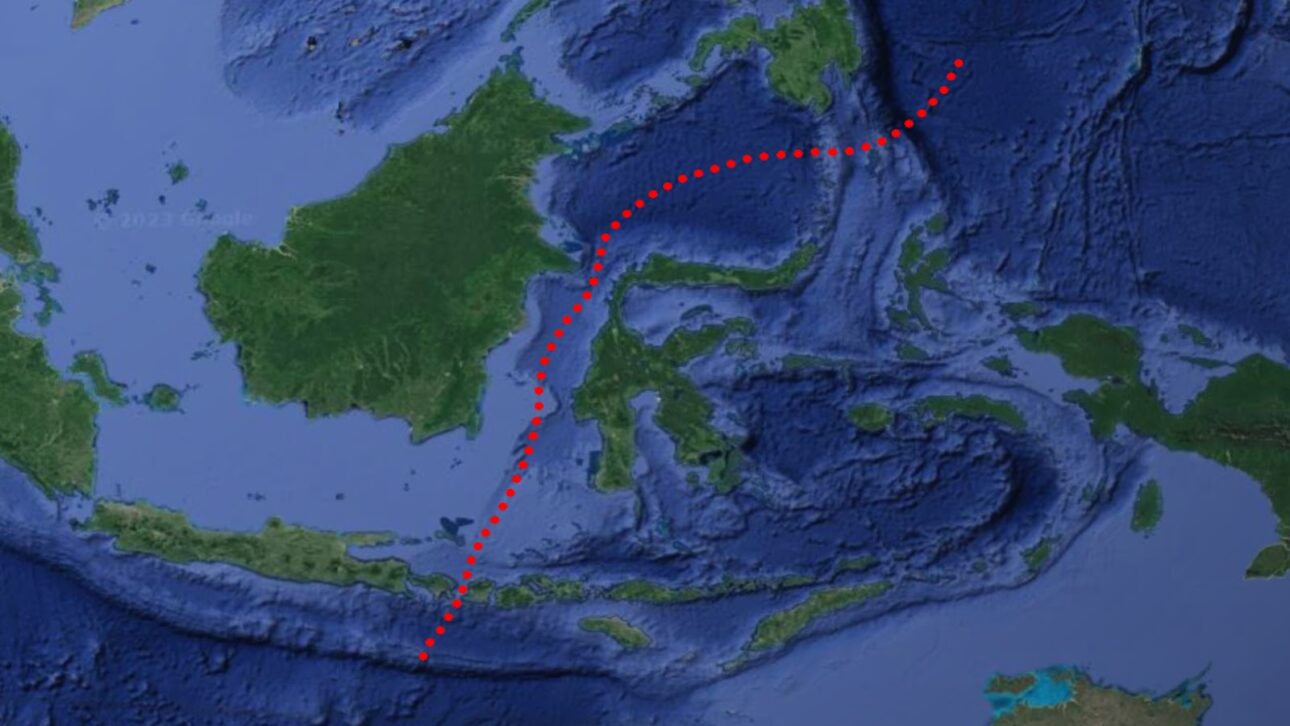
In other words: there is a transition zone, but the pattern of separation between the faunas remains very strong.
Some groups, like bats and beetles, have managed to cross. But these are exceptions. Large mammals, reptiles, and birds remain largely separate, as if they are respecting an invisible pact not to cross their geographical limits.
Why Does This Still Impress Scientists?
Because the Wallace Line is a reminder that not everything mixes, even when time, geography, and climate change. It shows that there are deep natural limits capable of shaping evolution over millions of years, even in places of minimal distance.
This boundary continues to influence everything: biodiversity, ecosystems, conservation strategies, and even ecological tourism. Many of the islands located near the line have unique fauna, with a high degree of endemism — that is, species that exist only there.
Furthermore, Wallace’s case proves that simple ideas based on direct observation and scientific intuition can become pillars of modern science. Long before there were genetic maps, satellites, or global databases, a man with notebooks and a keen eye noticed what no one else saw.
A Line That Remains Alive
Today, the Wallace Line is taught in biology, geography, and ecology courses around the world. It continues to fascinate just as much as in the 19th century. And even if modern science treats it as an “ecological gradient” or “transition zone,” its essence remains: an enduring natural limit to evolution that has yet to be erased by time.
It reminds us that there are mysteries in nature that survive modernity. That invisible boundaries also shape the world — not between nations, but between species, between forms of life, between stories that unfolded in parallel without ever crossing.
The Wallace Line is much more than a mark on a map. It is a symbol of how the Earth silently shapes itself over ages — separating, isolating, preserving. Even in a world of satellites, airplanes, and globalization, there are limits that remain intact.
For those interested in evolution, nature, and curiosities about biogeography, this invisible line is one of the most remarkable stories ever recorded. Because it gently proves that nature also knows how to draw its own boundaries.






Interessante.