Portuguese
  Spanish



Entire Nuclear Fleet Dispatched Simultaneously After Rosatom Announcement in St. Petersburg
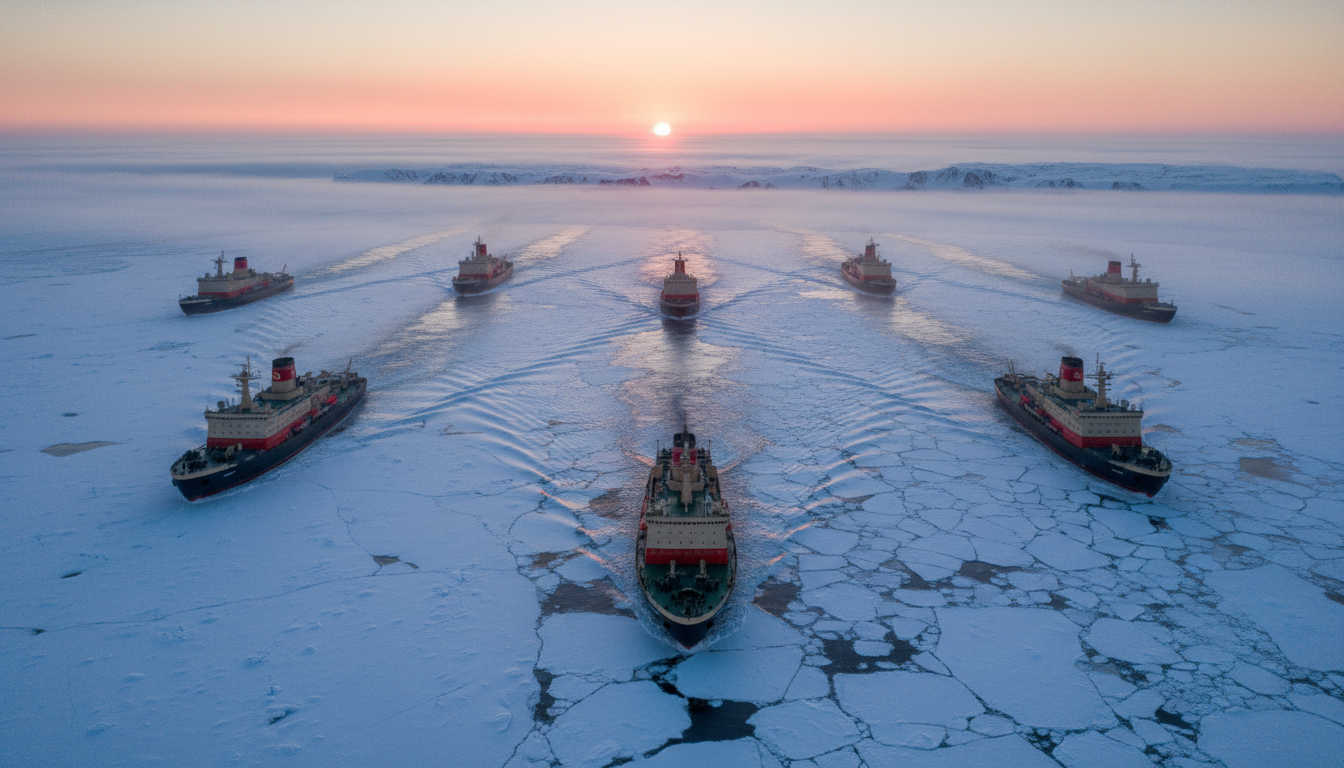
For the first time in history, Russia simultaneously deployed all 8 nuclear icebreakers that form its Arctic fleet.
The mobilization began in the first days of December 2025. The Arctic froze two weeks earlier than the typical calendar that year.
Thus, Moscow was pushed to an unprecedented decision to keep Russian oil and LNG export routes open.
-
European Parliament Approves Digital Euro, Aiming to Challenge Visa and Mastercard’s Dominance and Transform Payments Across Europe by 2029

-
Israel finds Hezbollah militarized tunnel over 200 meters long under village, with 4 missile launch shafts, 12 chambers, anti-tank missiles, drones, and weapons depots at a depth of 25 meters.

-
Ukraine launches largest drone attack on Moscow since 2022, Russia claims to have intercepted nearly 200 aircraft near the capital, Kapotnya refinery targeted again, and offensive reignites alert about war reaching the Russian energy heart just a few kilometers from the Kremlin.

-
Truck drivers, freight, and fines from 2022 take center stage in politics: Chamber approves MP with amnesty, mandatory tracking by CIOT, million-dollar penalties, and new minimum wage for those who spend more than 24 hours on the road.



According to gCaptain, Alexei Likhachev announced the operation on November 18, 2025. Likhachev is the CEO of the state-owned Rosatom.
The announcement took place at the keel-laying ceremony for Project 22220 Stalingrad. The event was held at the Baltic Shipyard in St. Petersburg.
As reported by Moscow Times, the Russian Arctic Directorate extended the annual operating time of each ship.
Therefore, the cycle increased from 240 to 270 days per year. Vyacheslav Ruksha, head of the Arctic Directorate, directly justified the measure.
According to Ruksha, the ship needs to remain at sea for 270 days to ensure the continuity of the Northern Sea Route.

Which are the 8 nuclear icebreakers mobilized on the Northern Sea Route
The 8 active nuclear icebreakers belong to three different classes. Four units are from the new Project 22220 generation.
According to the project’s technical documentation, these are the Arktika, Sibir, Ural, and Yakutiya.
The fifth unit of this series, the Chukotka, has already been launched and is expected to enter service in 2026.
The other four units include the veteran 50 Let Pobedy, measuring 159.6 meters and 25,000 tons. The fleet is completed by the Yamal and the two shallower-draft ships Taymyr and Vaygach.
Thus, the Russian fleet covers combinations of deep and shallow draft, allowing it to operate both in open sea and in the frozen estuaries of the Ob and Yenisei.
Each Project 22220 displaces about 33,500 tons and uses two RITM-200 reactors with 60 MW of shaft power.
As the technology was designed, the fleet can break through ice up to 2.8 meters thick in a direct route.
The 50 Let Pobedy, in service since 2007, inherited a more robust bow structure from the Soviet era.
The history of this ship also appears in other investigations about the Russian fleet by Click Petróleo e Gás.
Therefore, Russia has three ships of the next class, the Leader, under construction, measuring 210 meters and with RITM-400 propulsion.
The first of these, the Rossiya, was supposed to enter service in December 2027. According to Dieselnet, delivery was rescheduled for February 2028.
Components ordered from Ukrainian suppliers stopped being delivered after the start of the war.

Why Moscow mobilized the entire fleet of 8 ships at this time
The Russian decision combines three simultaneous pressures. The first is the early freezing of the Arctic in 2025.
Thus, navigation in the corridor connecting the Yamal gas fields to Asian ports was blocked by thicker ice.
The second pressure is the European Union’s 19th sanctions package. As reported by Arctic Today, it was adopted in September 2025.
The package prohibits the import of Russian liquefied natural gas from January 1, 2027. It also affects insurance, financing, and navigation services linked to Russian oil.
The third pressure is geopolitical. Captain Tom Sharpe, former commander of the British icebreaker HMS Endurance, published an analysis in Telegraph.
Sharpe interpreted the full mobilization as a sign of “extreme pressure on Putin.” Russia needs to keep the Arctic corridor open while NATO reinforces surveillance in the Barents Sea.
Therefore, the nuclear fleet is not just escorting cargo ships. It is doing the double work of serving as a strategic signal and cover for the so-called “shadow fleet.”
How sanctions are affecting the Arctic fleet and exporters’ profits
The economic effects are already appearing in the balance sheets. Total cargo volumes transported by the Northern Sea Route fell to 37.02 million tons in 2025.
According to the Moscow Times, the reduction was 2.3% compared to the previous year. Of the total, LNG accounted for 58%, oil for 21%, and condensate for approximately 4%.
In fact, movement in all Russian Arctic Basin ports contracted by 6.3% in 2025.
Mikhail Grigoryev, head of Gecon consultancy, stated that volumes in 2026 are unlikely to exceed those of 2025. There are no new growth drivers.
Therefore, the financial impact is direct for Novatek, Russia’s main producer of liquefied natural gas.
Net profit fell from 493 billion rubles in 2024 to 183 billion in 2025, according to Polar Journal.
Thus, this 62.9% drop shows the real extent of the damage caused by European restrictions.
- NSR Volume 2024: 37.9 million tons
- NSR Volume 2025: 37.02 million tons (-2.3%)
- Composition 2025: 58% LNG, 21% oil, 4% condensate
- Novatek Profit 2024: 493 billion rubles
- Novatek Profit 2025: 183 billion rubles (-62.9%)

What Russia gains by deploying the full fleet of 8 nuclear icebreakers simultaneously
Despite the meager numbers, the mobilization pays strategic dividends. The fleet ensures wider operational windows for the Arctic Gate terminal in Yamal.
According to Maritime Executive, the terminal maintained direct oil shipments from Yamal even in the winter of 2025 thanks to the nuclear escort.
Another gain is the relationship with China. The Diplomat magazine published an analysis in April 2026.
According to the material, Beijing uses the Northern Sea Route to reduce travel time between Chinese ports and Europe by up to 40% compared to the route via the Suez Canal.
According to RBC Ukraine, the fleet was divided into two main missions.
Five units operate in the Gulf of Ob: Taymyr, Yamal, Arktika, Yakutiya, and Sibir. The 50 Let Pobedy reinforces this mission.
On the other hand, Ural and Vaygach were assigned to the Yenisei Gulf and the Yenisei River.
To understand the complete logistical cycle of Russian gas on this route, it is worth consulting the coverage of Yamal LNG’s export record on Click Petróleo e Gás.
Risks and recent incidents of the fleet
The operation is not without risks. The 50 Let Pobedy collided with the cargo ship Yamal Krechet in January 2026.
According to the ship’s technical specifications, the incident was minor.
However, it exposed the operational fatigue generated by the increase in days at sea and the compression of maintenance intervals.
Similarly, the aging of the fleet is a concern. The Taymyr and Vaygach entered service between 1989 and 1990. The 50 Let Pobedy is from 2007.
On the other hand, Russia maintains the pace of replacement. Project 22220 will be expanded to seven units by 2030.
Chukotka, Leningrad, and Stalingrad will be added to the four already in service. According to the iz.ru agency, Rosatom confirmed the schedule in November 2025.

What this means for Brazil and global markets
The full mobilization of the Russian nuclear fleet does not directly affect Brazilian oil. It does, however, reorganize the global liquefied natural gas market.
With Russia managing to maintain Asian exports via the Arctic, Russian supply continues to compete with American, Australian, and Qatari products.
As a result, this balance puts downward pressure on the international price of LNG. Brazil feels the effect precisely when it tries to position pre-salt gas in the foreign market.
Moscow’s Arctic strategy thus serves as an indirect thermometer for Petrobras, Equinor, and other Brazilian pre-salt operators.
According to an analysis by the European Parliament, the EU still depends on approximately 16% of Russian LNG.
This percentage is expected to drop to zero only in 2027, when the 19th package’s embargo comes into effect.
It is worth noting that the operation may not be sustainable. Without Western and Ukrainian components, Rossiya, Leningrad, and Stalingrad may be delayed.