





 Português
  Inglês
  Espanhol
  8 min de leitura
  0 comentários


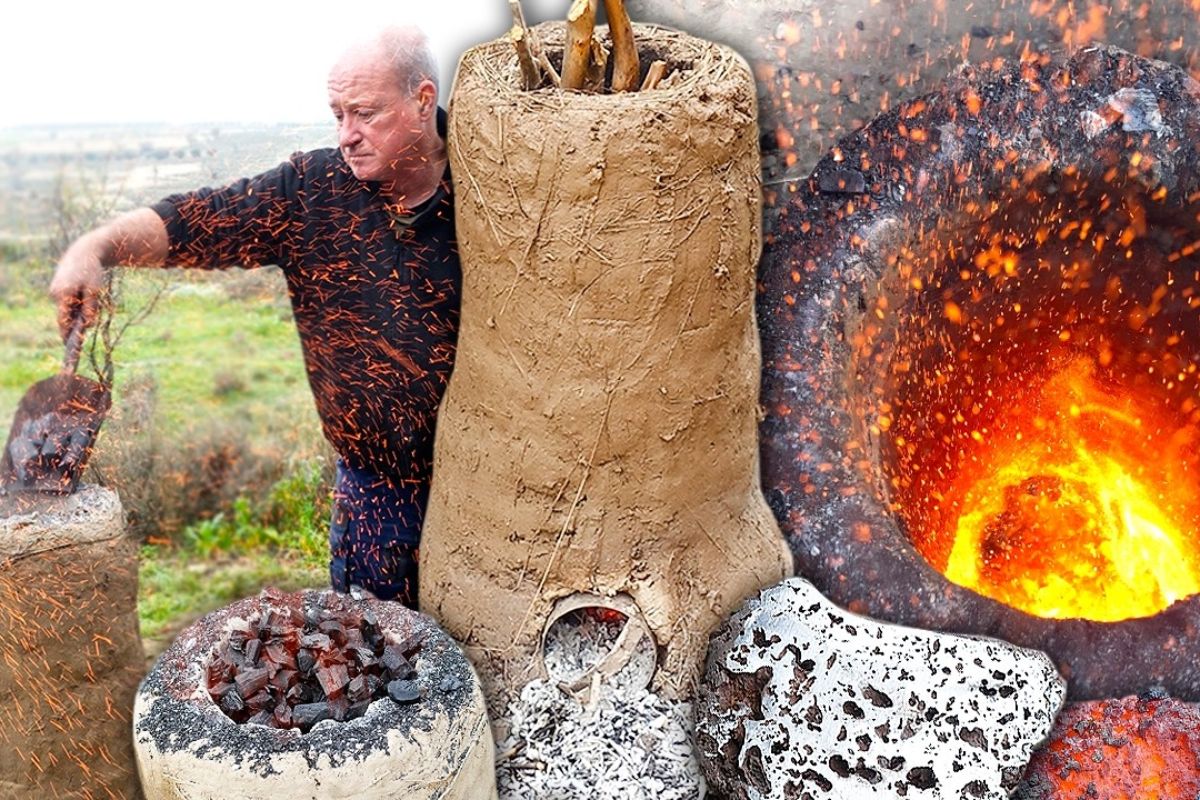
The Primitive Furnace Of The Iron Age Was Reconstructed In La Muela, Zaragoza, By Four Blacksmiths Who Combined Clay, Vegetable Charcoal And Limonite To Repeat An Ancient Metallurgical Process, Reaching Between 1200 And 1300 Degrees And Extract A Lump Of Iron After Dozens Of Successive Loads Over Two Consecutive Days.
The primitive furnace of the Iron Age resumed operations in La Muela, in the province of Zaragoza, thanks to master blacksmith Thomas Mink, cutler Pablo Tena, blacksmith Nacho Díaz, and blacksmith and forger Miguel Ángel Martínez Luque. The proposal was straightforward yet ambitious at the same time: reconstruct a reduction system similar to those used over 2,500 years ago to transform limonite into metallic iron using only clay, vegetable charcoal, and strict temperature control.
The result was more than a craft demonstration. The experience showed, on a practical scale, how an ancient process relied on very precise technical details, from the preparation of the clay to the size of the charcoal, from the drying of the chimney to the positioning of the tuyere. When the furnace finally entered operating mode, the internal chamber reached between 1200 and 1300 °C, a threshold sufficient to form the lump, also called sponge iron, the raw core from which the metal can be refined.
How The Furnace Was Built To Not Collapse Before The Burning
The assembly of the primitive furnace of the Iron Age began with the preparation of the clay.
-
With an unusual prize, Japan transforms office chairs into a resistance race on the streets, ISU-1 Grand Prix grows, fills stages, and pays 90 kilograms of rice.

-
House in England with a 7.6-meter shark embedded in the roof attracts attention worldwide and becomes a curious attraction in Oxford.

-
Masterpiece in Spain, under construction since 1882, receives 4.8 million visits in a year and impresses with its gigantism and architecture.
-
Attracting around 250,000 people a year, a lighthouse 200 meters from the sea, on a 60-meter high cliff, on the North Sea coast in Denmark, becomes one of the most impressive examples of how nature can threaten historical buildings.


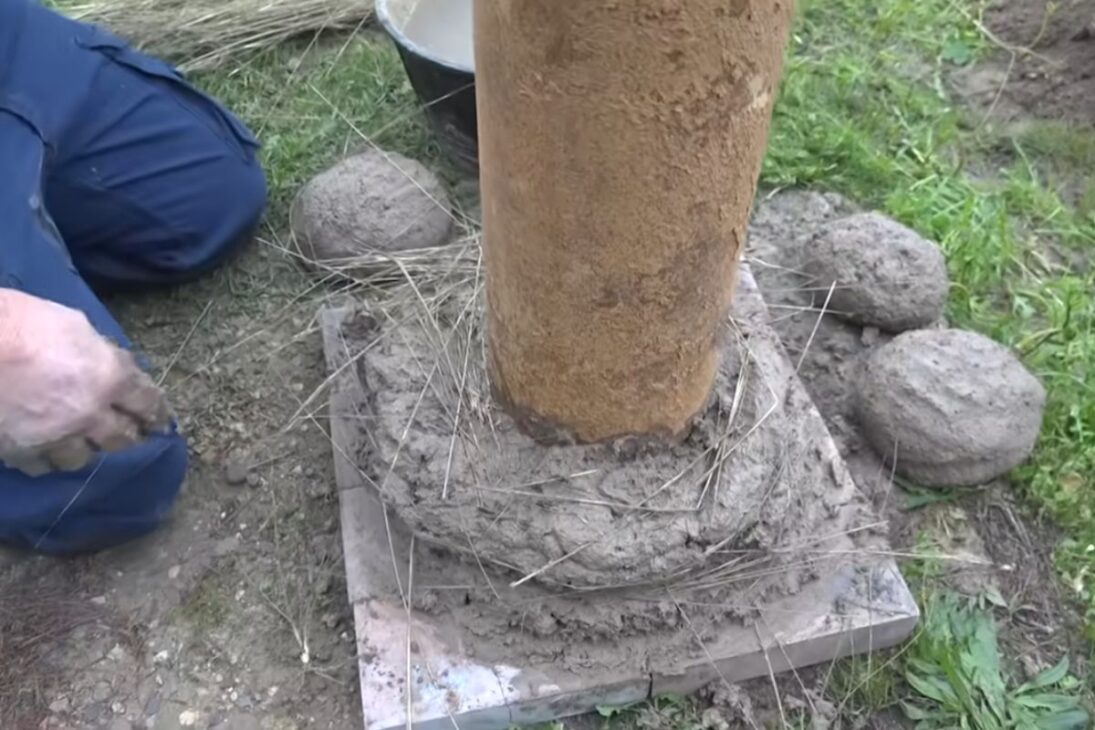
The clay was sifted to remove larger stones and debris that would hinder the structure, but small particles were kept because they would help later in the chemical behavior of the set. Moisture also required attention.
Too wet clay meant an immediate risk of collapse, especially since the chimney would be erected to a considerable height for a still fresh clay body.
The base was made with refractory bricks and was given a slight slope to facilitate the drainage of slag. On this base, the blacksmiths used a vertical metal tube as a mold to raise the clay chimney.
The lower part was thicker, about 15 centimeters, to support the weight of the structure. At the top, already close to 80 to 90 centimeters high, the walls could taper down to about 5 centimeters.
This was not an aesthetic choice, but structural and thermal at the same time.
Another decisive detail was the incorporation of straw and grass into the mass. This material was not added on a whim.
Once the structure dried and the interior began to receive intense heat, the fibers would burn and leave small voids in the wall.
These voids would function as thermal insulation, reducing heat loss and helping the primitive furnace of the Iron Age maintain internal stability during the reduction.
Even so, drying could not rely only on time. The blacksmiths removed the internal mold and lit embers inside the chimney to accelerate the process.
They also opened a small lateral passage to increase draft through the chimney effect and remove moisture.
Without this step, wet clay would steal heat from the system and compromise the entire efficiency of the furnace even before the ore was fed.
Why Limonite Had To Be Roasted Before It Turned Into Metal
The chosen raw material was limonite, an iron ore that needed to be roasted before entering the furnace.
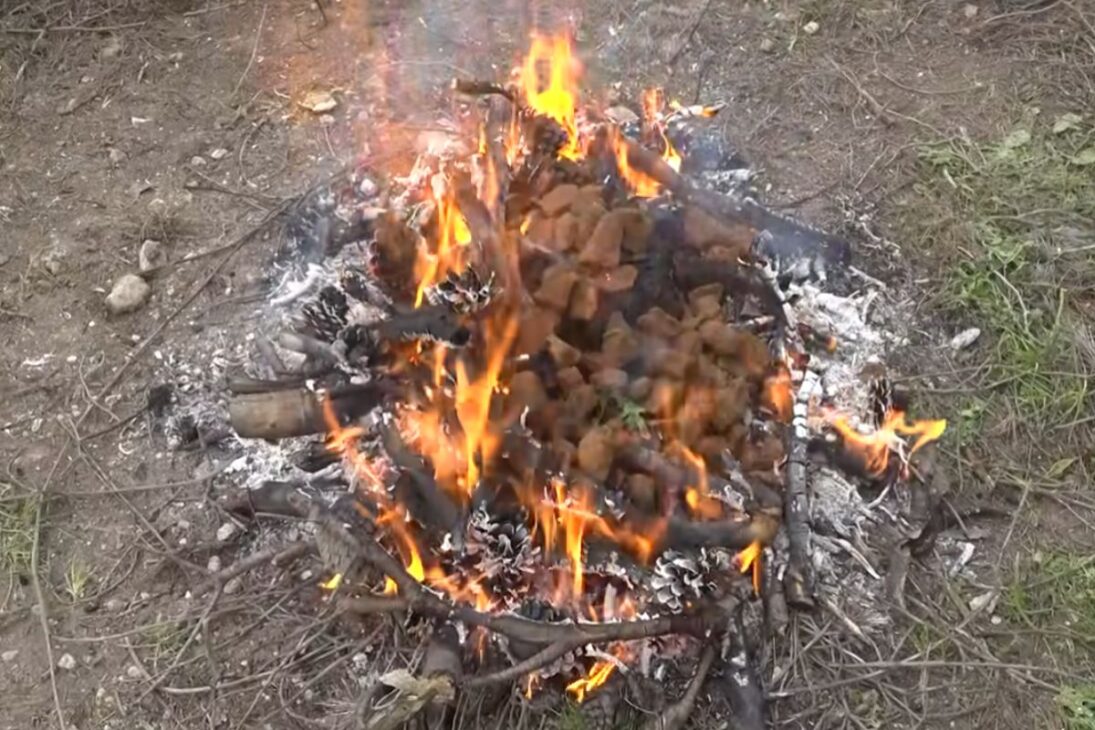
This step had multiple functions. First, it eliminated external moisture and the intrinsic moisture of the mineral itself.
Then, it helped to burn off undesirable elements in the process, such as sulfur and phosphorus. The roasting was not an auxiliary phase, but an indispensable prior chemical transformation.
The material’s own response made this clear. Before being roasted, limonite did not respond to a magnet.
After heating, it began to display magnetic behavior, a sign that its structure had changed and that the reduction process was already, to some extent, initiated.
The ore also became more fragile and porous, an important condition to be broken down to the appropriate size and react better inside the primitive furnace of the Iron Age.
The fuel chosen was vegetable charcoal, not mineral coal. The reason was technical.
Mineral coal could introduce sulfur into the system and undermine the final result. On the other hand, vegetable charcoal, in addition to being compatible with the ancient method, favored the generation of the carbon monoxide necessary for reduction.
This gas was one of the true invisible protagonists of the experiment, as it needed to remain circulating within the chamber to remove oxygen from the ore and release the iron.
The size of the charcoal also could not be random. Pieces that were too large would hinder combustion and gas control.
Too small pieces, on the other hand, would disrupt the internal dynamics of the bed too much. Therefore, the material was manually broken down until it reached a more appropriate grain size.
In ancient metallurgy, the difference between partial success and total failure often lies in details that seem too small to attract attention.
The Moment When The Furnace Began To Operate As A Metalworking Machine
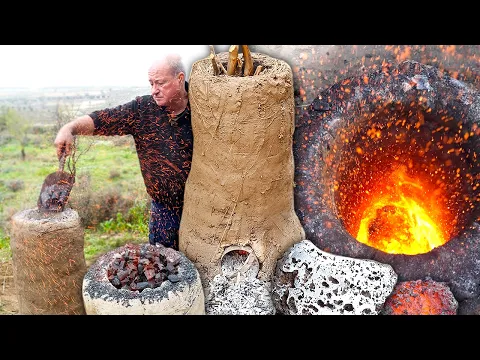

On the second day, with the structure already dry enough, the group installed the tuyere and prepared to close the openings made during drying.
There were two modern concessions in the process: a reusable copper tuyere and an electric blower instead of bellows.
Everything else followed the ancient logic of a primitive furnace of the Iron Age, with a reducing atmosphere, alternating feeding of coal and ore, and constant monitoring for cracks and leaks.
The air entry nozzle was installed at an angle and height calculated to concentrate heat in the area where the lump should grow.
The goal was clear: create the hottest zone of the furnace just below the tuyere, capable of consolidating metallic particles and forming the sponge iron mass.
If the air entered at the wrong point, the furnace could heat up yet still fail to form useful metal.
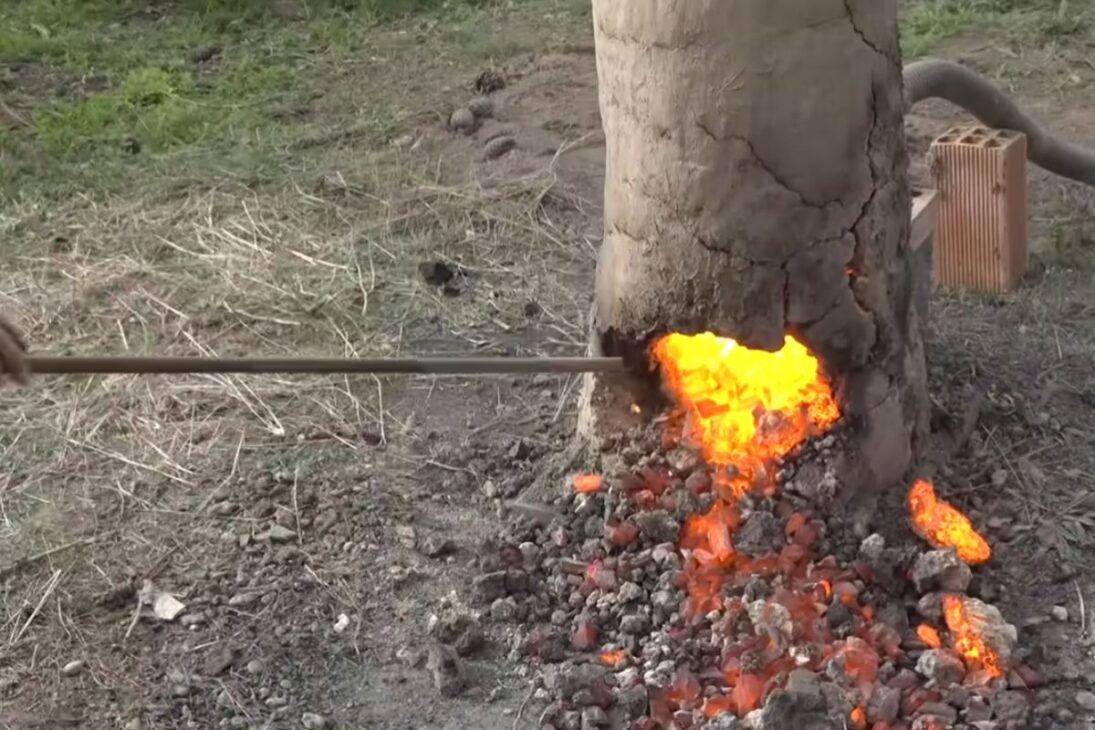
The preheating lasted about an hour. During this time, coal was fed until the combustion chamber reached the ideal operating range, between 1250 and 1300 °C.
With the internal diameter of the furnace around 17 centimeters, Thomas Mink defined the ratio of 360 grams of ore to 420 grams of coal per load.
It was a slightly favorable ratio for the fuel, just to enhance the generation of carbon monoxide.
From there, the work turned into a routine of precision. The furnace had to remain filled to the top to maintain process stability.
Each load was accompanied by time control, observation of the burn, and correction of cracks that allowed the reducing atmosphere to escape.
The furnace was alive, but also fragile, and any crack could mean loss of temperature, loss of gas, and loss of efficiency exactly at the point where the iron needed to form.
Slag, Drainage And The Struggle To Save The Lump Before Collapse
Throughout the operation, more than 20 loads were made, then 27, until the total reached around 30 feedings. In theory, part of the molten slag should be extracted through drainage at the base, making room for the lump to grow with less interference.
In practice, this did not happen as expected. The base of the furnace, cooler, seemed to favor the formation of a dome of solidified slag, blocking the lake that should flow.
Even with repeated attempts at drainage, the molten slag did not exit satisfactorily. However, this did not mean that the process had failed completely.
The master blacksmith could feel by touch and internal resistance that there was metal formation inside.
The difficulty lay in freeing the metal without destroying the structure already heavily stressed by heat and accumulated loads.
At this point, the primitive furnace of the Iron Age entered a critical zone. The clay structure was already weakened, and insisting on new loads could compromise everything.
The decision was made to interrupt the feeding, let the remaining charcoal burn, and prepare to open the furnace to remove the metallic mass still at a very high temperature. It was a containment solution, not a comfortable one.
When the wall was breached, the lump appeared trapped in the rear region.
The furnace practically gave way along with the extraction. The mass was removed while still incandescent and immediately compacted to reduce subsequent refining work.
It was the most ancient and brutal moment of the entire experience: the metal did not come out as a bar, sheet, or finished piece, but as an irregular, porous body, still loaded with slag and residual carbon.
What The Final Result Reveals About Metalworking 2,500 Years Ago
After cooling and cutting, the lump clearly showed the presence of iron generated in the process.
The final balance was objective. About 10 kilos of iron ore with a content of 55% iron oxide were used, equivalent to approximately 5.5 kilos of usable material in theory.
The concrete result of the experiment was around 1.5 kilos of raw iron. The efficiency was low, but the metallurgical logic worked.
This point is decisive as it helps to understand why these furnaces were both inefficient and revolutionary.
The yield was modest, the structure unstable, the operation required experience, and the final production still needed further refining in the forge.
Even so, that metal offered an advantage that bronze and copper did not deliver in the same way in several contexts: greater hardness and new possibilities for working.
Most importantly, the experiment showed that a primitive furnace of the Iron Age did not depend on mystery but on control over raw material, airflow, temperature, time, and slag behavior.
Ancient metallurgy was not rudimentary in the sense of random. It was rigorous, empirical, and built on observation accumulated over generations.
It also became clear that the process did not end with the extraction of the lump. The sponge iron obtained still needed to be refined to remove slag and excess carbon, losing weight along the way to become usable wrought iron.
In other words, between the raw stone and the final metal, there was a long chain of decisions. This chain is what gives real dimension to the technical knowledge developed over 2,500 years ago.
The reconstruction in La Muela not only repeated an ancient experience. It physically exposed how iron metallurgy demanded mastery of fire, clay, ore, and operation rhythm.
When four blacksmiths manage to reactivate this system with clay, limonite, vegetable charcoal, and a chimney of less than one meter, what emerges is not nostalgia but historical engineering in its raw state.
In the end, the primitive furnace of the Iron Age showed something that still impresses today: the transition from stone to metal did not depend on modern machines to exist, but on an extremely refined knowledge about heat, reduction, and matter.
Do you think techniques like this still have value today only as historical reconstruction, or do they continue to teach something essential about technology, manual labor, and the origins of materials?








Seja o primeiro a reagir!