






 Portuguese


Renault Duster Dakar II 2.0 4×4 2018 costs R$ 67.9 thousand on Fipe, has 148 hp, a 6-speed manual transmission, and all-wheel drive.
The 2018 Renault Duster Dakar II 2.0 4×4 manual costs R$ 67,947 according to the Fipe Table as of September 2026, positioning an SUV with a naturally aspirated engine of up to 148 hp, 6-speed manual gearbox, and selectable all-wheel drive below the R$ 68 thousand threshold. The national average indicated by Webmotors is slightly lower at R$ 67,599.67, with listings ranging from R$ 60,900 to R$ 75 thousand.
According to Quatro Rodas, the Dakar II series was launched in Brazil with three configurations, with the 2.0 4×4 six-speed manual being the most robust in the lineup, initially priced at R$ 87,220. In addition to the mechanical setup, it received a visual identity inspired by the Dakar Rally, a multimedia center, rearview camera, cruise control, and exclusive finishing elements.
Duster Dakar II 4×4 drops to R$ 67,947 on Fipe
The current value completely alters the model’s positioning. As of September 2026, the Fipe reference for the 2018 Duster Dakar II 2.0 16V Hi-Flex 4WD manual is R$ 67,947, while the national average calculated by Webmotors is R$ 67,599.67.
-
Honda Fit DX 2019 Priced at R$ 71,226: Reliable Mechanics, i-VTEC 1.5 Flex Engine with Up to 116 hp, 5-Speed Manual Transmission, 363 Liters of Trunk Space, and Fuel Efficiency of Up to 13.6 km/l

-
Mitsubishi’s Luxury 4×4 Kombi: Used Pajero Full with Seven Seats Starts at R$190,000, Featuring 3.2 Turbo Diesel Engine, 200 hp, and All-Wheel Drive for Tough Terrain

-
Suzuki Vitara 1.6 Automatic Offers 375-Liter Trunk, Priced Around R$ 76,000, Achieves Up to 13.2 km/L, and Delivers Japanese Mechanics with 126 hp
-
Costing less than a brand new Honda City: with an elegant design, 480 liters of trunk space, a 2.0 turbo flex engine with 184 hp, an 8-speed automatic transmission, and fuel efficiency of up to 12.8 km/l, the 2018 BMW 320i M Sport delivers rear-wheel drive, 0 to 100 km/h performance in 7.3 seconds, and premium sedan status for around R$ 125,300


The platform itself lists a range of ads between approximately R$ 60.9 thousand and R$ 75 thousand. This means some units are already appearing at the price of less capable used compact cars to face rough roads, low-grip terrain or rural routes.
When it was introduced in April 2017 as part of the 2018 lineup, the 2.0 4×4 configuration cost R$ 87,220. The nominal difference to the current Fipe value is R$ 19,273, not adjusted for inflation.
2.0 engine delivers up to 148 hp and 20.9 kgfm
Under the hood is the well-known 2.0 16V flex four-cylinder engine with 1,998 cm³. The engine develops 143 hp with gasoline and up to 148 hp when fueled with ethanol, with maximum power at 5,750 rpm.
The torque reaches approximately 20.2 kgfm with gasoline and 20.9 kgfm with ethanol, available at 4,000 rpm. It’s an aspirated configuration, thus very different from the small turbo engines today that concentrate torque at much lower rotations.

The Duster 4×4 weighs approximately 1,362 kg, according to tests by Quatro Rodas. This mass-to-power ratio allowed for sufficient performance for the intended purpose, although the model never aimed to achieve sports behavior.
In a measurement by the publication using gasoline, the acceleration from 0 to 100 km/h was completed in 11.7 seconds. The priority was much more on versatility, robustness, and the ability to tackle difficult surfaces than on absolute acceleration.
Six-speed manual transmission is an important part of the 4×4 recipe
While other versions of the Duster Dakar II used automatic or simpler manual transmissions, the 4×4 configuration received a six-speed manual transmission.
This choice is directly related to the vehicle’s proposal. The relatively short first gear helps in situations that require power at low speed, while the other ratios allow for managing the engine’s speed during road use.
For buyers accustomed to modern compact SUVs, dominated by CVTs, automatic transmissions, or torque converter automatics, finding a six-speed manual 4×4 utility vehicle priced below R$ 68,000 (about US$12,300) has become relatively uncommon.
This is also a feature that requires attention during the purchase. The clutch, gearshift operation, and transmission system need to be inspected, especially in units that have frequently been used on trails, rural roads, or low-grip terrains.
System allows selection between 4×2, 4×4 automatic, and lock
The main mechanical differentiator of the model is its traction system. The driver can select operating modes suitable for various conditions, including front-wheel drive, automatic distribution to four wheels, and locking the 4×4 system.
In normal use on dry asphalt, operating in 4×2 reduces the need to send power to the rear axle. When traction loss occurs, the automatic mode allows the system to distribute torque between the axles as needed.
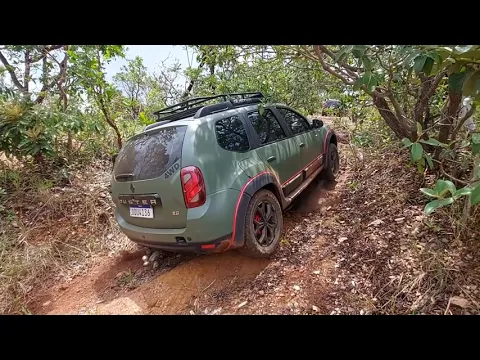

The locking mode, on the other hand, is designed for specific low-speed situations where it is important to maintain operation of both axles. This architecture places the Duster well apart from the vast majority of current entry-level compact SUVs, which exclusively use front-wheel drive.
Quatro Rodas also highlighted the off-road geometry of the model, with an entry angle of 30 degrees, exit angle of 34.5 degrees, ground clearance of approximately 21 centimeters, and ramp angle of 20 degrees.
Trunk changes in the 4×4 version due to rear transmission
This generation of the Duster became known for its trunk space of 475 liters in the 4×2 versions, one of the largest figures among compact SUVs of its time. However, in the 4×4 configuration discussed here, there is an important technical difference.
The presence of the rear traction system and specific suspension reduces the trunk capacity of the Duster 4×4 to approximately 400 liters. Thus, the famous 475 liters associated with the Duster family correspond only to the front-wheel drive versions, while the Dakar II 4WD sacrifices part of that capacity to accommodate the complete assembly.

Even with 400 liters, there is still enough space for family luggage, and the split rear seat allows for increased area when not all seats are occupied.
The difference also reflects the physical cost of transforming a compact SUV into a vehicle with a functional 4×4 system: the driveshaft, rear differential, and independent suspension occupy space that in 4×2 versions could be used to expand the cargo area.
Independent Rear Suspension Distinguishes the Duster 4×4
Another feature appears beneath the body. At the front, the Duster uses independent McPherson suspension. In the 4×4 version, the rear adopts independent multi-link architecture, instead of the torsion beam used in front-wheel-drive configurations.
This change is necessary partly due to the architecture of the all-wheel-drive system and also alters the vehicle’s behavior over uneven surfaces.
The dimensions help keep the Duster relatively compact. It measures approximately 4.329 meters in length, 1.822 meters in width, 1.683 meters in height, and 2.674 meters between the axles.
The model uses 215/65 R16 tires in the configuration tested by Quatro Rodas. The relatively tall profile favors impact absorption from potholes and dirt roads, a characteristic consistent with the vehicle’s more rugged proposal.
Fuel Consumption Reached 11.4 km/l in Road Test
A naturally aspirated 2.0-liter engine, a tall body, and a 4×4 system do not inherently make the Duster Dakar a benchmark for fuel efficiency. Nevertheless, the figures from tests show that its highway performance can be reasonable for its intended purpose.
In a Quatro Rodas evaluation of a comparable Duster 2.0 4×4, the model recorded 7.7 km/l in urban driving and 11.4 km/l on the highway using gasoline.

Other fuel consumption references for the model vary according to methodology, year, and usage conditions, which is why the 11.4 km/l should be understood as test results, not guaranteed consumption in all situations.
The Duster has a tank of approximately 50 liters. Using the 11.4 km/l figure as a theoretical exercise, it could represent up to 570 km with the entire nominal capacity utilized. In practice, speed, terrain, tires, fuel, load, mechanical conditions, and frequent activation of all-wheel drive alter the outcome.
Dakar II Series Introduced Exclusive Equipment and Visuals
The designation Dakar II is not just a sticker placed on a conventional Duster. Renault created specific visual elements to link the series to the brand’s adventurous identity and its history associated with the famous rally.
Externally, there were side stripes with the inscription Dakar Spirit, specific logos, black mirror covers, and diamond-finished 16-inch alloy wheels in black and silver.

Inside, the model features a two-tone dashboard, seats with specific upholstery, and custom headrests referencing the Dakar.
The equipment list included air conditioning, electro-hydraulic steering, rear parking sensor, onboard computer, fog lights, cruise control with speed limiter, rear camera, and a Media Nav multimedia center with a 7-inch touchscreen.
Safety Shows the Project’s Age
Although the mechanical capability still attracts attention in 2026, the Duster Dakar II belongs to a generation developed under safety standards different from those found in today’s new SUVs.
The model was factory-equipped with front airbags for the driver and passenger, ABS brakes, electronic brake distribution, and emergency braking assistance. Depending on the configuration and year, additional electronic systems associated with the 4×4 line also appear.

Still, buyers accustomed to six airbags, autonomous emergency braking, collision alerts, lane-keeping assistance, and adaptive cruise control will not find this level of technology in a project launched many years earlier.
This is one of the main counterpoints to the current price. The Duster offers a lot of mechanical capability for the money, but those prioritizing modern driver assistance electronic systems may find newer options less prepared for off-road conditions.
For R$ 68,000, Few SUVs Combine 148 hp, 4×4, and Six Gears
This is precisely where the Duster Dakar II draws attention again. The FIPE price of R$ 67,947 in September 2026 places the model in a region dominated by entry-level front-wheel-drive SUVs with smaller engines or automatic versions with no intention of off-road capability.
The Duster offers a different recipe: a 2.0 naturally aspirated engine producing up to 148 hp, 20.9 kgfm of torque, a six-speed manual transmission, selectable 4×4 drivetrain, independent rear suspension, and 21 centimeters of ground clearance.
There are concessions. The urban fuel consumption is not low, the cabin reveals the project’s age, the safety package is far from current vehicles, and the 4×4 version reduces the trunk space from 475 to approximately 400 liters.
In contrast, those who truly need to tackle dirt roads, rural access, mud, or low-traction sections find capabilities that have disappeared from many modern SUVs sold only with front-wheel drive.
The combination explains why the 2018 Renault Duster Dakar II 2.0 4×4 six-speed manual remains one of the most unique options priced under R$ 70,000 (about US$13,000): while much of the market has embraced increasingly urban SUVs, it retains a large naturally aspirated engine, six-speed manual transmission, and an all-wheel drive system that allows the driver to choose when all four wheels need to engage.


