





 Portuguese
  English
  Spanish
  6 min of reading
  0 comments


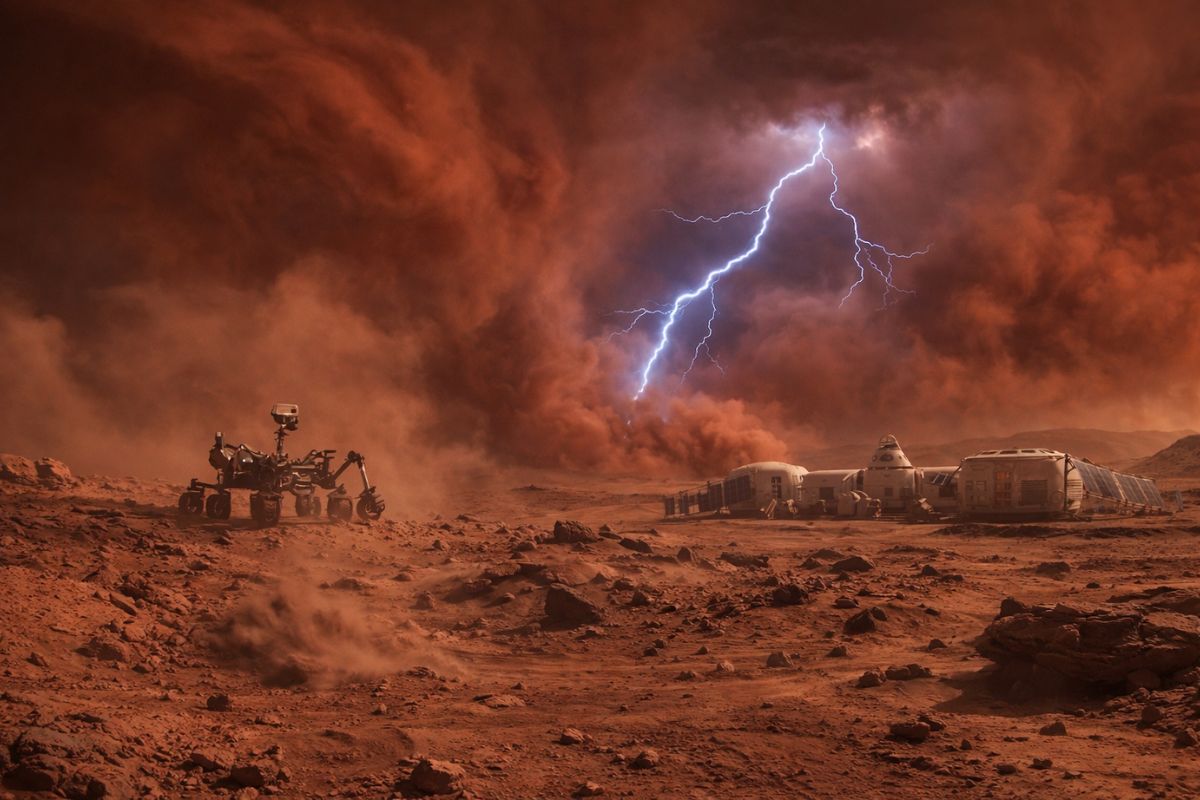
NASA’s Perseverance rover captured unprecedented evidence of electrical discharges in Mars’ atmosphere during dust storms, revealing an environment much more dangerous than previous models predicted and forcing engineers to redesign protection systems for future crewed missions.
The electrical discharges that the Perseverance rover has just recorded in Mars’ atmosphere represent more than a scientific curiosity; they are a concrete warning for all space engineering. For the first time, radiation sensors and high-precision cameras installed on NASA’s robot identified rapid electromagnetic pulses during dust storms on the red planet, confirming that Mars lightning exists and that the static electricity generated by the friction of sand particles reaches critical levels. The discovery, documented by NASA, redefines what was known about Mars’ meteorology and calls into question the safety protocols used until now.
The impact of this revelation goes directly to the planning of future missions. If Mars has electrical discharges capable of generating dangerous electric arcs, all electronic equipment, landing modules, solar power systems, and even habitats designed for astronauts need to be rethought. Shielding against electromagnetic interference, which until now was sized for cosmic and solar radiation, now needs to include protection against local atmospheric phenomena that no one expected to find on a planet with such a rarefied atmosphere.
How Perseverance managed to detect electrical discharges on Mars
According to the portal CatracaLivre, detecting electrical discharges on another planet is not trivial. Perseverance uses a combination of radiation sensors and high-speed cameras that continuously monitor atmospheric variations on Mars. The instruments are capable of identifying electromagnetic pulses that last milliseconds, filtering out cosmic background noise to isolate the specific signature of a Martian electrical discharge. Advanced algorithms process images in fractions of a second to capture transient events that would be invisible to the naked eye or less sophisticated equipment.
-
Artemis II astronauts return from space and request Uncrustables after ten days for their first meal, and the Navy supplies the ship with an “abundant amount,” the manufacturer promises a lifetime supply.
-
Japanese mission uncovers the secret behind a 50-year astronomical mystery and reveals who was really emitting the X-rays from the star γ Cas.
-
(VIDEO) Three giant parachutes slowed the Orion capsule from 40,000 kilometers per hour to just 32 km/h, and NASA completed the most anticipated landing of the decade in the Pacific Ocean with the four Artemis II astronauts back on Earth after 10 days in space.
-
Artemis II returns to the Pacific after 10 days and brings 4 astronauts back from the Moon, breaking the record for human distance and proving the reentry of Orion in a historic mission.
The confirmation process required exceptional scientific rigor. The data captured by the rover is sent to Earth via relay satellites, ensuring that each recorded pulse can be analyzed with maximum technical fidelity. NASA scientists had to rule out internal interferences from the rover itself and distinguish atmospheric electrical discharges from other electromagnetic phenomena before announcing the discovery. The robust hardware of Perseverance, designed to withstand Mars’ extreme conditions, was essential for the detection to be possible, proving that investment in cutting-edge instrumentation yields scientific returns that justify every dollar spent.
Why electrical discharges on Mars surprised the scientific community
Mars’ atmosphere is approximately 100 times thinner than Earth’s. Under these conditions of extremely low pressure, the formation of electrical discharges was considered unlikely by most existing atmospheric models. The logic was simple: without a dense enough atmosphere to sustain the ionization process that generates lightning on Earth, Mars should not produce this type of phenomenon. Perseverance proved that this logic was wrong.
The mechanism responsible for Martian electrical discharges is different from that on Earth. On Mars, the friction between sand and dust particles during storms generates a buildup of electrostatic charge that reaches levels sufficient to produce sparks and electric arcs. The almost total absence of moisture in the Martian atmosphere—a factor that helps dissipate static electricity on Earth—contributes to the intensification of electric fields to the point of causing visible electrical discharges. What was thought to be impossible turned out to be not only real but potentially frequent during the violent dust storms that periodically engulf the entire planet.
What changes in the design of equipment sent to Mars
The confirmation of electrical discharges in the Martian atmosphere forces engineers to completely revise the protocols for shielding and isolating electronic components. The buildup of electrostatic charge on the surfaces of landing modules can result in electric arcs capable of damaging internal circuits, compromising optical sensors and interfering with radio communication systems. Until now, designs considered cosmic and solar radiation as the main electromagnetic threats; atmospheric electrical discharges simply did not appear on the risk list.
The technical solutions being developed include integrated circuits with floating grounding systems to prevent shorts in rarefied atmospheres, high-sensitivity electric field sensors integrated into the external structure of vehicles, and polymer coatings that minimize static generation from mechanical friction. The development of new conductive materials will be essential to dissipate the energy generated by electrical discharges in a controlled and safe manner during dust storms. Each upcoming mission to Mars will have to incorporate these standards, which represents a significant increase in complexity and cost in the design of any equipment intended for the Martian surface.
How electrical discharges affect the human colonization plan for Mars
The planning of crewed bases on Mars gains a variable that no one had included in simulations until now. The existence of electrical discharges means that human habitats will need lightning rods and mesh protection systems, something that seems trivial on Earth but requires specific engineering on a planet with reduced gravity, a rarefied atmosphere, and extreme thermal conditions. The solar power infrastructure considered the main source of electricity for future colonies will be exposed to atmospheric electrical spikes that can cause permanent damage to the panels.
The safety of astronauts is also directly affected. Space suits, surface vehicles, and portable equipment will have to be redesigned to withstand unexpected electrical discharges during external operations.
A detailed understanding of these phenomena allows for the creation of more accurate weather models for Mars, which will be crucial for the navigation of drones and helicopters on the planet. Knowing when the atmosphere is prone to producing electrical discharges will allow flight routes to be altered preventively and astronauts to avoid extravehicular activities during times of highest risk.
What the discovery of electrical discharges on Mars teaches about Earth
Every piece of information obtained by Perseverance on Mars feeds the development of technologies with direct applications on Earth. The study of how electrical discharges behave under low pressure and lack of moisture allows for advances in areas such as commercial aviation, semiconductor manufacturing, and protection of critical infrastructure against electromagnetic interference.
The exchange of knowledge between space exploration and the terrestrial industry is a self-reinforcing cycle: technologies created to protect a rover on Mars can be adapted to protect wind turbines, telecommunications networks, or hospital equipment.
The discovery also refines the general understanding of how electricity behaves under extreme conditions. The data on electrical discharges collected by Perseverance is already being used to improve engineering simulations that predict the behavior of insulating materials under extreme temperature variations and prolonged exposure to intense electromagnetic fields.
The knowledge generated on Mars does not stay on Mars; it migrates to laboratories and production lines around the world, accelerating innovations that might take decades to emerge without the impetus of planetary exploration.
The future of Mars exploration after this discovery
The detection of electrical discharges by Perseverance is not the endpoint of research; it is the beginning of a new line of investigation that will occupy the scientific community for years. The next generations of rovers and probes sent to Mars are already being designed with early detection sensors for electrical discharges, more robust protection systems, and the ability to map atmospheric electric fields in real-time. The goal is to transform a newly discovered phenomenon into a predictable and manageable variable.
For those following space exploration, the message is clear: Mars is more complex, more dynamic, and more dangerous than previously thought, and each discovery by Perseverance rewrites the instruction manual for getting there. Electrical discharges are just the latest chapter in a story being written in real-time, millions of kilometers away, by a robot that continues to surprise even the scientists who built it.
The future of human presence on Mars directly depends on the ability to understand and neutralize every threat that the red planet presents, and Martian lightning has just entered that list.
Perseverance has just proven that Mars has lightning, and this changes everything in the planning of future missions. Do you think that the colonization of Mars is still viable in light of so many challenges? Should this discovery accelerate or slow down NASA’s plans?







Seja o primeiro a reagir!