





 Portuguese
  English
  Spanish
  3 min of reading
  0 comments


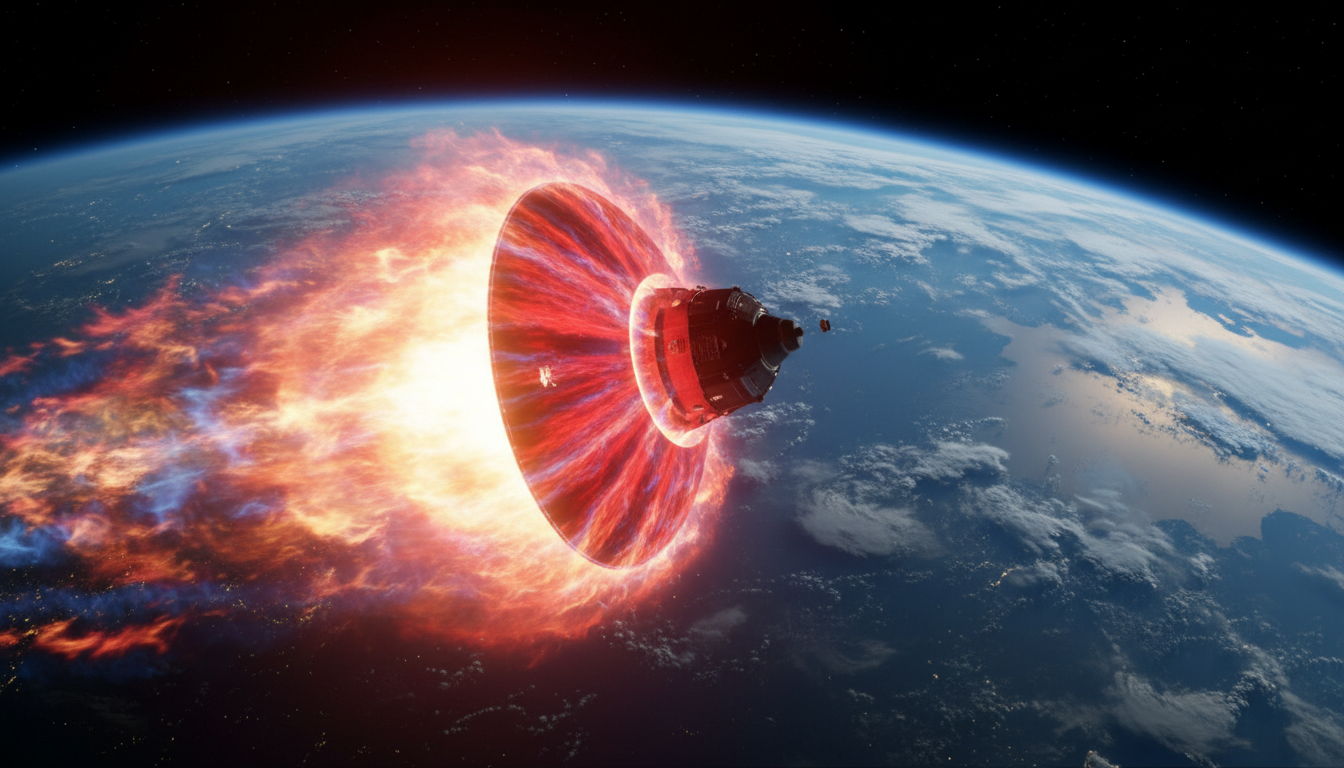
NASA’s Artemis II mission took 4 astronauts around the Moon for the first time in 53 years, the Orion capsule re-entered the atmosphere at over 30,000 km/h withstanding temperatures that melt steel, reached 7,500 km beyond the far side of the Moon surpassing the Apollo 13 record, and splashed down in the Pacific Ocean on April 11, 2026, paving the way for Artemis III to land the first woman on the lunar surface.
For the first time since December 1972, humans saw the Moon up close. NASA’s Artemis II mission brought 4 astronauts back after 10 days in deep space.
The Orion capsule splashed down in the Pacific Ocean on April 11, 2026, near San Diego, being recovered by the U.S. Navy.
And the technology that brought them back makes the Apollo program — which took humans to the Moon in the 60s — look like a toy.
-
From 1969 to 1972, only 12 human beings set foot on the Moon, and then the world simply stopped going, until this week when NASA showed that the journey back has finally begun.
-
Prairie chicken robots simulate mating dances and sounds in Wyoming to bring the species back to habitats and prevent breeding at Jackson Hole Airport after a decline from 73 to 3.

-
Tabarca, an 18th-century walled island with only 30 hectares and around 50 residents, lives isolated in the Mediterranean and now wants to separate from Alicante.

-
In Qatar, a strategic terminal at Hamad Port has been designed to store enough rice, sugar, and oil to supply 3 million people for up to two years, turning the port into one of the most secure food vaults in the Gulf.


The most powerful rocket ever built by NASA
Artemis II launched on April 1, 2026 at 6:35 PM (local time) from Launch Complex 39B at Kennedy Space Center, Florida. Thus, the same location from where the Apollo missions departed.
The SLS (Space Launch System) Block 1 rocket is the most powerful ever built by NASA. Thus, it propelled the Orion on a translunar injection trajectory with multiple burns.
After 1 day in low Earth orbit for checks, the capsule headed towards the Moon. The lunar flyby occurred on April 6, 2026.
The Orion reached 7,500 km beyond the far side of the Moon — the farthest point from Earth ever reached by humans, surpassing the Apollo 13 record from 1970.

4 astronauts who made history
The Artemis II crew consists of:
Reid Wiseman (commander), Victor Glover (pilot), Christina Koch (mission specialist), and Jeremy Hansen (mission specialist, from the Canadian Space Agency).
Thus, Hansen became the first Canadian to travel to deep space. Additionally, Koch is the astronaut who holds the female record for continuous time in space.
The 4 conducted tests on essential Orion systems in a deep space environment: life support, communications, navigation, and manual control.
Re-entry at 30,000 km/h with temperatures that melt steel
The atmospheric re-entry of Orion lasted 13 minutes. Thus, the capsule reached speeds around 30,000 km/h — typical for lunar mission re-entries.
During 6 minutes, all communications were cut off. Thus, mission control lost contact with the crew while the thermal shield faced extreme temperatures.
However, the re-entry followed a steeper profile than originally planned. This is because Artemis I (uncrewed, 2022) revealed erosion on the thermal shield during “bouncing” re-entry.
NASA adjusted the profile based on data from Artemis I — an engineering decision that may have saved the mission.

What makes Apollo look like a toy
The technological difference between 1969 and 2026 is staggering.
The Orion uses free return trajectory, leveraging the gravity of Earth and the Moon to reduce fuel consumption. Thus, it is safer than the Apollos, which relied on large engine burns.
The SLS generates more thrust than the Saturn V. The Orion has life support, navigation, and communication systems that did not exist in the Apollo era. Additionally, the thermal shield is designed for speeds and temperatures that the Apollos never faced in a direct profile.
To understand how this level of extreme engineering is already operating on offshore oil platforms, see the report.

What comes next: first woman on the Moon
The next mission is Artemis III, scheduled for 2027-2028. Thus, it will be the first crewed landing on the Moon in over 55 years.
The target is the lunar south pole, where scientists believe there is water ice in permanently shadowed craters. Thus, Christina Koch could become the first woman to set foot on the lunar surface.
However, the mission has faced delays due to technical issues with the SLS and SpaceX’s Starship (which will be the landing module). The total cost of the Artemis program already amounts to US$ 93 billion.
Still, after 53 years of silence, humanity is not just returning to the Moon — it is coming back to stay. And the technology that made this possible makes everything that came before look like a rehearsal.





Seja o primeiro a reagir!