Bacteria that remove uranium eliminated about 95% of the dissolved metal in contaminated water and converted it into a stable chemical compound.
Scientists from Germany and Spain observed, for the first time, microorganisms converting dissolved uranium in contaminated water into a stable chemical form. The experiment used samples from an old German mine and showed that after 130 days, only about 5% of the radioactive metal remained in the liquid part.
The result was obtained by researchers from the Helmholtz Center Dresden-Rossendorf, in partnership with the University of Granada. Published on May 4 in the journal Nature Communications, the study indicates that bacteria that remove uranium can contribute to future environmental recovery technologies.
Chemical transformation went beyond metal retention
The scientists did not only identify uranium adhered to the surface of the microorganisms. The analyses showed that a significant part of the element underwent a chemical transformation associated with bacterial activity.
-
OpenAI prepares a complex of over $30 billion in the United States, with energy comparable to the consumption of 2.4 million homes and capacity to expand the operation of artificial intelligence models.

-
Samsung surprises by launching designer smart glasses with Google AI, advanced Android integration, and multimodal features for voice and image commands, marking a new phase of premium wearables focused on luxury and productivity.
-
Japan erects a 24.8-meter statue in a shopping mall courtyard representing an animated robot, the largest of its kind ever built in the world, with a moving arm and 62 light points that recreate a scene from a 1988 film.

-
A couple lifted the floor of the family house just to put in thermal insulation and ended up unearthing the past. In the dirt floor, there were aligned stones, a glass bead that the husband swore was a toy piece, and an iron axe that revealed they had all been sleeping for over a century on top of a Viking-era grave.


A large part of the uranium remained in a pentavalent state during the process. When the samples dried and came into contact with oxygen, this condition favored the emergence of the stable compound recorded by the researchers.
This observation differentiates the experiment from processes where the contaminant is only temporarily trapped in the cells. The chemical stability can reduce the mobility of uranium and limit its dissolved presence in the water.
Bacteria that remove uranium received glycerol
To activate the metabolism of the microorganisms, the team added glycerol to the samples. The substance functioned as a carbon source and provided energy for the bacterial community present in the contaminated water.
The containers were kept in conditions similar to those found underground in the mine, where there is little or no oxygen. In this way, the laboratory reproduced part of the environment in which the organisms were already adapted to survive.
Evelyn Krawczyk-Bärsch, a microbiologist at HZDR and co-author of the research, explained that previous work already indicated the use of dissolved uranium in bacterial metabolism. The novelty was demonstrating that this process can also result in a more stable substance.
Water Became Transparent and Dark Solid Accumulated
At the end of 130 days, the researchers found a dark material deposited at the bottom of the containers. This precipitate corresponded to the solid phase formed during the chemical reactions observed in the experiment.
Above the deposit, the water remained transparent. The visual separation accompanied the strong reduction in the amount of uranium that was still dissolved in the sample.
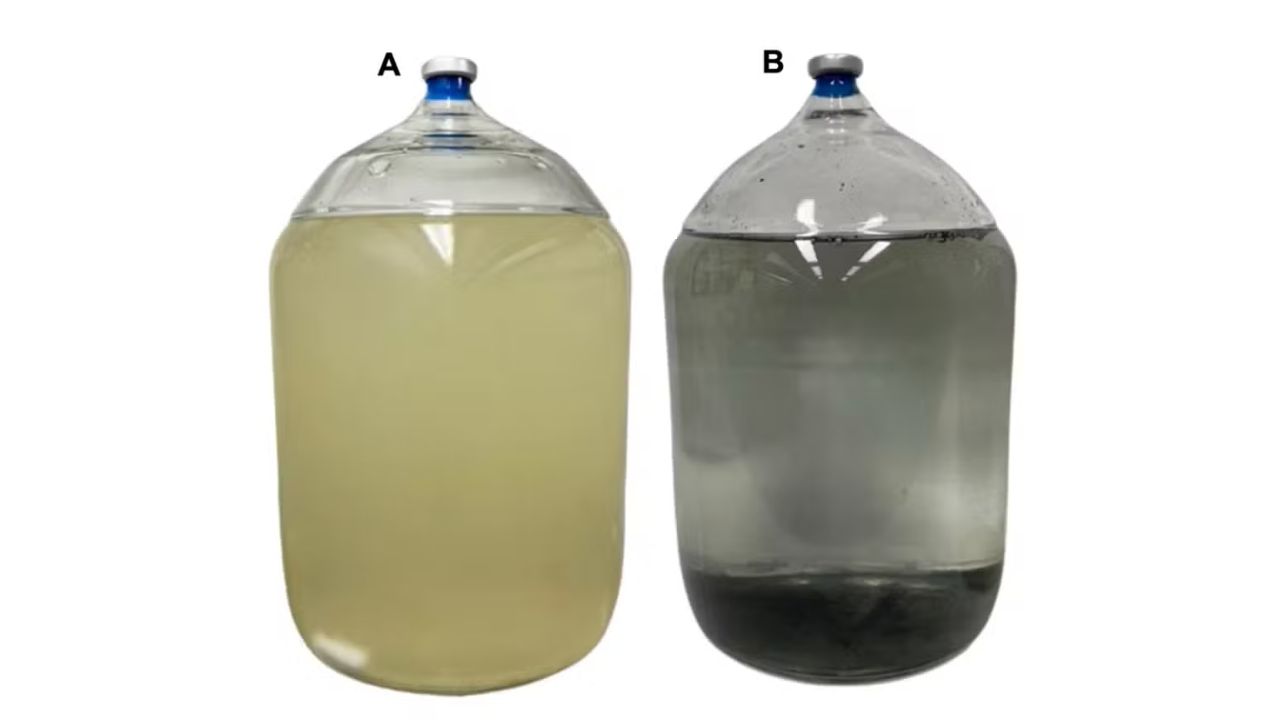
The result showed that approximately 95% of the initial content had left the liquid phase. For the team, the formation of the solid helps to understand how microorganisms can alter the fate of radioactive contaminants.
Old Mine Continues to Require Water Treatment
The samples were taken from the entrance of the Schlema-Alberoda mine treatment station. The site was explored by Wismut GmbH in the former East Germany, when the region was under Soviet influence.
The activity was terminated in 1990, after German reunification. With the closure, the influx of groundwater flooded the structure and created an environmental problem that still requires continuous control.
The accumulated water presents high concentrations of dissolved uranium. Before being released, it needs to undergo procedures aimed at reducing contamination.
Microbial Life Adapted to Radioactive Environment
Even under extreme conditions, the mine harbors a community of microorganisms. These bacteria have developed the ability to survive in an environment marked by the presence of the radioactive metal and the low availability of oxygen.
The research sought to understand if this community directly interfered with the chemical behavior of uranium. To this end, the scientists avoided working only with isolated cultures and used samples collected from the mine’s own system.
The experiment revealed that the organisms were not only resistant to contamination. They also participated in reactions capable of modifying the form in which uranium remained in the water.
Why Dissolved Uranium Concerns Scientists
When it remains dissolved, uranium can follow the movement of water through the soil. This behavior increases the possibility of the contaminant reaching other areas and affecting underground reserves.
Regions with a history of mining face this type of problem due to prolonged contact between rocks, waste, and water. Contamination can affect ecosystems and pose risks to human health.
Transforming the element into a solid and stable form can reduce its ability to disperse. This is where bacteria that remove uranium become important for environmental studies.
Biological Method Can Avoid Additional Waste
Decontamination techniques based on microorganisms have been investigated for several decades. One of the advantages studied is the possibility of reducing contaminants without producing large amounts of secondary waste.
Physical-chemical treatments can also remove metals from water, but they may require other steps to manage the materials generated. The biological approach seeks to leverage reactions carried out by the organisms themselves.
Previous research had already demonstrated significant reductions of dissolved uranium by microbial processes. The new work adds information about the chemical nature of the material formed after removal.
Experiment Reproduced Specific Geochemical Scenario
The authors emphasize that the results were obtained with water from a particular mine. The chemical composition, bacterial community, and absence of oxygen formed a specific set of conditions.
This means that the 95% performance cannot be automatically transferred to any contaminated area. Other waters may present different minerals, microorganisms, and concentrations.
Even so, the team considers it possible that similar processes occur in other locations. New tests will be necessary to verify in which environments the bacteria that remove uranium maintain the same efficiency.
Discovery still needs to leave the laboratory
Although the results are promising, the research did not present an immediate large-scale application. Scientists still need to determine how to control the process outside experimental conditions.
It will also be necessary to evaluate the stability of the compound over longer periods. An environmental recovery strategy needs to prevent uranium from dissolving again if the site’s chemical conditions change.
The team will also need to investigate the amount of glycerol required and the response of microbial communities in waters with other characteristics. These factors will influence the feasibility of a real treatment.
Bacteria can become allies of decontamination
The study shows that organisms naturally found in a radioactive environment can play an active role in transforming the contaminant. Instead of just surviving, the bacteria altered the chemical state of uranium.
The removal of approximately 95% of the metal from the liquid phase represents an advance in understanding these processes. The formation of a stable compound expands the possibilities of limiting the circulation of the contaminant.
If the results are confirmed in other scenarios, uranium-removing bacteria could be integrated into new strategies to treat water affected by mining. For now, the discovery establishes a scientific basis for understanding how microbial activity can help immobilize one of the most persistent contaminants in these environments.