





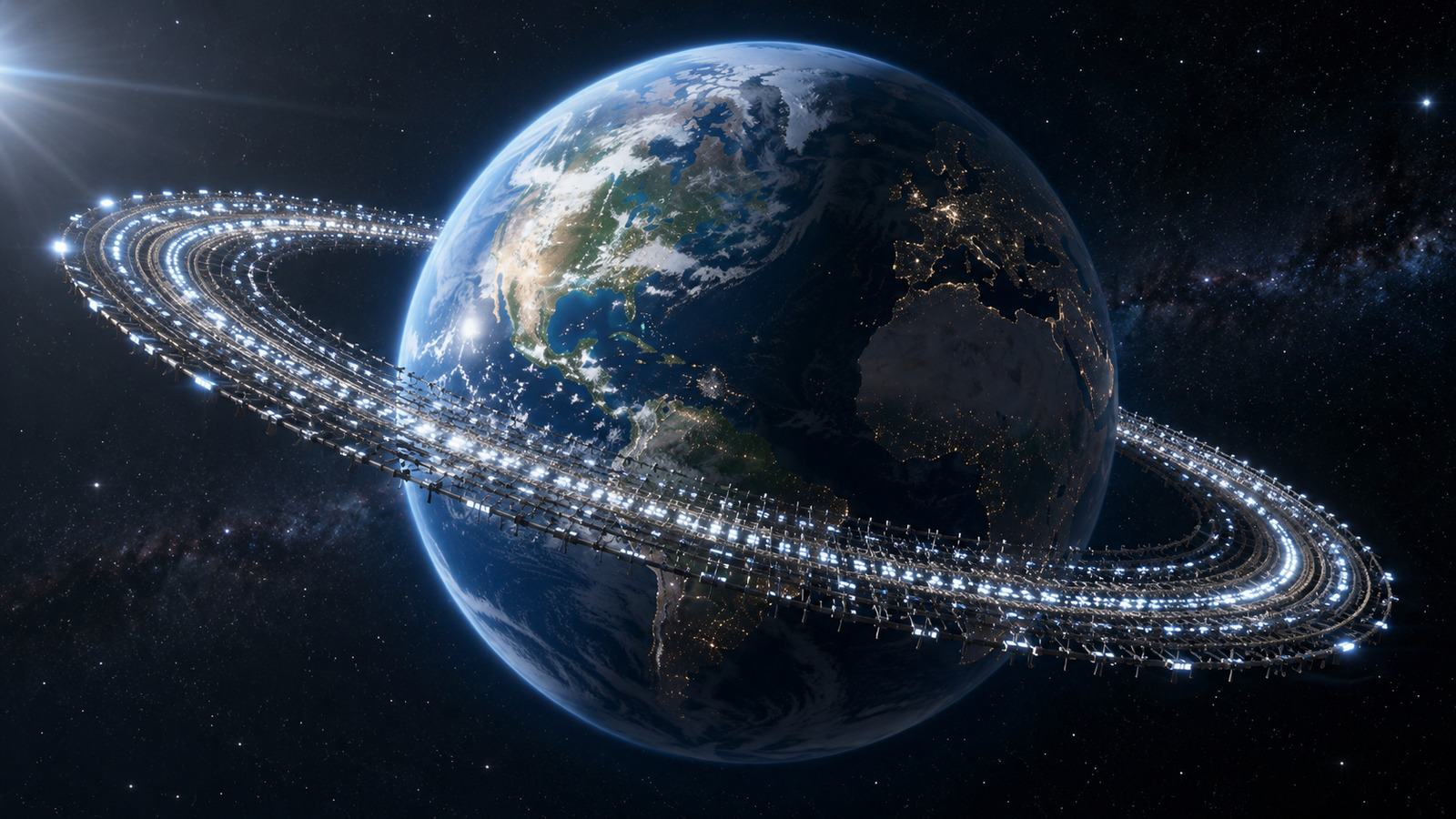

More than a million satellites and 50 thousand orbital mirrors could form bright bands around the Earth, alter the night sky, and reduce the efficiency of telescopes used in research of global importance
Plans by companies to launch more than a million satellites intended for space data centers, in addition to 50 thousand orbital mirrors, could form a ring of satellites visible worldwide. Researchers warn that the luminous band could outshine stars and planets, alter the night sky, and hinder astronomical observations.
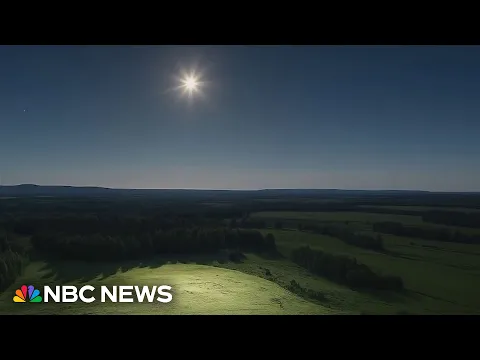

Ring of satellites would be the result of the race for space data centers
The scenario is related to the advancement of projects aiming to take large data processing structures to space. Combined, the constellations presented by companies exceed one million satellites.
SpaceX, Starcloud, Cowboy Space, Orbital, and Blue Origin are among the companies that have applied to the United States Federal Communications Commission, the FCC, for authorization to develop or launch large orbital constellations.
-
Seeds in Space: South Africa Will Send Rooibos Seeds to the International Space Station (ISS)

-
Samsung launches its first phones with silicon-carbon batteries, a technology that offers higher energy density, favors thinner devices, and creates an important competitive advantage for the next generation of high-performance smartphones.

-
Goodbye traditional air conditioning: French technology does not have a condenser, uses indirect evaporation, thermal power of 2 kW with low electrical consumption, and aims to replace the compression cycle with water cooling in spaces up to 40 m².
-
Transporting 129.6 million passengers and growing 9.4% in the year, Brazil’s air transport set a historical record in 2025, with the domestic market carrying 101.2 million people and the international market advancing 13.4% to 28.4 million.




China also intends to create its own network of space data centers in the next five years.
Meanwhile, the Californian company Reflect Orbital plans to place 50 thousand mirrors in orbit to reflect sunlight onto terrestrial plants during the night.
On July 10, Reflect Orbital received authorization from the FCC to operate the Eärendil-1, its first orbital mirror demonstrator. The satellite will be 18 meters by 18 meters and is scheduled for launch by the end of this year.

Equipment would depend on an orbit with continuous solar illumination
According to Hugh Lewis, professor of astronautics at the University of Birmingham, orbital data centers and space mirrors need to remain continuously illuminated by the Sun to fulfill the functions anticipated by operators.
To achieve the so-called 24 hours of sunlight in space, the equipment would have to occupy an orbit that follows the terminator line, the boundary between the illuminated and dark regions of the Earth.
This trajectory would pass over the North and South poles. Unlike Starlink, distributed around the planet, the new constellations would be concentrated in the same orbital plane, close to each other and following the same direction.
Seen from the surface, this concentration would appear as a luminous band crossing the sky. Lewis states that accommodating so many constellations would require stacking them in this specific orbit, creating an impact he described as “absolutely catastrophic” for the night sky.
Simulations show luminous bands crossing the sky daily
Astronomer Samantha Lawler, from the University of Regina, participated in computational simulations involving projects like Starmind, from SpaceX, Project Sunrise, from Blue Origin, and Stampede, from Cowboy Space.
The models indicate that visible satellites could outnumber the stars, as well as obscure some of them. As the Earth rotated under the orbit, the ring of satellites would cross the sky twice daily.
The first passage would occur between the end and the beginning of the night. The second would be observed shortly before dawn, approximately at the same times every day, with a potentially more intense effect during winter.
Some constellations would have different inclinations. Project Sunrise, for example, could form a pattern resembling the letter X over the main ring.
Near the equator, the observer would see the complete shape. In areas further north, two separate bands would be seen, one appearing in the morning and the other after sunset.
Brightness could compromise telescopes and asteroid research
Lawler emphasizes that the simulations use public information and have not yet been peer-reviewed. Even so, the models indicate that the scattered light would remain in the sky for up to two hours after the satellites disappeared over the horizon.
This residual brightness would reduce the useful operating period of telescopes. According to the researcher, taxpayer-funded facilities could produce less science for the same cost, affecting even the search for dangerous asteroids near Earth.
The final intensity will depend on the number of equipment actually launched. Each mirror from Reflect Orbital, however, is expected to present brightness comparable to Venus, the brightest object in the night sky after the Moon.
A previous study by the European Southern Observatory indicated that a constellation of 50,000 mirrors could increase the brightness of the night sky by up to 300%, making some of the most sophisticated telescopes practically unusable.
For John Barentine, a dark sky advocate, the new projects would transform the current almost invisible rings of satellites and debris into permanent reflective bands, positioned precisely in the most important twilight windows for global astronomy.
This article was prepared based on information from Space.com and on data, simulations, and statements from researchers cited in the provided material, with numbers and information preserved as per the consulted content.


