





 Portuguese
  English
  Spanish
  5 min of reading
  0 comments


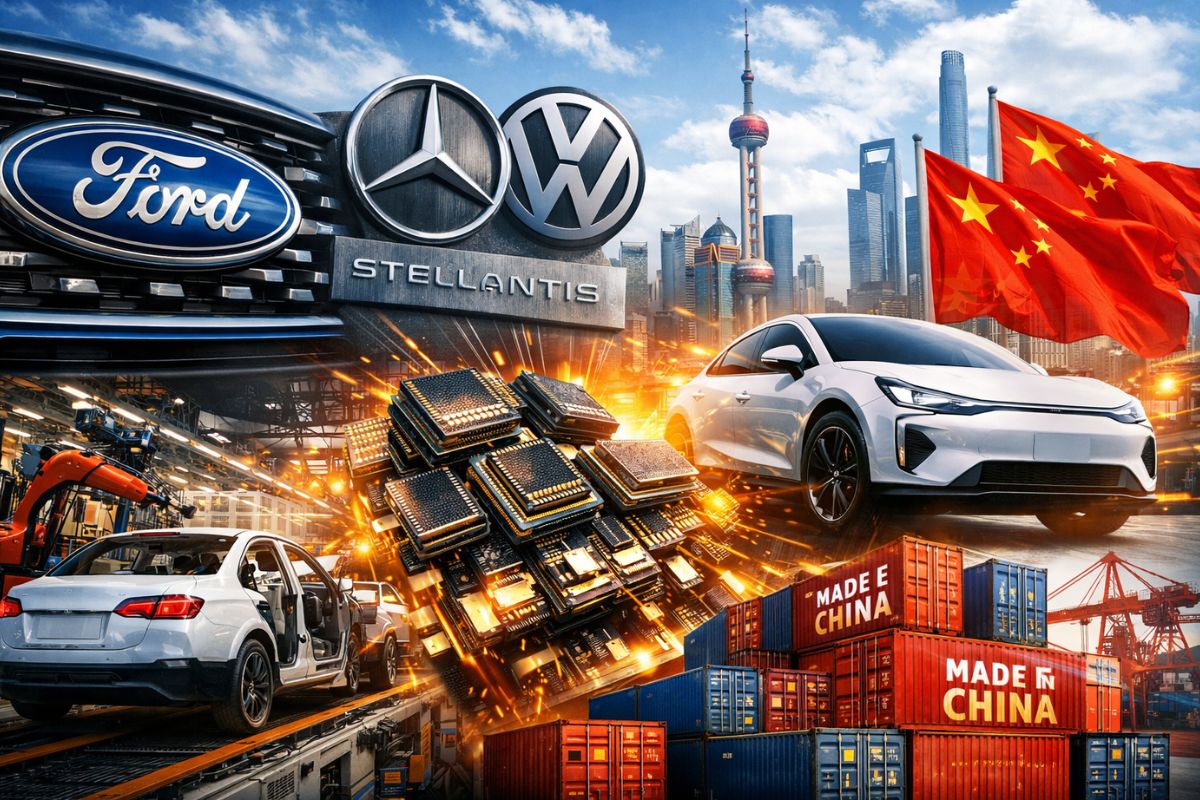
China has already registered five times more future transportation patents than Germany, and now European and American automakers are importing software platforms and even Chinese engineers for their own models, while Ford CEO Jim Farley classifies the advance as an existential threat to the Western industry.
According to the portal Brasil 247, China has stopped being the factory of the world to become the brain of the global automotive industry, and the largest automakers in the West already recognize this. Stellantis is considering using electric vehicle platforms and software from Chinese Leapmotor as a basis for models from brands like Fiat, Opel, and Peugeot. Mercedes-Benz is in talks with Geely about cooperation on future electric vehicles. Volkswagen has partnered with Xpeng. Renault developed the new electric Twingo in Shanghai. And Ford CEO Jim Farley described this scenario in two words: “existential threat.”
What is happening goes beyond a trade war. China has imposed a new pace on the industry, dubbed “China Speed” by its own Western executives: development cycles that take less than two years compared to five to seven for traditional automakers, intense integration between suppliers and factories, and the ability to fix flaws via remote updates on the same day. Since 2009, the Chinese government has invested at least $230 billion in support of the electric vehicle sector, according to the Center for Strategic & International Studies. The result is an industry that has registered over 343,000 patents for future transportation technologies between 2000 and 2023, nearly five times the total of Germany, and now exports not only cars but the very logic of how cars are made.
What is “China Speed” and why does it scare Western automakers
The term defines a production model where the vehicle does not need to be fully finished to hit the market. Some Chinese manufacturers have adopted the practice of launching the car and continuing to adjust it through remote software updates.
-
While NASA resumes its path to the Moon, Elon Musk pushes SpaceX for a new leap towards Mars, millions of satellites, and a trillion-dollar scale, and Brazil emerges along the way as a billion-dollar market, regulatory pressure, and a space trump card with Alcântara.

-
Super El Niño gains strength in new forecasts and could cause droughts, floods, and extreme global heat, making 2027 the hottest year in history.

-
An invisible phenomenon in Antarctica on a continental scale reveals a direct impact on the polar climate by showing that penguin droppings release ammonia, form bright clouds, and raise an unexpected scientific curiosity about the balance of the icy atmosphere.

-
A rare phenomenon of silent electric flashes in trees on the east coast of the United States intrigues researchers, confirms a century-old suspicion, and raises concerns about invisible environmental impacts.

A concrete example: a Leapmotor C10 tested on the Autobahn in Germany braked abruptly during driving. After an email to engineers in Hangzhou, China, the car received an update that fixed the problem. In a European automaker, the solution could take weeks.
This speed has structural roots. Many Chinese automakers were founded by entrepreneurs from the technology sector, not from the old automotive industry.
Founders of Xpeng, Nio, and Li Auto have backgrounds in internet startups; Lei Jun from Xiaomi comes from the software world.
Teams are younger, organized under aggressive performance goals, and intense domestic competition in China forces continuous innovation; those who do not evolve quickly simply disappear. It is this internal pressure that has forged the pace that now scares Detroit, Wolfsburg, and Stuttgart.
Which traditional automakers are already adopting technology from China
The list is extensive and grows every month. Stellantis is in talks with Xiaomi and Xpeng about possible investments in Europe, in addition to the existing partnership with Leapmotor.
Audi is working with SAIC Motor on electric models based on a local Chinese platform. Renault aims to source 40% of the parts for the new electric Twingo, by value, from suppliers in China. Nissan announced an investment of at least $1.4 billion to create electric vehicles in China for external markets.
Even traditional suppliers are migrating. Robert Bosch, the world’s largest auto parts manufacturer, is cutting thousands of jobs in Germany while shifting battery and driver assistance activities to China.
Bosch engineers in Suzhou redesigned an electrical connector in six months, about half the time that teams in Germany would need. The company acknowledged that development timelines in China are often much shorter and classified the country as an important innovation hub.
Why Ford’s CEO calls China an existential threat
Jim Farley is not using hyperbole. Ford faces a scenario where Chinese automakers are advancing into markets that were considered safe territories: Brazil, Mexico, the UK, the Middle East, while tariff protection in the U.S. only delays an entry that many consider inevitable.
UBS analysts estimate that just the battery cells already give Chinese manufacturers like BYD a cost advantage of about $2,000 per vehicle. The bank projects that these companies’ market share will rise from 25% in 2025 to 35% by 2030.
Farley is discussing with the Trump administration ways to structure joint ventures between American and Chinese companies should China’s entry into the U.S. market expand.
Ford recognizes that it cannot compete solely with what it has; it needs to somehow incorporate Chinese speed and cost to survive. European executives have already compared the moment to a “Nokia moment,” referencing the impact that the iPhone had on the Finnish mobile leader. The suggestion is clear: those who do not adapt will disappear.
The risks of Chinese speed that no one should ignore
“China Speed” is not just a virtue. The “launch and then fix” model has already generated concrete problems.
In October, JD Power’s annual survey recorded a decline in the reliability of cars sold in China for the second consecutive year, with Japanese and American joint ventures outperforming local brands. The study pointed out that insufficient validation systems in research and development, combined with pressure for cost reduction, are becoming a systemic risk to quality.
An emblematic case occurred in February when a Lynk & Co Z20 SUV turned off its headlights at night after the driver asked the voice system to turn off an internal reading light.
The vehicle was left in the dark and collided with the median; no one was injured, but the incident raised debate about consumers becoming involuntary product testers. The automaker installed an update, and the senior executive apologized, but the incident exposed that speed without proper validation has real costs.
Western automakers still maintain a relevant advantage in long-term reliability; the question is whether this advantage is sufficient to offset the difference in price and speed.
What all this means for the future of the cars you drive
Volkswagen CEO Oliver Blume summed up the scenario in one sentence: “There is no other region in the world where the transformation of our industry is occurring more consistently, dynamically, or quickly. It is in China that it is decided who will be at the forefront of this transformation.”
The German Chancellor Friedrich Merz, after visiting China, was even more direct: “Germany simply is no longer productive enough.”
For the consumer, the impact will come in the form of cheaper electric cars, with more embedded technology and constant updates, but possibly with less guarantee that each feature has been thoroughly tested before hitting the streets.
China has changed the rules of the game: speed and cost have become more valuable than tradition and pedigree. Western automakers that understand this in time can reinvent themselves. Those that do not may join Nokia on the list of giants that underestimated the speed of change.
What do you think: will Western automakers be able to compete with China, or will the future of the car be decided in Shanghai? Leave your opinion in the comments.






Seja o primeiro a reagir!