





 Portuguese
  English
  Spanish
 3 min of reading
  0 comments


Rare Fossil Of Giant Turtle Found In Acre By Ufac Team And May Help Understand The Amazonian Fauna Of The Past
A discovery made on the banks of the Acre River caught the attention of Brazilian researchers. A fossil of a giant turtle was found by a team from the Federal University of Acre (Ufac) and institutions from São Paulo. The find could contribute to a better understanding of the Amazonian fauna millions of years ago.
Fossil Of Millions Of Years
The fossil is from a turtle species called Stupendemys geographicus. It lived during the Miocene epoch, which spanned from about 23 million to 5.3 million years ago.
According to the researchers, this turtle inhabited the Amazon region between 13 and 7 million years ago.
-
China is testing a train that will operate at 400 km/h in daily service, which is 80 km/h faster than the French TGV, and uses carbon fiber, magnesium alloys, and more than 4,000 sensors to become the fastest commercial train on the planet.

-
Forget about having an air fryer, electric oven, and steam pot taking up space in your kitchen because a 30-liter smart oven combines all these functions, automatically selects the ideal temperature, and even turns off by itself when cooking is done.

-
Engineers rewrote all the apps from scratch and bet everything on a buttonless screen: now the creator of the iPhone says that Apple needs to make the same revolution again because of AI.

-
Researchers in the U.S. have created a flying robot that transforms into a land vehicle while still in the air. The technology, based on aerodynamic transition, converts landing into a scene worthy of Transformers and redefines mobility between sky and ground.

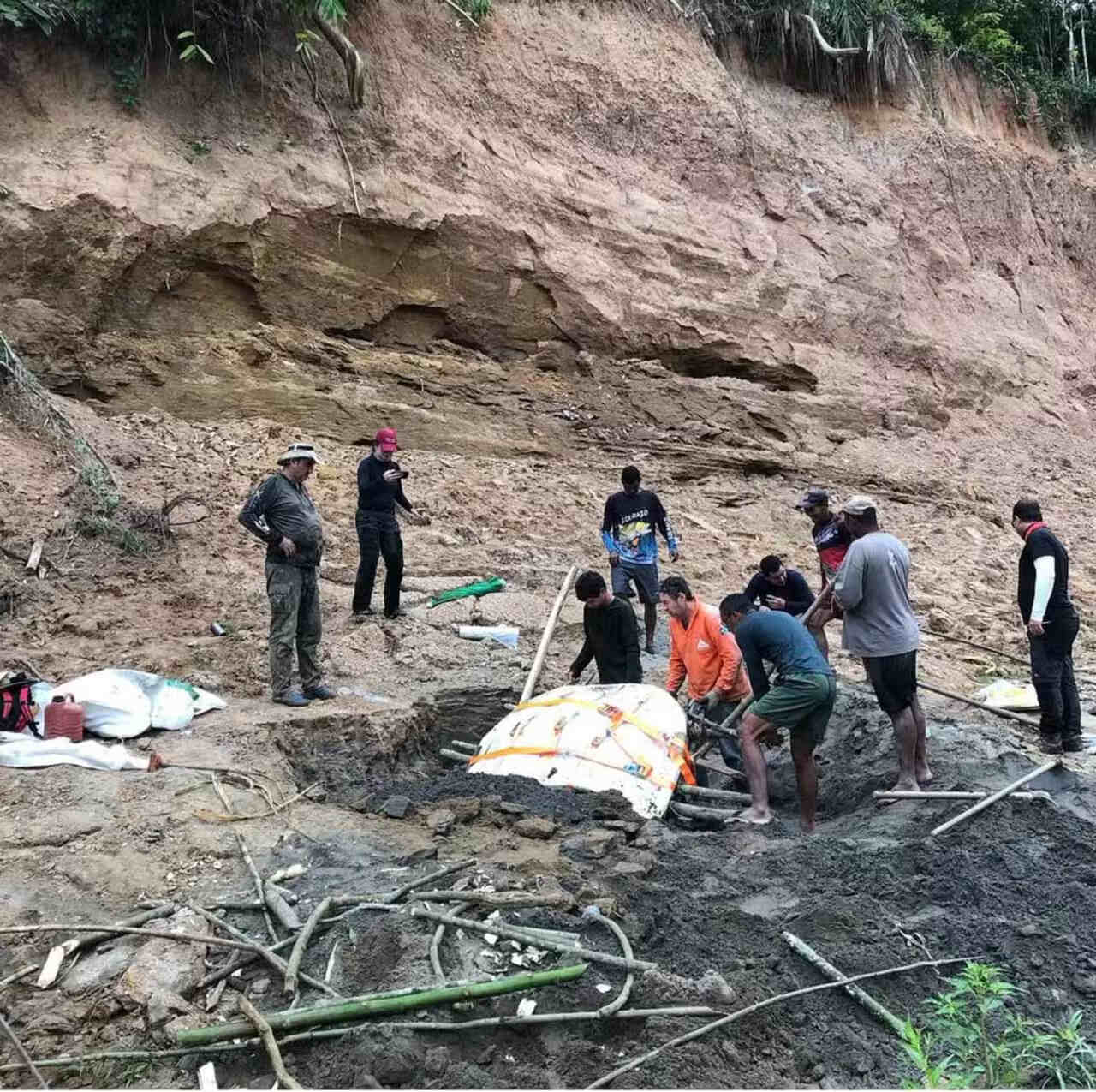
The discovery occurred in a locality known as Boca dos Patos, in the municipality of Assis Brasil. The area is within the Indigenous Land of Cabeceira do Rio Acre, on the border between Brazil and Peru. The team arrived at the site on June 17 and remains in the area.
Difficult Relocation And Fossil Recovery
The level of the Acre River is below three meters, which makes access difficult. The trip to the excavation area takes about five hours and is made by boat and car. After removal, the fossil was taken to an improvised camp near the site.
The attempt to transport the fossil in a pickup truck failed due to its size and weight. The researchers are now awaiting a truck from Ufac to transport the piece to the capital, Rio Branco.
Scientific Importance
The expedition’s coordinator and Ufac professor, Carlos D’Apolito Júnior, emphasized the significance of the find. “This is the largest, best-preserved fossil that has ever been seen,” he stated. He explained that the material will be essential for understanding the paleontology of the region.
It has not yet been possible to measure or weigh the fossil, but it is known that this species of turtle could reach more than three meters in length. According to the professor, it is the largest freshwater turtle that has ever existed.
Other Discoveries Of The Same Species
The Stupendemys geographicus is not a total novelty to science. The first records of the species date back to the 1970s.
In 2020, researchers found a three-meter shell in the Tatacoa Desert in Colombia, and another fossil in Venezuela. A jawbone was also found and provided clues about the animal’s diet.
Paleontologist Edson Guilherme from Ufac reported that the new fossil will be studied in the university’s laboratory.
“Only one complete shell has been discovered in Venezuela. We discovered the other one on this expedition. Unfortunately, it was only half of the shell,” he explained. Based on what was found, scientists hope to estimate the size of the animal.
Research Project In Remote Rivers
The expedition is part of the project “New Frontiers In The Fossil Record Of Southwestern Amazonia.” The initiative is funded by three institutions: CNPq (National Council for Scientific and Technological Development), Fapac (Foundation for Research Support of the State of Acre), and Fapesp (Foundation for Research Support of the State of São Paulo).
The objective is to conduct expeditions in little-explored rivers of the Amazon region, especially in Acre. The intent is to systematically find and collect fossils in remote areas.
Multidisciplinary Team Involved
The excavation in Acre involved researchers from Ufac, USP from Ribeirão Preto, and Unicamp. Participants included Carlos D’Apolito, Ighor Mendes, Adriana Kloster, Francisco Ricardo Negri, and Edson Guilherme from Ufac.
From USP and Unicamp, Karina Alencar, Edson Jorge Pazini, Gabriel Barbosa, Annie S. Hsiou, and Alessandro Batezzeli were involved.
The fossil, which is already secure at the camp, will be analyzed in the coming months. The expectation is that the studies will provide new answers about the fauna that inhabited the Amazon region millions of years ago.
With information from G1.





-

-

-

-

-

-

122 pessoas reagiram a isso.