





 Portuguese
  English
  Spanish
  6 min of reading
  0 comments


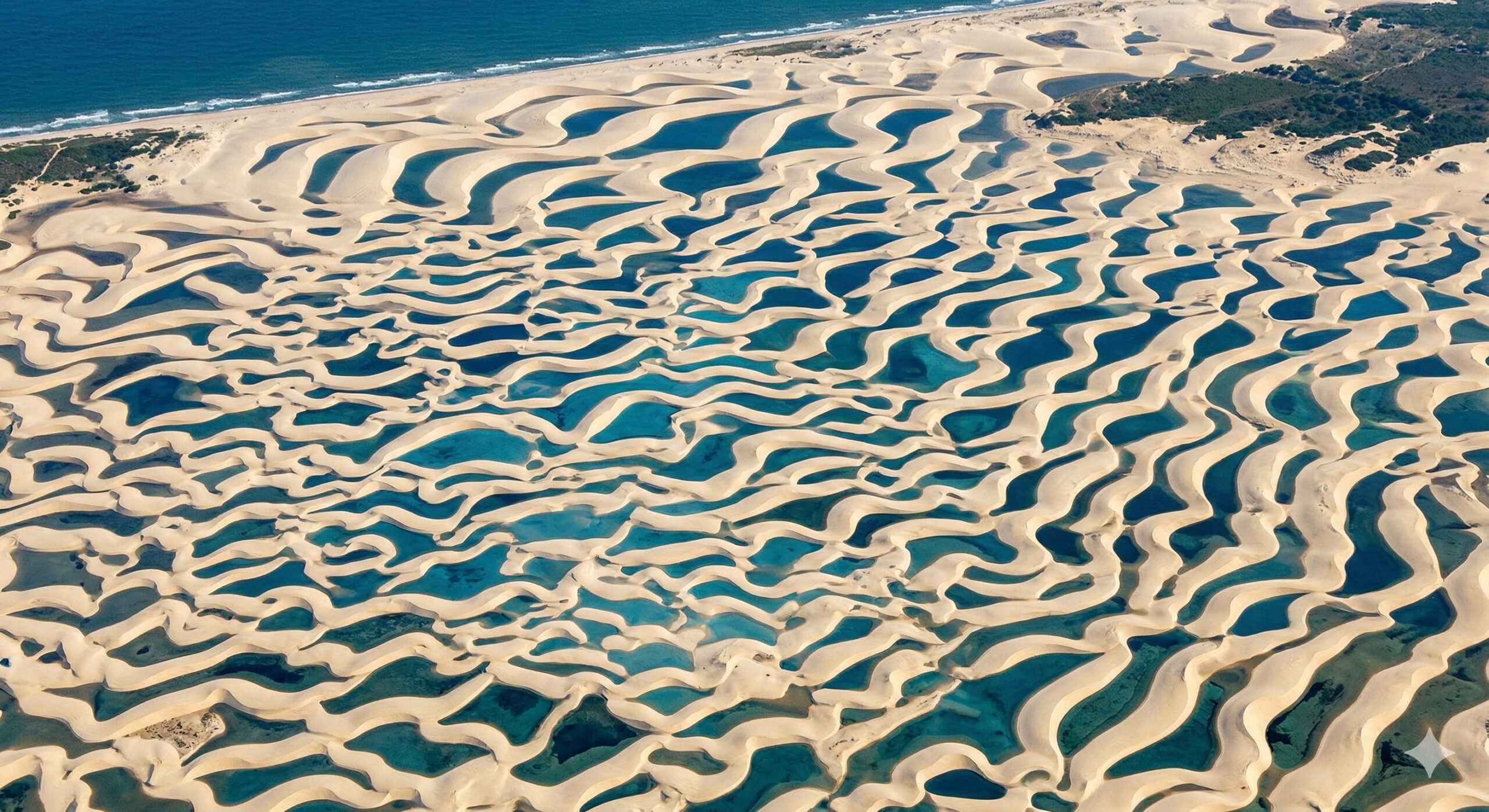
Lençóis Maranhenses form thousands of lagoons between moving dunes and create, seen from space, a blue mosaic that changes with each season.
Analyses based on satellite images and studies released by research institutions have once again highlighted what is already considered one of the most unusual geographical phenomena on the planet: the Lençóis Maranhenses, in northeastern Brazil. Located in the state of Maranhão and protected as a national park, the system occupies 156,562 hectares and brings together a vast set of moving dunes interspersed with temporary and permanent lagoons, forming a landscape that, at first glance, resembles a classic desert, but functions in a completely different way. According to the Unesco dossier on the Lençóis Maranhenses National Park, the area receives large volumes of water during the rainy season, resulting in the formation of inter-dunal lagoons and a continuous transformation of the landscape.
Unlike traditional deserts, the Lençóis Maranhenses receive intense seasonal rains, which raise the water table and allow the emergence of thousands of lagoons between the dunes. These lagoons appear in the rainy season and disappear in the dry season, creating a blue mosaic that is repeatedly redrawn throughout the year. According to a report from Revista Pesquisa FAPESP about physical and geomorphological studies in the region, more than 90% of the rain falls between January and July, when the water is quickly absorbed by the sand, raising the water table and filling the temporary lagoons between the chains of dunes.
This rare behavior on a global scale transforms the region into a natural laboratory for studies of hydrology, geology, and sediment dynamics. The literature highlighted by Pesquisa FAPESP shows that the unique shape of the Lençóis depends on the coincidence between the annual cycle of winds and the oscillation of the water table, while Unesco describes the park as a system of dynamic dunes and lagoons fed exclusively by rain, with dune migration that can reach 25 meters per year.
-
China wants to transform the space solar power plant into a source of clean energy, but a study reveals that the same microwave beams sent from orbit to Earth could also be used for electronic warfare, communication control, and large-scale military support.

-
Australian engineers have created a robot dolphin that cleans oil from the ocean by absorbing oil and repelling water at the same time with over 95% purity, and they are now working on versions the size of a real dolphin to operate autonomously at sea.

-
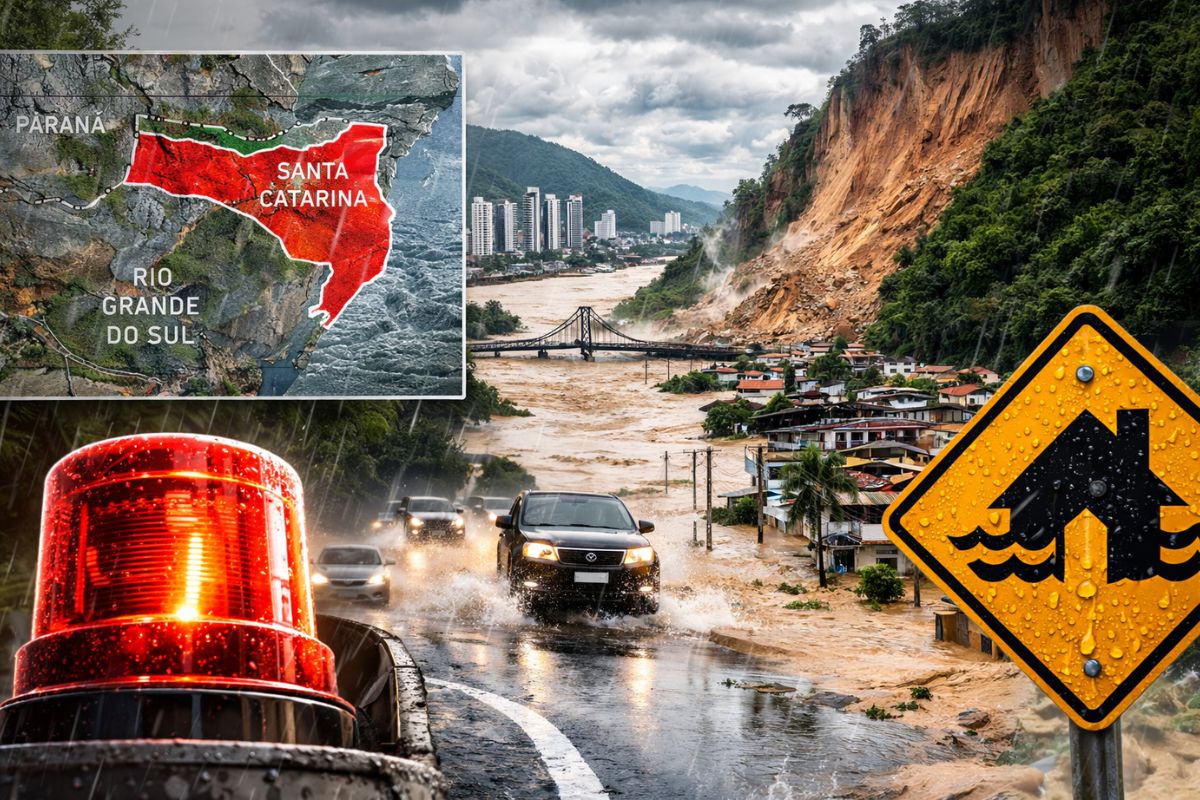
Civil Defense issues red alert for Santa Catarina with rainfall of up to 130 millimeters between Monday and Tuesday and very high risk of flooding, inundations, and landslides in the Itajaí Valley and Greater Florianópolis, which are already feeling the impacts.
-
A few kilometers from the equator, the Brazilian space base in Alcântara has a position that can drastically reduce rocket fuel, appears in satellite images, and rivals French Guiana, while bearing the weight of an explosion that killed 21 technicians and stalled the program for years.
Lençóis Maranhenses are not a desert and receive up to 2,000 mm of rain per year
Despite the visual appearance of a vast field of sand, the Lençóis Maranhenses cannot be classified as a desert. The region has rainfall indices that vary between 1,200 and 2,000 millimeters annually, values significantly higher than those observed in true deserts, where precipitation generally does not exceed 250 mm per year.
This characteristic places the Lençóis in a unique category: a system of dunes in a humid environment. The combination of sand, water, and wind creates a scenario that challenges traditional classifications of physical geography.


The sand that makes up the dunes is the result of geological processes linked to the erosion of sediments transported by rivers and the ocean, which over thousands of years have been accumulated and shaped by the action of the winds.
Dunes up to 40 meters move continuously and transform the landscape over time
One of the most striking elements of the Lençóis Maranhenses is the presence of dunes that can reach up to 40 meters in height. These formations are not fixed. They gradually shift with the action of the winds, continuously altering the region’s relief.
This movement has a direct impact on the formation and disappearance of lagoons. As the dunes advance, they can:
- bury old lagoons
- open new depressions
- modify the flow of water
This dynamic behavior means that the landscape observed in one year may not be the same in the following year, creating an environment in constant transformation.
Formation of lagoons depends on the combination of intense rains and a water table close to the surface
The emergence of lagoons in the Lençóis Maranhenses is directly linked to the interaction between seasonal rains and the water table. During the rainy period, which occurs mainly between the months of January and June, rainwater infiltrates the sand.
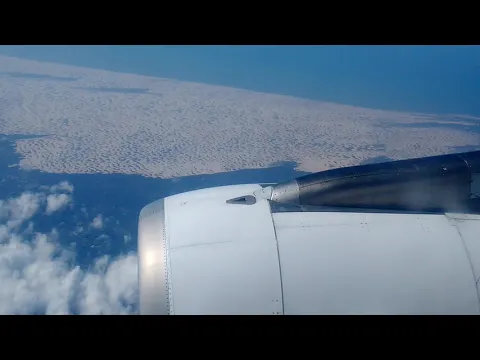
However, below this sandy layer lies a less permeable formation that prevents complete drainage of the water. This causes the liquid to accumulate in the depressions between the dunes, forming freshwater lagoons.
These lagoons can vary in size and depth, depending on the volume of rain and the terrain configuration at that moment.
Thousands of lagoons emerge in the rainy season and disappear during the dry season
During the peak of the rainy season, the Lençóis Maranhenses can host thousands of lagoons simultaneously. Some of them stand out for their size and depth, while others are smaller and more ephemeral.
With the arrival of the dry season, between July and December, intense evaporation causes these lagoons to gradually disappear. This cycle repeats every year, creating an alternation between periods of water abundance and phases in which the landscape is once again dominated by sand. This seasonal behavior is one of the factors that most contributes to the unique character of the region.
Seen from space, the Lençóis Maranhenses form a blue mosaic that changes with each season
When observed by satellites, the Lençóis Maranhenses reveal a visual pattern that cannot be perceived from the ground. The lagoons, distributed among the dunes, create blue spots that contrast with the white sand, forming a geometric mosaic in constant change.

This pattern varies over time:
- new lagoons emerge in different areas
- old lagoons disappear
- the shape of the spots changes as the dunes shift
This dynamic means that images captured in different years present distinct configurations, reinforcing the idea of a living landscape in continuous transformation.
The dynamics of sediments and winds explain the constant reorganization of the system
The movement of the dunes is a direct result of the action of the prevailing winds in the region. These winds transport sand particles, shaping and reshaping the structures over time.
Moreover, the interaction between wind, water, and relief creates a highly dynamic system, in which small adjustments can generate significant changes in the landscape.
This continuous process of reorganization makes the Lençóis Maranhenses an extremely sensitive environment to climatic and environmental variations.
Despite the seemingly hostile conditions, the Lençóis Maranhenses host various forms of life. Some species have developed specific strategies to survive in this seasonal environment.
Among the best-known examples is the fish known as cloud fish, which can survive buried in the sand during the dry period, waiting for the return of the rains to become active again. Additionally, migratory birds use the lagoons as stopover points, and adapted vegetation grows in the more stable areas of the system.
The scientific importance of the Lençóis Maranhenses goes beyond the visual landscape
The Lençóis Maranhenses are not just a visual spectacle. They also represent an important field of study for various scientific areas.
Researchers use the region to investigate:
- dynamics of dunes in humid environments
- behavior of water tables
- impacts of climate change
- adaptation of species to extreme environments
These studies help to understand not only the region itself but also similar processes in other parts of the world.
Environmental protection seeks to preserve one of the most unique systems on the planet
The Lençóis Maranhenses are protected as a national park, which ensures the preservation of their natural characteristics and limits human interventions that could compromise the balance of the system.
Conservation is considered essential, especially in the face of pressures such as:
- uncontrolled tourism
- climate change
- changes in rainfall patterns
The maintenance of this environment directly depends on the preservation of its natural processes.
A landscape that changes every year raises an inevitable question about the future of the phenomenon
The Lençóis Maranhenses demonstrate how natural factors can create complex and highly dynamic systems. The interaction between water, wind, and sand produces a landscape that is never exactly the same, even when observed in regular cycles.
In light of this scenario, a central question arises: to what extent can climate change or environmental alterations impact this balance and modify one of the most unusual natural phenomena on the planet?
Leave your analysis in the comments.








Seja o primeiro a reagir!