





 Portuguese
  English
  Spanish
  4 min of reading
  0 comments


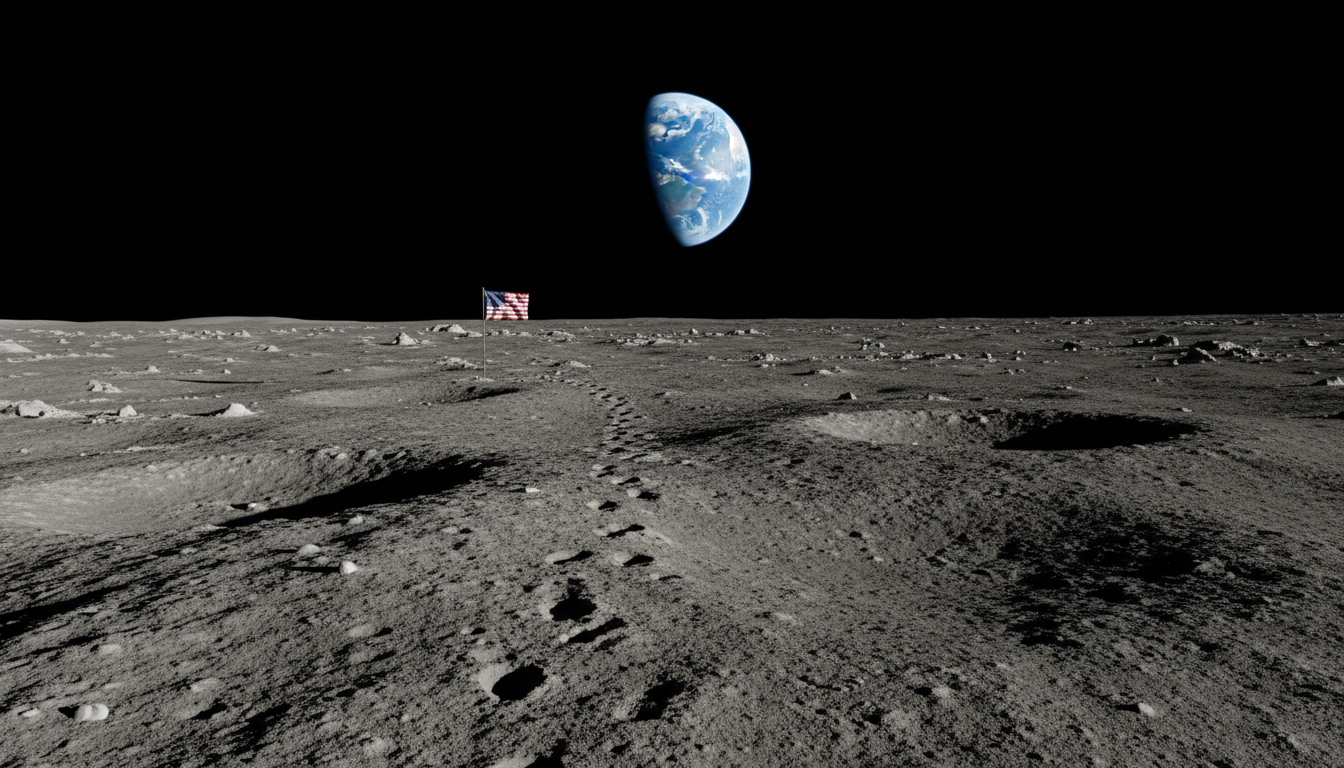
Only 12 human beings have walked on the Moon in six Apollo missions between 1969 and 1972, the last being over 50 years ago on Apollo 17 with Eugene Cernan, and the world stopped going due to budget cuts that reduced NASA’s share from 4% to 0.5% of the U.S. federal budget, until the Artemis II mission brought astronauts back from lunar orbit this week and paved the way for Artemis III to take the first woman to the surface.
Of all humanity that has ever existed — billions and billions of people — only 12 human beings have walked on the Moon. Therefore, it is a more exclusive club than any other in history.
The first time was on July 20, 1969, when Neil Armstrong descended from the lunar module and said the most famous phrase in history: “That’s one small step for man, one giant leap for mankind.”
The last time was in December 1972, when Eugene Cernan left the lunar surface on Apollo 17. After that, the world simply stopped going. For over 50 years.
-
Prairie chicken robots simulate mating dances and sounds in Wyoming to bring the species back to habitats and prevent breeding at Jackson Hole Airport after a decline from 73 to 3.

-
Tabarca, an 18th-century walled island with only 30 hectares and around 50 residents, lives isolated in the Mediterranean and now wants to separate from Alicante.

-
In Qatar, a strategic terminal at Hamad Port has been designed to store enough rice, sugar, and oil to supply 3 million people for up to two years, turning the port into one of the most secure food vaults in the Gulf.

-
A mason from Mato Grosso do Sul develops an unusual plastering technique that eliminates seams, reduces the time to three hours, and leaves the wall completely smooth.


The 6 times humanity walked on the Moon
The Apollo program conducted 11 crewed flights between 1968 and 1972. However, only 6 managed to land on the lunar surface. Thus, each mission took 2 astronauts to the surface while 1 remained in orbit.
Apollo 11 (1969) was the first. Armstrong and Buzz Aldrin spent 21 hours and 30 minutes on the Moon and collected 21.5 kg of rocks.
Apollo 12 landed just 163 meters from the target — an incredible precision for 1969. Additionally, Apollo 14 became famous because Alan Shepard played golf on the Moon.
Apollo 15 took the first lunar rover — the Rover — which traveled 27 km across the surface. Apollo 17 broke all records: 75 hours on the Moon, 22 hours of walks, and 115 kg of samples collected.
And Apollo 13? Almost a tragedy. An explosion in the oxygen tank aborted the landing, but the 3 astronauts returned alive. Therefore, it was called a “successful failure.”

The 12 humans who walked on the Moon
The complete list of the 12 astronauts who walked on the lunar surface:
Neil Armstrong and Buzz Aldrin (Apollo 11, 1969). Pete Conrad and Alan Bean (Apollo 12, 1969). Alan Shepard and Edgar Mitchell (Apollo 14, 1971). David Scott and James Irwin (Apollo 15, 1971). John Young and Charles Duke (Apollo 16, 1972). Eugene Cernan and Harrison Schmitt (Apollo 17, 1972).
Schmitt was the first and only scientist (non-military pilot) to walk on the Moon. However, most were test pilots with military experience.

Why the world stopped going to the Moon for over 50 years
The answer is simple: money. At the height of the Apollo program, NASA consumed 4% of the U.S. federal budget. After Apollo 17, that number fell to 0.5%.
Additionally, the Cold War was losing intensity. Therefore, the political motivation for the space race disappeared along with the budget.
The entire program cost $25.4 billion at the time — equivalent to $280 billion in current values. Thus, it generated 400,000 jobs and advancements in computing, materials, and medicine.
But the bill was too high for a country facing the Vietnam War and internal economic problems. And so, for over half a century, no one returned.
Until this week when NASA showed that the return has finally begun
The Artemis II mission has just brought 4 astronauts back from lunar orbit. Therefore, it is the first time in 53 years that humans have seen the Moon up close.
The next step is Artemis III, which plans to land at the lunar south pole. Thus, Christina Koch could become the first woman to walk on the lunar surface.
The Artemis program has already cost $93 billion. However, this time NASA says it will not just visit — it wants to stay permanently.
“Artemis will take us back to the Moon to stay permanently,” said Bill Nelson, NASA administrator.
To understand the engineering behind the return, see how advanced robotics technology is already operating in extreme conditions on Earth.

The difference between 1969 and 2026
In Apollo 11, the onboard computer had less processing power than a modern calculator. However, it put two men on the Moon and brought them back.
The Artemis Orion capsule is another story. It re-entered the atmosphere at over 30,000 km/h and withstood temperatures that melt steel.
China plans crewed missions for 2030. India landed Chandrayaan-3 in 2023. The space race is back — and this time it’s not just the U.S. vs. the USSR.
From 12 people in all of human history to a new era of lunar exploration. Fifty years of silence are coming to an end — and the next footprint on the Moon could be that of a woman.








Seja o primeiro a reagir!