





 Portuguese
  English
  Spanish
  5 min of reading
  0 comments


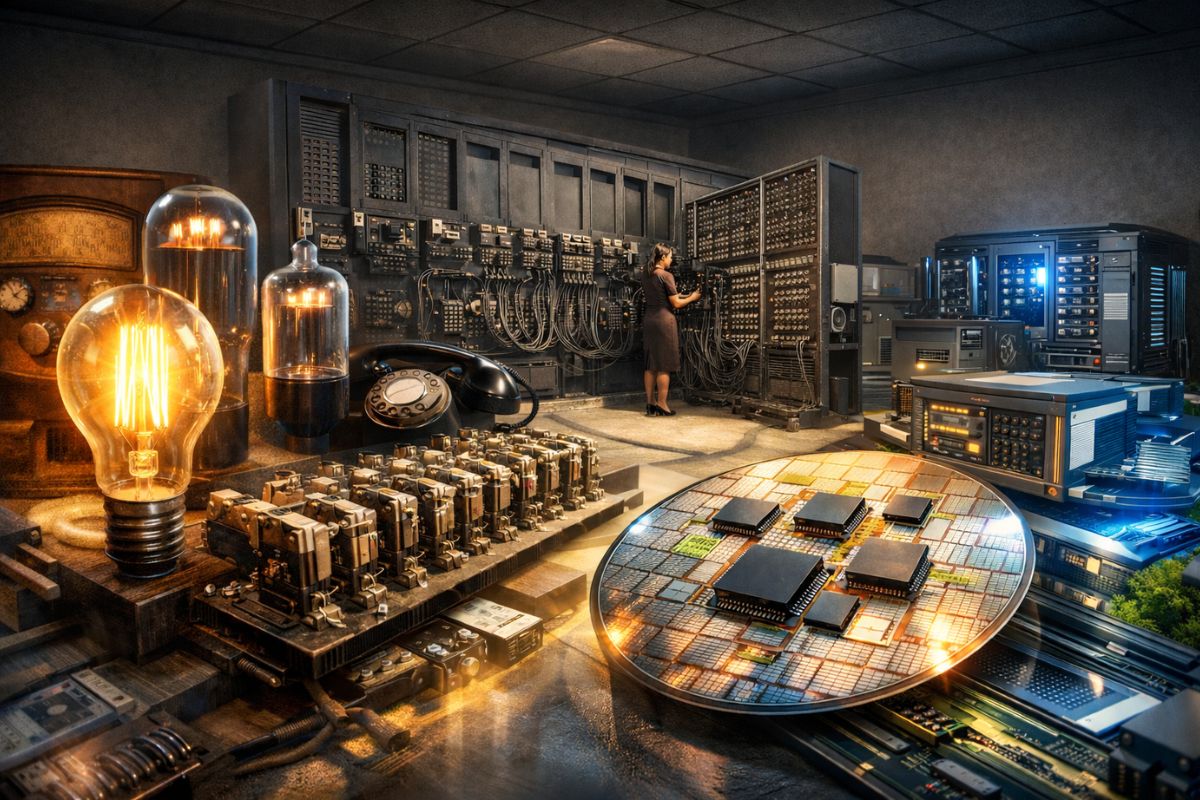
Understand how an observation inside a lightbulb led to diodes and tubes, amplified radio and telephony, and birthed the first giant digital computers.
The modern era of electronics began with a lightbulb, and this ultimately changed the fate of computers. The turning point was realizing that, in addition to light and heat, a heated filament could also “release” electrons and create a usable physical effect.
From there, the evolution was stepwise, diode, triode, amplification, relays, and logic, until it reached huge, noisy machines that were hungry for energy. And at the end of this path came the idea that would make modern computers possible: to perform the same trick with electrons, but within a solid material, in silicon.
The lightbulb and the clue no one expected

The first lightbulbs had a carbon filament sealed in a vacuum glass bulb. With an applied potential difference, the current passed through the filament, heating it to over 1700°C until it glowed.
-
With more expensive oil and the risk of shortages, China is expanding the use of technology developed in Germany during World War II that transforms coal into plastics, fuels, and chemical products.

-
Toxic plant of 4 meters, banned in Spain, is already taking over gardens and parks in Thuringia, Germany: volunteers say that pulling it out is not enough, roots sprout again and seeds last for years; residents are asking for glyphosate to eradicate it.

-
Get the coat ready: after an extratropical cyclone brought storms to Brazil, an intense cold air mass is arriving in the country with lows of 0°C in the South and isolated frosts that could reach as far as the Southeast over the weekend.

-
The South American bird that seems to carry a natural “Sharingan” has intense red eyes that shine like glass in the water and makes the small diver one of the most unusual sights in the lakes of South America.

The vacuum was essential because, with oxygen, the filament would burn out quickly. Still, the lifespan cited for the first lightbulbs was only 116 hours.
The detail that paved the way for everything came from an observation by Thomas Edison: over time, the glass of the bulb would turn yellow and then brown, but only on one side.
The explanation is that the heated filament emitted electrons, and in direct current, these electrons were attracted to the positive side, accelerated, and collided with the glass, discoloring it there. This clue set the stage for the electronic revolution that would lead to the first digital computers.
Edison Effect and thermionic diode: the “one-way street” of electricity

The phenomenon of emitting electrons from a heated filament was already known as thermionic emission, but it gained notoriety after Edison, to the point of being called the Edison effect for a time.
In 1904, John Ambrose Fleming patented a device similar to the lightbulb, but with a second electrode inside the bulb.
When this plate was positive relative to the filament, electrons crossed the gap and closed the circuit. If the plate was negative, it would repel electrons and there would be no current. It was a one-way street, and that’s why the device became known as a thermionic diode.
This diode was used to detect radio signals and also to convert alternating current into direct current. By combining diodes and a capacitor, it was possible to obtain a relatively stable direct current, a practical step that would support many applications before electronic computers matured.
The triode and the amplification that unlocked radio and telephony

At the beginning of the 20th century, the major obstacle was amplifying weak signals. Radio had a limited range due to a lack of reliable amplification equipment. And phone calls, according to the base, were limited to about 13 km because the signal weakened too much.
Relays helped in telegraphy, amplifying dots and dashes of Morse code, but the binary output did not handle analog and complex signals well, such as radio waves and voice.
The turning point came in 1906 when Lee de Forest added a third electrode to the diode: a wire grid between the cathode and the anode. The triode was born.
The logic of the triode is elegant: a large potential difference could exist between the anode and cathode, but the actual flow of electrons was controlled by the voltage on the grid.
A small variation on the grid controlled a much larger variation at the anode, allowing high-frequency amplification. This technology made possible, for example, the first transcontinental call from New York to San Francisco on January 25, 1915.
Relays, boolean algebra, and the idea of “doing mathematics with circuits”

The bridge between electronics and logic took shape in 1937 when Claude Shannon described the connection between electrical circuits and boolean algebra. In the boolean system, true becomes 1 and false becomes 0, and operations like AND can be represented by circuits.
In the same year, George Stibitz built a digital calculator that added two one-bit binary numbers using a relay. The inputs were switches, open meaning 0 and closed meaning 1. The output appeared on bulbs. The setup became known as the “kitchen model” because it was made in an improvised manner, with simple parts.
The circuit became known as a half adder and can be interpreted as logic gates: an XOR and an AND, exactly the type of basic block that would allow scaling from demonstrations to real computers.
The leap from electromechanical computers to larger machines
By connecting more half adders and relays, it was possible to build circuits capable of more advanced calculations. Stibitz and colleagues created the Model One with over 400 relays, capable of adding two eight-digit numbers in about one-tenth of a second and multiplying eight-digit numbers, although more complex operations took longer.
But the limit of relays appeared quickly. The relay is mechanical, opening and closing physical contacts. This brings wear, slowness, and a lot of noise.
For an office environment or the future of computing, the solution needed to be an electronic switch with no moving parts.
ENIAC: the electronic computer that occupied a room

The triode valve was not just an amplifier: it could also act as a switch. With the grid very negative, no current flows, the state is 0. With the grid very positive, maximum current flows, the state is 1. This switch happens without moving parts and without the noise of relays, simply controlling electrons in a vacuum.
This path led to the ENIAC, which first went into operation on December 10, 1945. It occupied an entire room, weighed 30 tons, and consumed 175 kW. There is a rumor that when it turned on, the lights in Philadelphia dimmed, but the base claims this was a rumor because the ENIAC had its own generator to support the high consumption.
The ENIAC was programmable and fast for its time, performing 500 operations per second. And here is a historical detail: at that time, “computers” could still refer to people doing calculations with paper and pencil, so this leap in speed was decisive in consolidating computers as machines.
Why valves could not be the final destination
Despite the advancement, valves had significant flaws. The filaments needed to be constantly heated, consumed energy even at rest, were large, and unreliable. The base mentions that, in the ENIAC, on average one valve broke every few days, requiring locating and replacing the part.
This created the need for a solution that would perform the same job of controlling electrons, only within a solid piece of material, paving the way for silicon and the next era of computers.
In your opinion, was the most impressive leap the triode amplifying signals or the ENIAC transforming electronics into programmable computers?








Seja o primeiro a reagir!