





 Portuguese
  English
  Spanish
  5 min of reading
  0 comments


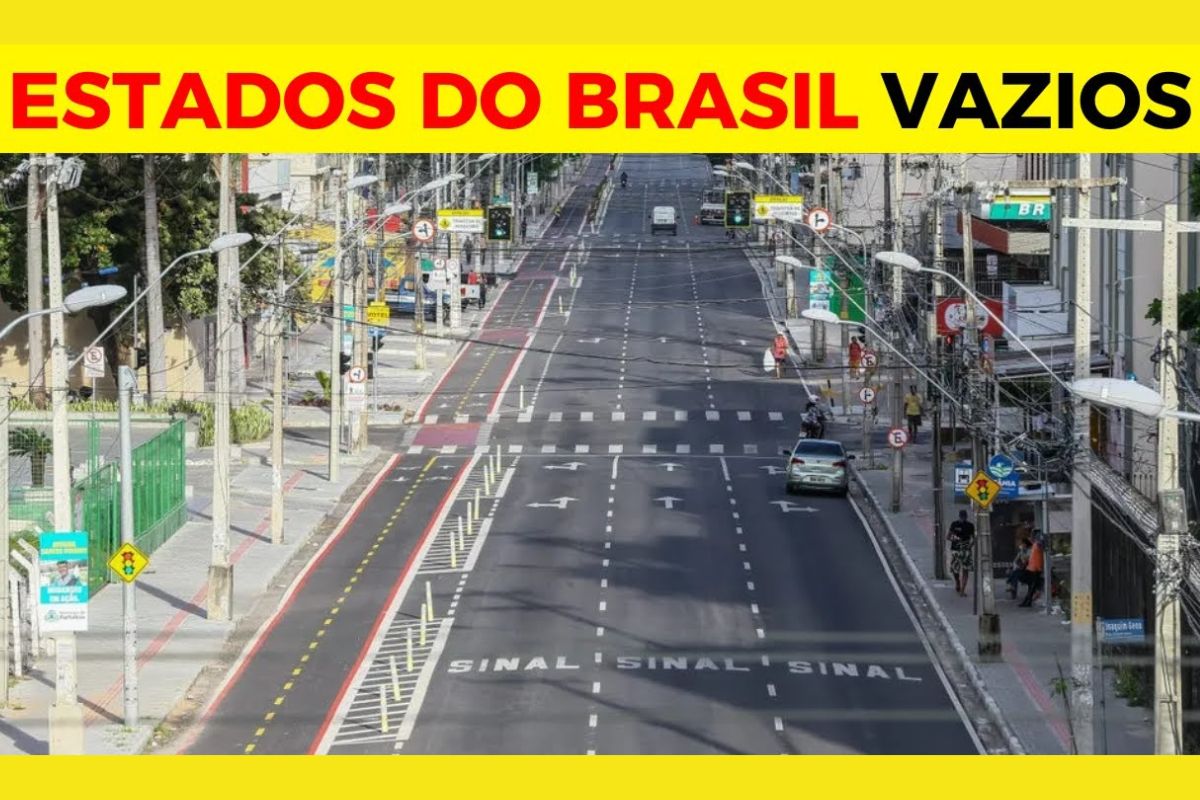
While The Southeast And Midwest Attract New Residents, Five States Face Population Decline, Structural Unemployment, And Young People Leaving In Search Of Opportunities.
The recent demographic portrait of the country reveals a Brazil of contrasts. While some states increase their population with the expansion of agribusiness, industry, and services, others face a silent process of depopulation. Internal migration, which has been moving millions of Brazilians towards more developed regions for decades, remains active and its effects are now concentrated in states that cannot retain their inhabitants.
According to regional data and demographic projections, Roraima, Rondônia, Acre, Alagoas, and Piauí form the group of five states with negative migratory balance. In common, they face poor infrastructure, low economic diversification, and dependence on the public sector. Below is a detailed analysis of each case and the challenges that keep part of the country in a state of population shrinkage.
Roraima: The Geographical Isolation And Migratory Pressure
In the far north of Brazil, Roraima is the least populous state in the country and one of those that suffers the most from the difficulty of national integration. Despite having a large territorial area rich in natural resources, its road and economic infrastructure is limited.
-
Attracting around 250,000 people a year, a lighthouse 200 meters from the sea, on a 60-meter high cliff, on the North Sea coast in Denmark, becomes one of the most impressive examples of how nature can threaten historical buildings.

-
The narrowest house in the world is only 63 centimeters wide, but inside it can accommodate a bathroom, kitchen, bedroom, office, and even two staircases.

-
In the middle of the sea, these enormous concrete and steel structures, built by the British Navy to protect strategic maritime routes, look like they came straight out of a Star Wars movie.

-
For years, no one could cross a neighborhood in Tokyo because of the tracks, but an impressive solution changed mobility and completely transformed the local routine.

The capital Boa Vista, the only Brazilian city located entirely north of the equator, concentrates the majority of the state population, leaving the interior with almost zero density.
Connections with other states mainly depend on the BR-174, which is frequently interrupted by rain and logistical failures.
In addition, the migrant crisis on the border with Venezuela overloads public services and heightens social tensions.
Even with underutilized tourism potential and vast natural reserves, Roraima continues to have a low capacity for job creation and strong dependence on federal transfers.
The result is the flight of qualified youth and an economy that remains stagnant.
Rondônia: The Interrupted Cycle Of The Agricultural Border
During the 1970s and 1980s, Rondônia was a symbol of the expansion of the Amazon frontier, attracting thousands of families in search of fertile land.
However, after the peak of the colonization cycle, the state began to face economic stagnation and gradual population loss.
Although Porto Velho maintains relative urban structure, much of the territory consists of medium and small cities with inadequate infrastructure.
The almost exclusive dependence on agribusiness, especially livestock and grain production, exposes the state to market fluctuations and the lack of productive diversification.
Additionally, land conflicts, intense deforestation, and the absence of industrial hubs limit the attraction of new investments. The lack of universities and technological centers also drives many young people to migrate to more developed regions.
Acre: The Weight Of Isolation And The Little Diversified Economy
Acre is one of the most isolated states in the country. Surrounded by forest and distant from major urban centers, it relies on highways that are often impassable during the rainy season.
This limitation raises product prices, reduces competitiveness, and restricts the growth of productive sectors.
With low population density and an economy based on public service, the state has little industrial presence and reduced participation from private companies.
The agricultural sector is still poorly mechanized, and commerce operates on a limited scale.
Although Acre preserves one of the largest biodiversities on the planet, its geography and federal budget dependence hinder the development of robust infrastructure.
The result is a constant exodus of young and qualified professionals, especially towards Amazonas and Rondônia.
Alagoas: Inequality, Insecurity And Historical Dependence
In the Northeast, Alagoas occupies a delicate position: it is one of the smallest states in the country, but ranks among those with the highest rates of poverty and social inequality.
Tourism boosts the economy of the capital, Maceió, but the interior remains marked by a lack of services and opportunities.
A large part of the economic activity still depends on the public sector and traditional agribusiness, especially sugarcane-related activities.
The absence of industrial and technological hubs restricts the creation of qualified jobs, while urban violence and insecurity continue to be barriers to families and investments settling.
Since the last century, Alagoas has had a negative migratory balance, with successive generations leaving the state in search of better conditions in the Southeast and other northeastern capitals.
Piauí: The State That Loses The Most Population In The Country
Among all, Piauí suffers the most from population exodus. Located in the heart of the Northeast, the state has lived for decades with low economic dynamism and limited industrialization.
The economy revolves around agriculture, public administration, and services concentrated in Teresina, while the interior remains dependent on social programs and federal transfers.
The deep regional inequalities undermine access to education, health, sanitation, and employment.
With few local prospects, thousands of Piauí residents continue migrating to São Paulo, Goiás, and the Federal District, perpetuating the cycle of evasion.
Even with recent advances in infrastructure and education, Piauí still faces difficulties retaining its young population—a challenge that threatens demographic balance and long-term development.
The five states represent the most vulnerable face of unequal Brazil, where geography, economic structure, and concentration of investments determine the fate of millions of Brazilians.
The population depletion in these regions reinforces the need for policies of regional integration, productive innovation, and decentralization of opportunities.
Without stimulating the local economy and improving infrastructure, the trend is that the migratory cycle will repeat itself, widening the disparities between the North, Northeast, and the rest of the country.
Do you believe that stronger regional policies could reverse the population exodus from these states? Leave your opinion in the comments and participate in the debate about the future of the Brazilian population.






-

Uma pessoa reagiu a isso.