





 Portuguese
  English
  Spanish
  5 min of reading
  0 comments



Novel model of the Earth’s interior reveals structures similar to tectonic plates up to 1,200 km deep.
In 2024, researchers from ETH Zurich and Caltech, with the participation of geophysicist Andreas Fichtner, published in the journal Scientific Reports a new high-resolution seismic model of the Earth’s interior. The study combined global seismic data with advanced full-waveform inversion techniques to more accurately reconstruct deep regions of the Earth’s mantle that had previously been known mainly indirectly.
The analysis revealed the presence of dense, elongated structures that behave like subducted tectonic plates, located at depths of approximately 900 to 1,200 kilometers. This finding is noteworthy not only for its depth but mainly for the location of these structures, as several appear beneath large oceans and continental interiors where there is no geological record of subduction compatible with traditional tectonic models, opening a new discussion about the composition and dynamics of the lower mantle of the Earth.
Full-waveform inversion technique allowed for more accurate reconstruction of the mantle
The central advancement of the study lies in the use of the technique known as full-waveform inversion, considered one of the most sophisticated approaches in modern geophysics.
-
Solar panels now use rain as an ally in a system that captures light and the impact of raindrops simultaneously to generate energy.

-
Considered almost extinct and found in only three municipalities in Ceará, one of the rarest birds on the planet has just recorded 12 nests and the birth of healthy chicks in the Chapada do Araripe, renewing hope that the species can still be saved.

-
The coffee that has already been repurposed into biofuel, concrete, and roadworks now takes on a new unexpected function: becoming a sustainable insulator with six times greater capacity and real potential to replace petroleum-derived foams.

-
Hidden in a 75-hectare forest within a university in Minas Gerais, a newly discovered fungus reprograms the brains of spiders, turns the victims into obedient zombies, and forces them to die exactly where it needs to spread its spores.

This method utilizes the complete behavior of seismic waves — including amplitude, frequency, and propagation time — to infer the physical properties of the planet’s interior. Unlike traditional methods that analyze only parts of this information, full inversion allows for the reconstruction of much more detailed images of the Earth’s mantle.
To enable this level of processing, the researchers used high-performance infrastructure, including supercomputers like Piz Daint, capable of processing massive volumes of global seismic data.
The result was a model with significantly higher resolution than previous ones, revealing patterns that were previously invisible.
Identified structures resemble subducted tectonic plates
The generated images show regions of high seismic velocity, typically associated with colder, denser materials. This type of signature is characteristic of tectonic plates that have been pushed into the planet’s interior in subduction zones.

These plates, over millions of years, sink into the mantle and can reach extreme depths. What surprised researchers was the fact that some of these structures appear in locations where there is no known active subduction.
Among the highlighted regions, one of the most impressive is beneath the Pacific Ocean, where deep structures have been identified in the range of 900 to 1,200 kilometers.
Presence in unexpected regions suggests more complex geological processes
The discovery does not indicate that these structures arose inexplicably, but rather that current models of mantle dynamics may be incomplete.
There are several hypotheses to explain these formations:
- they may be remnants of ancient tectonic plates that sank tens or hundreds of millions of years ago
- they may have been laterally transported by convection currents in the mantle
- they may represent fragments of tectonic events that are not fully recorded on the surface
This scenario reinforces the idea that the Earth’s interior is a dynamic and complex system, with processes operating on timescales much greater than human history.
Depth of structures reveals long-term dynamics of the planet
The range between 900 and 1,200 kilometers deep corresponds to regions of the lower mantle, near the so-called transition zone. In this region, pressure and temperature are extremely high, altering the behavior of materials.
The presence of plate-like structures at this depth indicates that parts of the Earth’s crust may remain preserved in the planet’s interior for extremely long periods.
This type of evidence is crucial for understanding:
- how heat is transported from the Earth’s interior
- how tectonic plates evolve over time
- how internal dynamics influence surface phenomena
Discovery reinforces the importance of seismic tomography in modern geophysics
Seismic tomography, a technique used to “see” the Earth’s interior, works similarly to medical exams that use waves to map internal structures.
In the case of the planet, earthquakes act as natural sources of seismic waves, which travel through the Earth’s interior and are captured by sensors around the world.
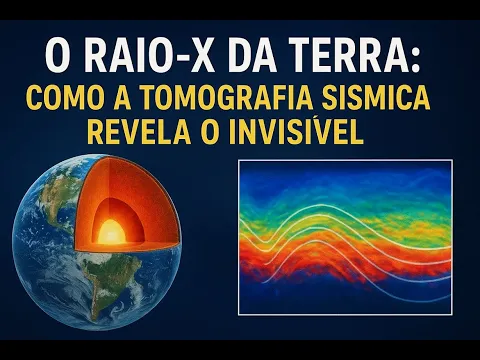

By analyzing how these waves propagate, scientists can infer properties such as:
- density
- temperature
- rock composition
With the use of full-waveform inversion, this process has become even more precise, allowing for the identification of details that were previously overlooked.
Metaphor used by researchers illustrates surprise at the results
During the study’s disclosure in outlets such as Live Science and Phys.org, researchers compared the discovery to the experience of a doctor who, after decades studying the human body, finds an unexpected structure in the circulatory system.
The analogy does not represent an impossible anomaly, but rather the impact of observing patterns that were not anticipated in existing models.
This type of discovery is common in areas where knowledge depends on indirect inferences, as is the case with deep geophysics.
Results indicate that current models of the mantle may need revision
The presence of these structures in regions not associated with current subduction zones suggests that the models used to describe the behavior of the Earth’s mantle may need adjustments.
This does not invalidate existing knowledge, but indicates that:
- the dynamics of the mantle may be more complex than previously thought
- ancient tectonic events may have left deep marks that are not yet fully understood
- internal circulation processes may redistribute material over large distances
This type of revision is a natural part of scientific advancement, especially in areas where direct observation is not possible.
Study expands understanding of the geological history of the planet
By revealing deep structures associated with ancient tectonic plates, the study contributes to reconstructing the geological history of the Earth.
This evidence helps answer fundamental questions, such as:
- where ancient plates ended up after millions of years
- how the planet’s interior has evolved over time
- which processes shaped the current configuration of the Earth’s crust
Each new piece of information obtained at this depth enhances understanding of how the planet functions as an integrated system.
Discovery raises new questions about what is still hidden in the Earth’s interior
Despite the significant advancement represented by this model, the results also reinforce a central reality of geophysics: much of the Earth’s interior remains unknown.
With the increase in computational capacity and the development of new techniques, it is likely that other unexpected structures will be identified in the coming years.
In light of this, a question remains open for science: how many other “hidden layers” still exist beneath our feet, waiting to be revealed by technologies that continue to evolve?






Seja o primeiro a reagir!