





 Portuguese
  English
  Spanish
  6 min of reading
  0 comments


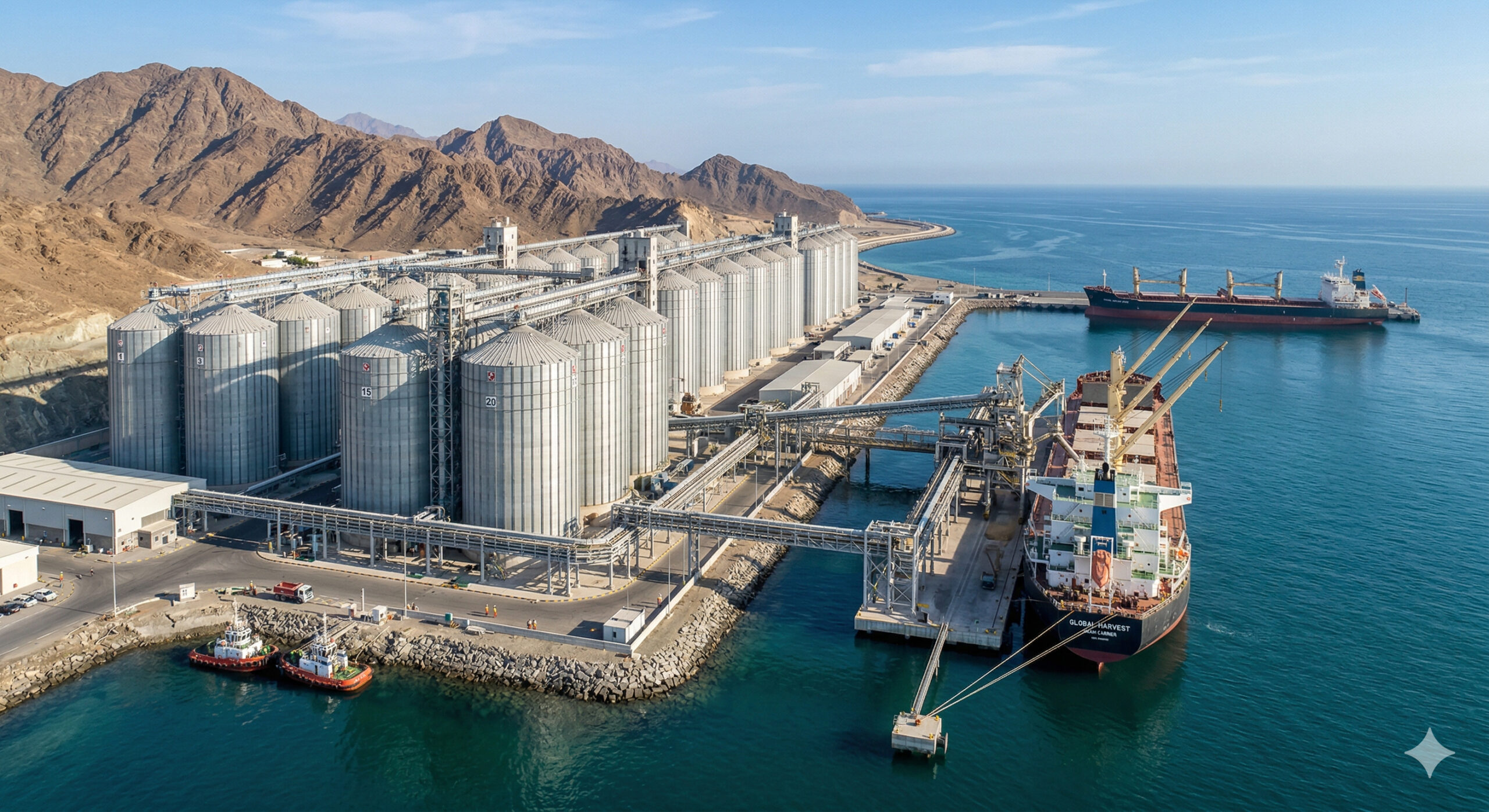
With a capacity of 300,000 tons, silos in Fujairah strengthen food security outside the Strait of Hormuz and gain a global strategic role.
In 2018, Reuters highlighted one of the most strategic structures ever built by the United Arab Emirates to ensure food supply in one of the most sensitive regions of the planet. Located in the emirate of Fujairah, outside the Strait of Hormuz, the complex was presented as part of a deliberate strategy to reduce logistical risks on a route that carries a critical portion of regional trade. The facility consists of a grain terminal with a capacity of about 300,000 tons, operated by Al Dahra at the port of Fujairah. According to the Port of Fujairah, the system comprises 20 silos and functions for both strategic reserves and commercial use, with a port connection aimed at the import, storage, and redistribution of grains. The central objective is clear: to ensure continuous access to food even in scenarios of geopolitical crisis, maritime blockades, or trade disruptions.
This infrastructure has placed Fujairah in a position similar to that which the emirate already occupies in the energy sector, but now with a new role: to act as one of the main points of food security in the Gulf and the Middle East, precisely because it faces the Indian Ocean and can be accessed without crossing the strait.
The Strait of Hormuz represents one of the largest logistical bottlenecks on the planet
The Strait of Hormuz is widely recognized as one of the most strategic maritime corridors in the world. Although it is best known for oil transport, the route is also essential for the flow of food and basic supplies that feed the Gulf countries.
-
Little known, the Veryovkina cave is considered the deepest in the world, with over 2,200 meters, defying any comparison.
-
Famous singer and Chinese manufacturer enter the dirty list of slave labor; operation rescues 14 employees on a farm in Goiás and 220 workers at a construction site in Bahia; punishment is a fine.
-
Cell phones in schools: learn how a year after the ban, students and teachers are already noticing positive effects and recording improvements in academic performance with increased attention and active participation.

-
Couple transforms industrial garage into dream home with 5 bedrooms, sauna, garden, and leisure area after million-pound renovation in England.

Any instability in the region — whether due to political tensions, conflicts, or military risks — can compromise the supply for millions of people. The dependence on a single route for food imports has always been seen as a critical vulnerability for countries with low internal agricultural production, such as the United Arab Emirates.
It was precisely this structural fragility that motivated the construction of the silos in Fujairah. By positioning storage outside the strait, the country creates a logistical alternative capable of maintaining the flow of supplies even in adverse scenarios.
The capacity of 300,000 tons transforms Fujairah into a strategic grain reserve
The storage capacity of 300,000 tons of grains places the Fujairah complex among the largest in the region. This scale allows large volumes of wheat, corn, and other cereals to be kept in stock for long periods, ensuring stability in supply.


In practical terms, this volume is sufficient to sustain the consumption of entire populations for months, depending on the level of demand. This type of reserve acts as a buffer against shocks in the global market, such as climate crises, logistical disruptions, or sudden price increases.
The construction of silos of this magnitude follows a global trend, where countries seek to increase their food autonomy in an increasingly unstable scenario.
Port infrastructure integrates storage and large-scale distribution
The Fujairah complex was not designed solely for grain storage but to integrate the entire logistics chain of import and distribution. Bulk carriers can unload directly at the port, where the grains are transferred to the silos by automated systems.
Subsequently, these products can be redistributed to different regions by land or sea. This integration reduces the time between arrival and distribution, increasing system efficiency and minimizing operational losses.
Moreover, proximity to international maritime routes facilitates access to global suppliers, expanding supply flexibility.
The food strategy of the United Arab Emirates responds to the dependence on imports
The United Arab Emirates imports most of the food it consumes due to the desert climate conditions that limit local agricultural production. This dependence makes the country particularly vulnerable to disruptions in international trade.
To mitigate this risk, the government has adopted a long-term strategy focused on food security, which includes investments in infrastructure, international partnerships, and the acquisition of agricultural assets abroad.
The Fujairah silos are a centerpiece of this strategy, allowing the country to maintain strategic stocks and respond quickly to supply crises.
Location outside the Gulf ensures greater resilience in crisis scenarios
One of the main advantages of the Fujairah complex is its location outside the Persian Gulf. This means that the grains stored there can be accessed without depending on the Strait of Hormuz, significantly reducing logistical risk.
This feature transforms the location into a kind of “food vault” protected against regional instabilities, ensuring continuity in supply even in extreme situations.
This approach reflects a broader shift in how countries are planning their food security, prioritizing redundancy and diversification of routes.
Food security gains strategic status comparable to oil
Historically, oil has always been the main strategic focus of the Gulf region. However, in recent years, food security has increasingly occupied a relevant space in public policies.
Recent global crises, including supply chain disruptions and extreme weather events, have highlighted the fragility of the international food system. In this context, structures like the Fujairah silos assume importance comparable to that of energy infrastructures, serving as a guarantee of internal stability.
This shift in priority shows how the concept of national security is expanding to include aspects beyond energy and defense.
Rapid response capacity reduces the impact of global shocks on supply
The existence of large stocks allows governments to respond quickly to crises, releasing grains into the domestic market to avoid shortages and price increases.
This type of mechanism is essential to maintain economic and social stability, especially in regions highly dependent on imports, such as the Gulf.
Moreover, the storage capacity allows countries to take advantage of lower prices in the international market to build up stocks, reducing long-term costs.
The Fujairah project is not an isolated case. Several countries around the world have been investing in storage infrastructure to strengthen their food security.
This trend reflects a structural change in the global system, where the predictability of supply is becoming increasingly uncertain due to factors such as climate change, conflicts, and economic volatility.
The construction of large-scale silos is a direct response to these challenges, allowing greater control over stocks and food flows.
Fujairah expands its strategic role beyond the energy sector
Traditionally known as an energy hub, Fujairah has been expanding its relevance to other strategic sectors, including food.
The combination of port infrastructure, geographical location, and storage capacity places the emirate in a unique position on the global stage. This diversification reinforces its importance as a critical point in international logistics, both for energy and for food.
The construction of silos with capacities of hundreds of thousands of tons shows how seemingly invisible infrastructures can have a direct impact on the stability of nations.
In a world where supply chains are becoming increasingly complex and interdependent, the ability to store and manage large volumes of food becomes a decisive factor in preventing humanitarian and economic crises.
These structures serve as an additional layer of security, protecting populations against external shocks.
Did you know that giant grain reserves can be as strategic as oil reserves?
Leave your opinion in the comments and tell us if structures like the Fujairah silos should become standard in other countries that depend on food imports.







Seja o primeiro a reagir!