





 Portuguese
  English
  Spanish
  5 min of reading
  0 comments


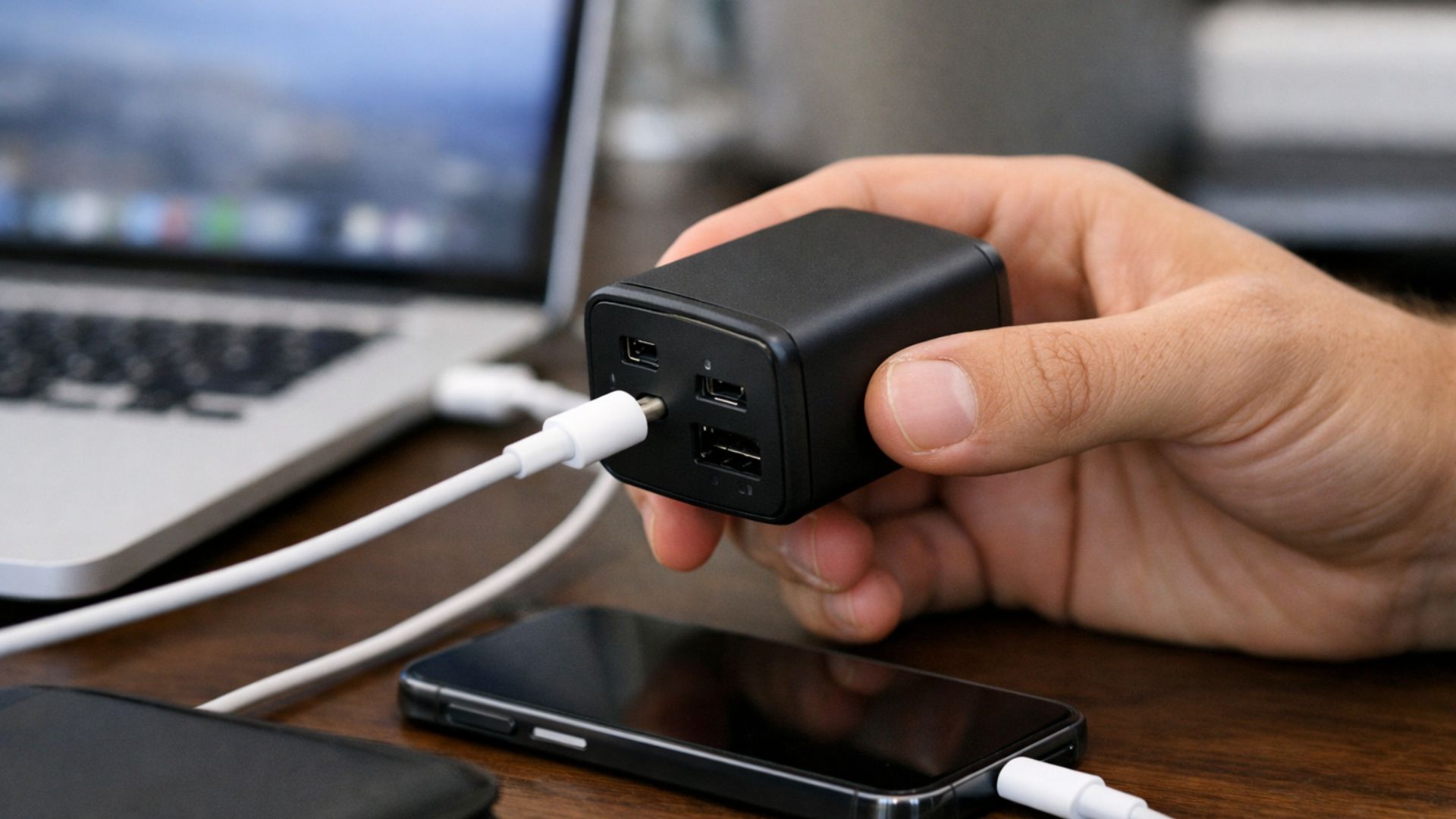
GaN technology transforms chargers into compact, powerful, and versatile solutions for multiple devices, driven by the advancement of USB-C and the search for energy efficiency in digital day-to-day life.
Chargers with GaN technology, short for gallium nitride, have started to gain traction by combining more power, smaller size, and the ability to power multiple devices simultaneously with a single adapter, something that until recently required different separate sources.
With the expansion of USB-C and the USB Power Delivery standard, which supports up to 240 watts in compatible cables and connectors, this movement has intensified and paved the way for a single charger to serve, in specific scenarios, a smartphone, tablet, and laptop.
Technical advancement of GaN improves energy efficiency
More than just a change in format, the evolution is directly linked to the material used inside the devices, as GaN allows for greater efficiency in energy conversion and reduces losses during operation.
-
New high-end condominium in Campo Grande comes under scrutiny for being too close to an archaeological site and may have construction affected.

-
Researchers transform food waste into a material stronger than concrete, made without cement, using cabbage, peels, and coffee grounds, which can still be consumed in an emergency.

-
A 3,000-year-old city found in a “hidden treasure” in Uzbekistan reveals a preserved wall, interconnected rooms, and artifacts that help explain how urban life emerged along the ancient Silk Road.

-
Central Asian country will install devices capable of inducing artificial rain to combat drought and extreme heat, and the project could completely change the air quality in the region by 2027 using large-scale cloud seeding.

According to Texas Instruments, solutions based on this semiconductor can achieve efficiency greater than 95% and also simplify thermal control, which reduces the need for larger structures for heat dissipation.
On the other hand, Infineon highlights that its GaN transistors operate at higher frequencies, require smaller components, and contribute to lighter and more compact designs, maintaining high performance even in reduced sizes.
Smaller size and more power change daily use

When compared to traditional silicon models, the GaN charger stands out for its balance between power and physical dimensions, which directly alters how this accessory is used in everyday life.
According to Belkin, the lower heat generation allows for closer internal components and reduces the size of the adapter without compromising power or safety, favoring more compact and portable designs.
Thus, chargers that fit in your pocket have started to offer power levels previously restricted to larger sources, especially those intended for laptops and higher energy-consuming equipment.
At the same time, this gain in format has changed the logic of use, as many consumers have started to replace multiple chargers with a single model capable of serving different devices throughout the day.
Still, this change has only solidified because the charging ecosystem has evolved collectively, with greater standardization and compatibility among manufacturers and devices.
Multiport chargers expand replacement
In this scenario, multiport models have become central pieces in replacing traditional chargers, as they concentrate different connections in a single adapter and allow for the simultaneous use of multiple devices.
An example is the 108 W GaN charger from Belkin, which features two USB-C PD ports and two USB-A ports, being advertised as capable of powering a laptop and three additional devices at the same time.
Meanwhile, Anker offers the 735 model, rated at 65 W, with two USB-C ports and one USB-A port, whose power distribution varies according to the connected devices and can reach 40 W on a main port.
At the same time, Ugreen bets on the Nexode 100 W model, with four ports, highlighting the possibility of simultaneously charging a laptop, tablet, smartphone, and other accessories with the same equipment.
More than the number of ports, the differentiator lies in the proposal to concentrate in a single block functions that were previously distributed among various specific chargers.
USB-C accelerates charging standardization

The consolidation of USB-C has played a decisive role in this advancement, as it has reduced fragmentation among standards and allowed for greater interoperability among devices from different categories and manufacturers.
With the revision 3.1 of USB Power Delivery, the limit has been increased to 240 W, expanding usage possibilities beyond the previous ceiling and allowing for new applications in day-to-day life.
Among these scenarios are situations where a monitor can power a laptop or where USB ports on laptops start providing power to other connected devices.
Despite this, not all equipment is automatically compatible with any charger, as factors such as required power, supported protocol, and type of connection directly influence the outcome.
Even within the USB-C standard, there are still significant differences between devices that only accept basic charges and those prepared for higher energy profiles.
Power distribution requires consumer attention
Another relevant point involves how power is distributed among the ports, as the total value reported is not always fully available across all outputs at the same time.
In the case of the Anker 735, the distribution varies according to the combination of connected devices, which alters the power delivered at each port during simultaneous use.
Similarly, the 108 W charger from Belkin automatically adjusts the power according to the demand of each device, prioritizing certain devices when necessary.
Thus, the presence of GaN technology does not guarantee maximum performance in all scenarios, especially when multiple devices are used simultaneously.
Therefore, understanding how power is distributed becomes as important as observing the total power advertised by the manufacturer.
Appropriate USB-C cable ensures promised performance
In addition to the charger, the cable has become crucial in the final performance, especially in applications that require higher power or simultaneous data transfer.

The USB-IF establishes that certified USB-C to USB-C cables should have identification of 60 W or 240 W, facilitating the distinction between simpler models and those prepared for more demanding use.
With this standardization, consumers can more clearly identify which accessories are compatible with high-power chargers and avoid unexpected limitations.
Although in basic uses the difference may be barely noticeable, in scenarios involving laptops or multiple devices, an inadequate cable can significantly compromise performance.
Energy efficiency repositions the charger in routine
Within the industry, the reduction in size and the increase in efficiency are treated as pillars of this transformation, especially with the advancement of GaN-based solutions.
According to Texas Instruments, it is possible to develop adapters up to twice as small while maintaining efficiency above 95%, while also reducing thermal impact during operation.
In the same vein, Infineon associates the technology with lower energy losses and greater compactness of internal components, which favors lighter and more portable products.
When these characteristics reach the market in multiport models, the charger stops being just a complementary accessory and takes a central position in the digital routine of many users.
This movement reinforces a gradual transition, in which the concentration of power, compatibility, and portability in a single device redefines how different devices are powered in day-to-day life.








Seja o primeiro a reagir!