





 Portuguese
  English
  Spanish
  6 min of reading
  0 comments


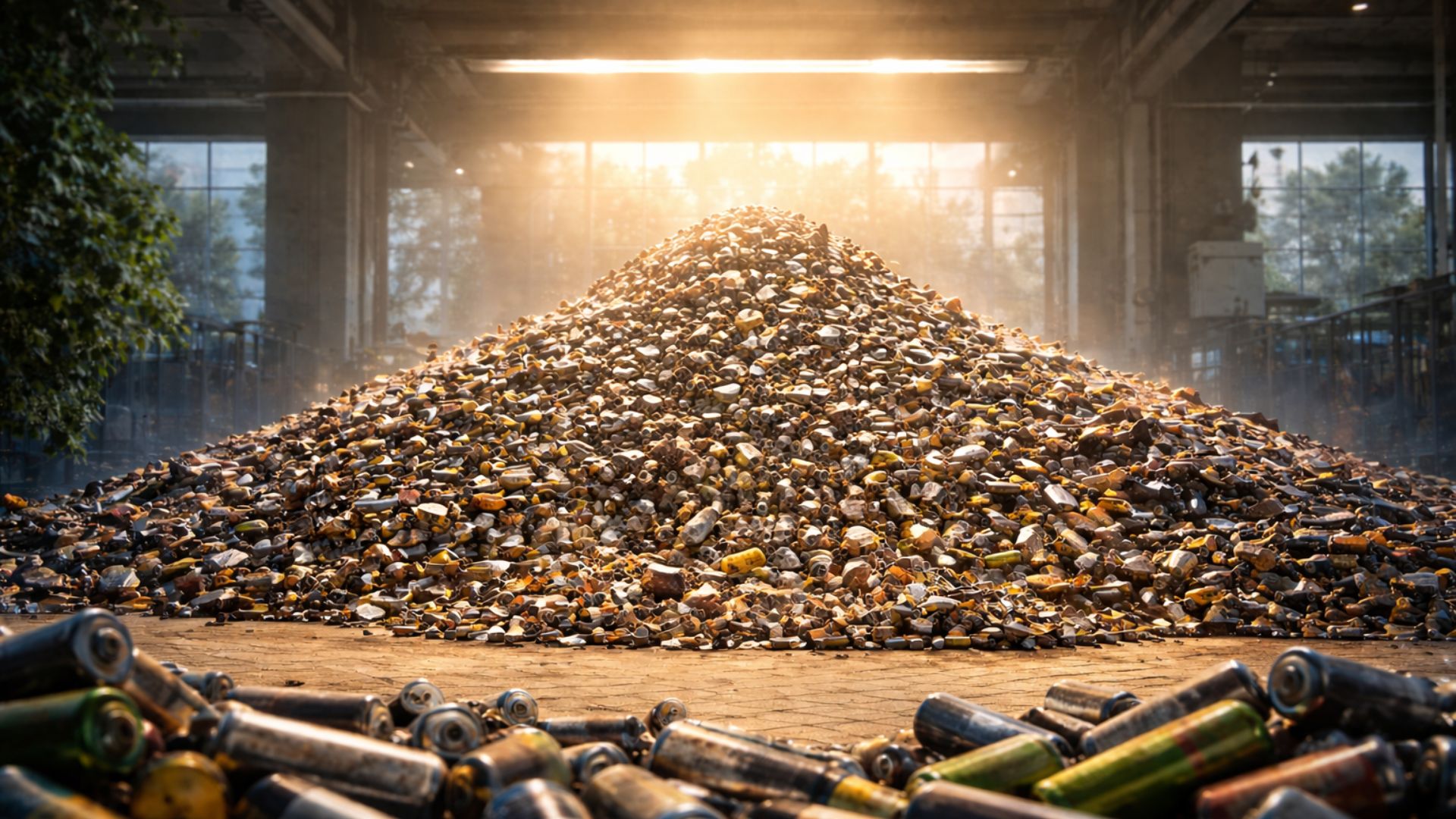
Billion-dollar battery consumption in Brazil contrasts with the advancement of rechargeable models that promise more durability and lower costs over time, expanding the debate on domestic economy, practicality in daily life, and impact on electronic waste disposal.
Disposable batteries remain widely present in the routine of Brazilian families, but the advancement of rechargeable versions has changed the comparison between immediate convenience and long-term cost.
A technical document available from the Ministry of the Environment estimates the annual consumption of batteries in the country at 1.2 billion, while manufacturers and reference materials on rechargeable batteries indicate that nickel-metal hydride models, NiMH, can withstand hundreds of cycles and, in some cases, reach 1,000 recharges or more, depending on the line and usage conditions.
This contrast helps explain why the switch has ceased to be treated solely as an environmental issue and has begun to factor into household expenses.
-
Millions of people have been eating mushrooms for millennia without knowing that this discreet food contains ergothioneine, an antioxidant that scientists now associate with memory protection and healthier aging.

-
Sun Tzu wrote 2,500 years ago that the supreme art of war is to defeat the enemy without fighting, and this phrase from a Chinese general born in 544 B.C. has become the most applied advice in the business world, in conflict psychology, and even in neighborly relations in 2026.

-
With 50,000 people crammed into 3 hectares and buildings stacked like a human anthill, this lawless city that lived without police and oversight reached the highest human density ever recorded in any habitable point on Earth before being erased from the map.

-
Constant tingling in the hands that doesn’t go away even when changing position may be the first warning that an essential vitamin for the nerves is lacking in the body, and ignoring this signal for weeks can cause damage that no supplement can reverse later.

In devices with frequent replacements, such as toys, flashlights, cameras, wireless controllers, and entertainment accessories, the rechargeable battery has been presented as a long-term alternative, because the higher initial expense can be offset by successive reuses, eliminating the need to buy new units with each discharge.
When is it worth using rechargeable batteries
In practice, the central difference between the two formats lies in the number of uses.
The disposable battery is designed for a single cycle and needs to be replaced when the energy is depleted.
On the other hand, the rechargeable battery returns to operation after being placed in a compatible charger, which changes the consumption logic within the home and reduces the dependence on constant replacements for frequently used equipment.
However, there is an important variation between brands and lines.
Panasonic reports that the latest versions of the eneloop family can reach up to 2,100 cycles, while the eneloop pro works with about 500 recharges.
The EPA, in informational material on rechargeable batteries, also notes that some models can reach 1,000 cycles, reinforcing the idea of technical breadth among the products available on the market.

This range explains why the economy cannot be treated as an automatic promise for any scenario.
The financial gain does not arise from an immediate drop in price on the shelf, but from the number of times the same battery is reused.
Energizer states on its technical and commercial pages that rechargeable batteries help save money when used with an appropriate charger, especially in devices that require recurring replacements throughout the month.
In a home with video game controllers, motorized toys, emergency flashlights, and wireless peripherals, the reasoning becomes clearer.
Instead of buying new batteries every time the charge runs out, the consumer operates with a fixed set of cells and a charger.
In this model, the expense tends to shift from recurring retail purchases to a higher initial investment, which only makes sense when the use is truly continuous.
Performance of batteries in different devices
The debate also involves performance, not just price.
Energizer’s technical manual on NiMH batteries informs that these rechargeables can outperform alkaline batteries in high-drain applications, such as digital cameras, although alkaline batteries still maintain a space in lighter or sporadic uses.
This helps to understand why the switch is often more advantageous in devices that require a more intense power supply in short intervals.
Panasonic supports a similar line by stating that eneloop batteries work in both low and high consumption applications, from clocks and mice to camera flashes, toys, and remote-controlled cars.
The company also highlights the stability of voltage throughout the discharge, a characteristic often pointed out as relevant in devices that lose performance when the energy drops more irregularly, as often occurs with disposable batteries at the end of their lifespan.
Still, the disposable battery retains advantages that help explain its massive presence in the Brazilian market.
It is easily found in supermarkets, pharmacies, convenience stores, and small shops, almost always ready for immediate use.
For those who need to get a device up and running right away and do not keep a charger at home, the single-use solution remains the simplest choice.
This habit of quick purchases carries real weight.
The figure of 1.2 billion units per year shows that the culture of immediate replacement remains strong, even with the spread of rechargeables.
The migration between technologies, therefore, does not occur in a linear or uniform manner.
It depends on the routine of each household, the type of equipment used, and the consumer’s willingness to maintain a charging system available.
Proper disposal and environmental impact
The comparison between the two formats does not end when the charge is depleted.
In Brazil, the official reverse logistics system requires manufacturers, importers, distributors, and retailers to provide locations for the collection of used batteries.
According to SINIR, consumers should take the material to the nearest collection point, where it is stored until it is collected, sorted, and sent to recycling companies.
Ibama highlights that Resolution Conama No. 401, from 2008, established maximum limits for lead, cadmium, and mercury and defined criteria for environmentally appropriate management.
The rule reduced the risk associated with these products but did not eliminate the need for proper disposal, as the end of the lifespan still requires specific disposal outside of regular waste.
In addition to the legal obligation, improper disposal increases the loss of materials that could be recovered.
The EPA states that when batteries are thrown in regular trash or improperly sorted recycling, critical materials are not recycled, and the waste management system loses the chance to repurpose them.
Although the agency places more emphasis on lithium batteries in its recent materials, the logic of avoiding waste through proper collection also helps sustain the appeal of reusable alternatives.
Within the home, the practical effect appears in the volume of waste accumulated over time.
A rechargeable battery that completes hundreds of cycles replaces several single-use units in the same function, which reduces the frequency of purchases and also the need to discard depleted cells at short intervals.
This is not about total waste elimination, but about a significant reduction when the device requires constant replacements.
How to choose between rechargeable and disposable batteries
However, not every device automatically points to the same decision.
Video game controllers, camera flashes, motorized toys, and repeatedly used flashlights tend to favor the rechargeable alternative, as they accumulate more cycles of use throughout the year.
In contrast, for items that are rarely used, the calculation depends on the interval between uses, the compatibility indicated by the equipment manufacturer, and the user’s discipline to keep batteries charged when necessary.
Therefore, the rechargeable battery has ceased to be an item restricted to technological niches, but it still does not fully replace the disposable battery in all situations.
The Brazilian market continues to rely on billions of single-use units, while the reusable alternative gains ground in high-demand devices and in discussions about recurring expenses, domestic practicality, and responsible disposal.
The central point today is not just the technology of the battery, but the frequency with which each household needs to replace it and the willingness to transform repeated purchases into planned recharges.






Seja o primeiro a reagir!