





The Britânia BAF16A combines an oven and air fryer in the same body, with 16 liters of capacity, ten ready functions on the digital panel, and a door that comes off entirely for washing. TechTudo tested the device and approved almost everything, except precisely the item that usually decides the purchase.
The Britânia BAF16A is an air fryer that doesn’t fit the narrow definition of a fryer. With 16 liters of internal capacity, it competes in the market segment that replaces the countertop electric oven, and the manufacturer itself classifies the model as a four-in-one device that bakes, fries, dehydrates, and reheats. TechTudo put the machine to the test in a review published in 2025, with scores by section, real recipe tests, cleaning evaluation, and energy consumption calculation.
The verdict was divided in an unusual way. Design, capacity, and ease of cleaning received the best ratings from the analysis, and the performance in preparations was considered satisfactory in almost everything that went through the device. What lowered the average was the asking price. At the time of the test, the model was only available on the manufacturer’s official website, with a promotional price of R$ 909.90, and the section dedicated to price and competitors received two out of five stars, the worst rating of the entire review. TechTudo’s conclusion is straightforward: the device makes sense if the price drops to the range of R$ 700 to R$ 800.
Sixteen liters on paper, five and a half inside the basket
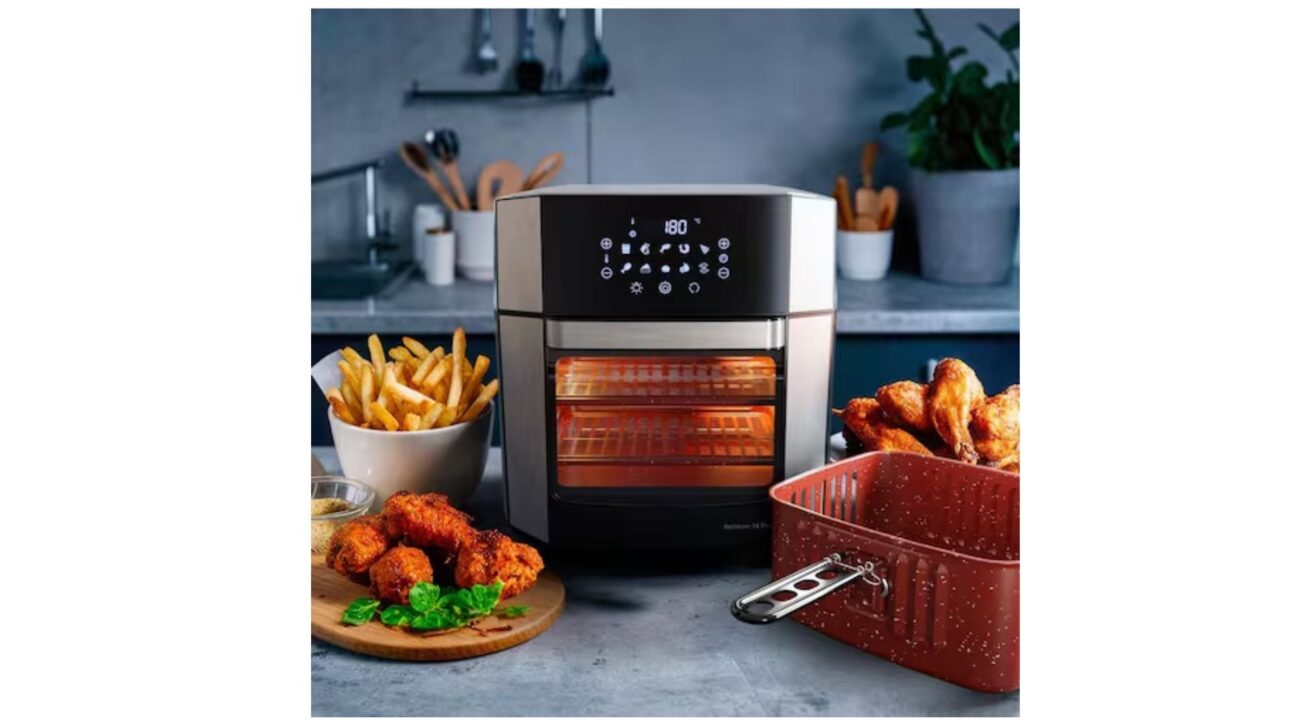
The number printed on the box is the total internal volume, not the useful frying space, and this distinction changes the entire comparison. The manufacturer’s official specifications separate the two measurements: there are 16 liters of internal chamber and a 5.5-liter non-stick basket. Comparing this 16 side by side with the 5 or 7 of a drawer fryer is comparing different magnitudes, because in the oven format the total volume includes the space between the racks, which exists for layered baking.
-
Rare fossil found in the interior of São Paulo reveals a new species of subterranean snake that lived up to 85 million years ago, preserved part of the skull and more than 100 vertebrae, and even allowed scientists to reconstruct regions of the brain.

-
With a few coins and a pile of scrap metal, a 22-year-old built a seven-seater solar vehicle that, according to him, runs more than 200 km solely on sunlight.

-
NASA probe wakes up after almost a year “sleeping” 9.5 billion kilometers from Earth and reveals unexpected clues about the frozen frontier of the Solar System

-
Three engineering students transform parts of old vehicles into an electric motorcycle with cameras, GPS, and sensors, creating a functional prototype after a year of work that slows down and stops automatically when detecting obstacles.


This architecture explains the most praised point of the test. With an open chamber and removable shelves, you can prepare different recipes at the same time without one affecting the other, and this was exactly what stood out in daily use. The device measures 37 by 35 by 33.5 centimeters and weighs 6.4 kilograms, dimensions that keep it on the countertop without becoming cumbersome, even in a tight kitchen.
The weight, however, is a point of caution. Six and a half kilograms don’t weigh anything while the device is stationary, but it’s a hassle when dragging the machine to change the outlet. In kitchens where the power point is in a difficult location, this movement becomes a tedious and repeated task.
The ten functions that appear on the digital panel
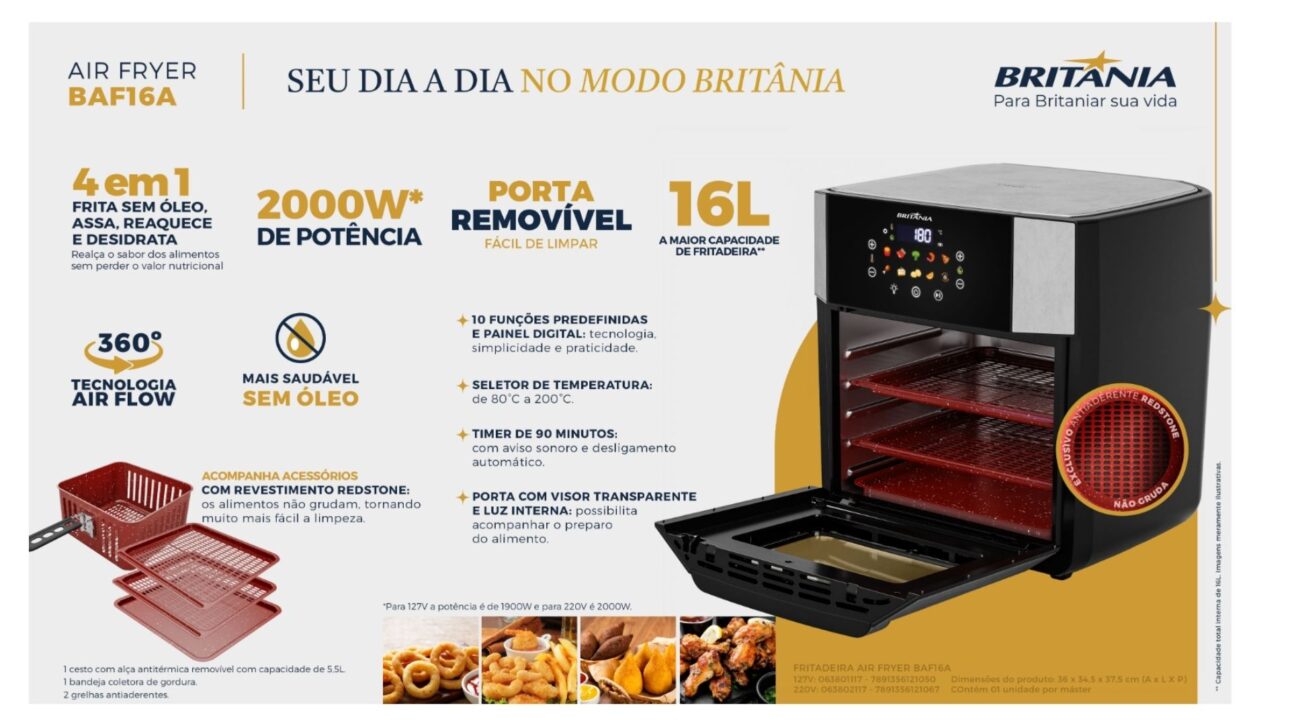
The list of features declared in the technical sheet has ten items, and it’s worth knowing them before buying, because not everything there is frying. They are: baking, grilling, oven, dehydrating, air fryer, slow cooking, griddle, stew, steaming, and keeping warm. The maximum temperature is 200 degrees Celsius, and the control is digital.
Some of these modes alone justify the oven format. Dehydrating requires low temperature and long time, something that a small drawer fryer rarely delivers with stability. Slow cooking and stew follow the same logic, and the keep warm function solves the classic problem of serving dinner at different times at home.
Not all ten functions were tested in the analysis, and this needs to be clear. What the review describes are specific preparations, not a mode-by-mode sweep. Steaming, in particular, is an uncommon feature in this category and is not detailed in any part of the test, so there is no way to know here how it behaves in practice.
What came out of the device during the test
The use was described as intuitive, to the point that anyone could operate the machine without struggling with the panel. Placing and removing the trays presented no difficulty, and the Redstone non-stick coating of the utensils gave a good impression of durability throughout the evaluation period.
In the part that matters, the food, the test menu was varied on purpose. The chamber saw lamb chops, beef steak, chicken, and dehydrated pumpkin, and all came out well prepared. The device delivers what it promises in common daily preparations, and this section closed with four out of five stars.
There is a detail that the test does not resolve and that changes the experience for those cooking for many people. The evaluation confirms that it is possible to make more than one recipe simultaneously, but it does not inform how many servings fit per shelf nor how many people the total volume actually serves. Those buying with the intention of replacing the oven for a family lunch are left without this number.
The cake took ten minutes longer than the competitor’s
The weak point of performance pointed out in the review is the time. Cooking in the BAF16A takes longer than in other models already tested by TechTudo, and the example given is quite concrete: a cake that would take about 30 minutes in an Electrolux air fryer took approximately 40 minutes in the Britânia.
There are ten minutes of difference in a single batch, which seems little in isolation and ceases to seem so when it becomes routine. In daily use, this increase weighs twice, first in the wait and then in the electricity bill, as a device on for longer consumes more. It is worth noting that the comparison appears in the analysis in a hypothetical tone for the competing model, that is, without indication that the two cakes were baked side by side on the same occasion.
What can be stated with certainty is the behavior observed in the Britânia: 40 minutes for a cake, with a result considered satisfactory. The rest of the comparison serves as a reference for the order of magnitude, not as a controlled test.
The door comes off completely, and cleaning was the highlight of the analysis
This was the only section of the review to receive five stars, and the reason is structural. All internal items are removable and made of good quality non-stick material, which prevents food residues from sticking and turning maintenance into scraping.
The feature that makes the difference is the removable door. Being able to remove the entire door from the body of the appliance solves the blind spot that torments those with an electric oven, that internal corner where grease accumulates and the hand cannot reach. With it out, internal and external cleaning happens in the same movement.
The entire process was resolved with warm water and a little detergent, without specific products, without prolonged immersion, and without complicated disassembly. For a 16-liter appliance that roasts meat and gratinates, this is no minor detail: it is the factor that usually determines whether the appliance continues to be used after the third month or becomes a cabinet ornament.
One hour a day costs around R$ 48 at the end of the month
The consumption was evaluated as balanced, without shock on the bill. In quick and small preparations, like a portion of potatoes or chicken fillets, the expense is practically irrelevant in the monthly rate. In long cookings, like cakes and large pieces of meat, the increase appears, albeit lightly.
The account presented in the analysis uses a fixed scenario. With the device on for about one hour a day in the 127 V version, the daily cost is around R$ 1.60, which projects approximately R$ 48.00 at the end of a month, a value described as above what is practiced by other devices in the category. The technical sheet indicates an average consumption of 1.9 kWh, a number that corresponds exactly to one hour of operation at 1,900 W, the power of the 127 V version. In the 220 V version, the power rises to 2,000 W.
An important data point is missing in this account, and it changes the result. The review does not inform which energy tariff was used in the calculation. Based on the numbers presented, the implicit value is around R$ 0.84 per kilowatt-hour, a level that varies greatly between distributors and tariff flags in Brazil. Anyone who wants to project the expense in their own home needs to redo the multiplication with the tariff from their own electricity bill.
The price is what brings down the air fryer’s rating
Here is the harshest verdict of the analysis, and the section that received only two stars. At the time of the test, the model was available only on the manufacturer’s official website, with a promotional price of R$ 909.90, and the review reads that there are competitors delivering similar performance for less money.
The article itself presents three different price ranges throughout the text, which is worth noting. At the beginning, it mentions a variation between R$ 900 and R$ 1,100. Later, when discussing cost-benefit, it cites a variation between R$ 900 and R$ 1,000. In the specific price section, it brings the exact promotional value of R$ 909.90 on the manufacturer’s website. The three pieces of information coexist in the same text without being reconciled.
A warning that is worth more than any rating: all these values are from December 2025. The price of small appliances in Brazil fluctuates with seasonal promotions, exchange rates, and stock availability, and the review itself conditions the recommendation to a price drop. Before deciding anything based on this analysis, the number needs to be checked on the day of purchase.
The almost twin of another brand
A subtle detail of the review deserves attention from those researching before buying. The evaluation notes that the model was compared with the PAF16A from Philco, tested by the same publication shortly before, and that the two devices offer very similar functions and specifications.
The similarity does not stop at the technical sheets. The product codes are practically identical, BAF16A and PAF16A, differing only in the first letter, which corresponds to the initial of each brand. For the consumer, the practical reading of this is objective: research both models before closing, because different brands with similar platforms usually have varied prices in retail.
The review does not state which of the two performs better, nor does it present an item-by-item comparison between them. What is recorded is the equivalence of features, and not a recommendation of one over the other.
The stars of the review itself do not match each other
When reading the analysis carefully, three inconsistencies in the ratings appear, and ignoring them would mean passing on flawed information. In the article index, design and capacity appear with five stars, while the title of the section itself shows four. Energy consumption appears with four stars in the index and with three within the section.
The third discrepancy is in the conclusion. The final score is declared as 3.5, but the star representation next to the number shows three. None of these differences are significant enough to reverse the overall judgment, which is clearly favorable to the device and unfavorable to the price.
Still, they matter to those who will decide based on numbers. Adding up the ratings displayed in the section titles, four for design, four for use, five for cleaning, three for consumption, and two for price, the arithmetic average is 3.6, close to the declared final score. The conclusion in text is consistent, even with the stars dancing along the way.
What the manufacturer’s data sheet includes and the analysis does not mention
The review covers use, cleaning, consumption, and price, but leaves out a series of specifications found in the product’s official documentation and retail listings. It’s worth gathering here what was left out, because some of this information weighs in on the decision.
The timer goes up to 90 minutes and the temperature control operates from 80 to 200 degrees Celsius, a range that explains the feasibility of the dehydrate mode. The external finish is stainless steel, with a non-slip base, and the device features an internal light, a transparent window to monitor preparation without opening the door, overheating protection, and automatic shut-off. The box includes two baking trays, a 5.5-liter non-stick basket with a removable handle, and a drip tray for grease and crumbs, all pieces with Redstone coating, as well as five height levels for rack adjustment.
The analysis also does not include noise measurement, preheating time, or temperature accuracy verification, three items that usually separate a good device from just a large one. The warranty is stated as 360 days, or 12 months, depending on where the data appears, and the model is sold in 127 V and 220 V versions, not dual voltage, which requires attention when choosing the correct voltage.
Is it worth it? The calculation the review proposes
The conclusion of the analysis is honest about what it approves and disapproves. For those looking for a large, well-built device, easy to operate, with good material shelves and uncomplicated cleaning, the BAF16A delivers all that. Quality of finish and variety of functions appear as strong points, and there are no complaints about the results in the tested foods.
The problem is the price. The evaluation states that the price charged is above what the device offers and conditions the recommendation to a specific scenario: a promotion that brings the value to the range of R$ 700 to R$ 800. Within this range, the purchase becomes advantageous. Above it, the review itself points out that the market has options with similar or superior performance for less.
The sentence that sums up the 3.5 rating is the most useful in the entire article: despite the great capacity and power, this is not the best value for money in the category. It’s not a condemnation of the product, it’s a condemnation of the price tag, and these two things age very differently.
Large, versatile, and expensive at the wrong time


The BAF16A effectively solves the problem for those tired of choosing between the small electric oven and the small drawer fryer, because it does both on the same outlet, with ten ready functions on the digital panel and a door that comes off entirely for washing. TechTudo’s test found no operational defects, only a ten-minute delay on the cake and a price tag hard to justify in December 2025.
The interesting thing is that this is one of those reviews that can change its outcome without anything changing in the product. The price just needs to drop to the range that the review itself indicates.
And here’s the question for you: how much would you pay for a 16-liter air fryer that bakes, fries, dehydrates, and reheats, knowing that it takes a bit longer and costs around R$ 48 per month in energy if it runs one hour a day? Share below how much you paid for yours and if it was worth it, because user experiences are more valuable than technical specifications.


