





 Portuguese
  English
  Spanish
  4 min of reading
  0 comments


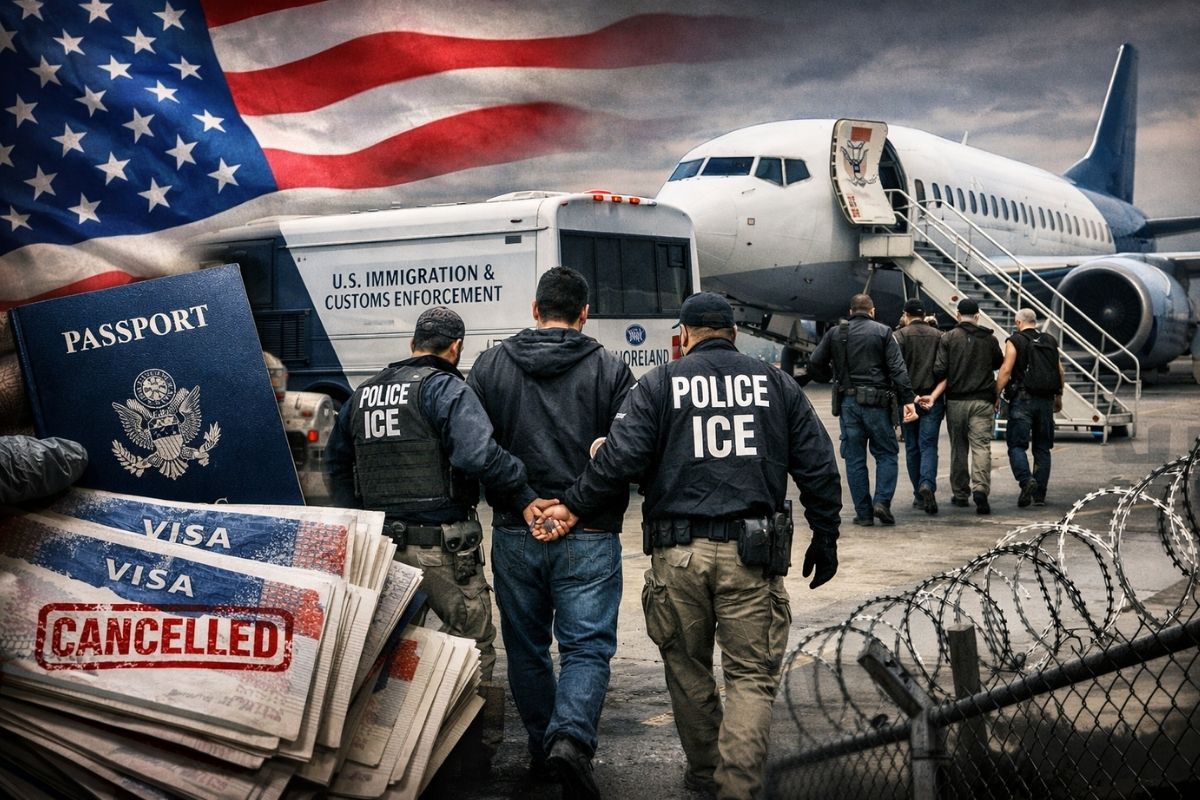
State Department Says That, Since January 20, 2025, It Has Revoked More Than 100 Thousand Visas and Calls It a Record. There Were 8 Thousand Student Visas and 2.5 Thousand Specialized. Reasons Include Excessive Stay, Driving Under Influence, Assault, and Theft, with Strict Screening and Social Media Today.
The US government reported on Monday (12) that it has already revoked more than 100 thousand visas since Donald Trump returned to the White House on January 20, 2025, classifying the volume as a record within the harsher immigration policy adopted during this period.
The escalation occurs amid a widespread crackdown on immigration, with unprecedented deportations, adoption of stricter screening for visa grants, reinforced social media checks, and the creation of a dedicated center to continuously monitor foreigners on US soil.
Record Number of Revoked Visas and Jump from 2024
The State Department claims that the count has already surpassed 100,000 revoked visas since Trump’s inauguration on January 20, 2025.
-
Lula responds directly to Trump and says that Pix is from Brazil and will not change under pressure from anyone, after a report from the United States pointed out the Brazilian payment system as an American trade barrier.

-
Amazon has just announced a new fee on all deliveries, and your online purchases will become more expensive starting April 17, including for those buying from the United States here in Brazil.

-
He sold his share for R$ 4 thousand, saw the company become a giant worth R$ 19 trillion, and missed the opportunity of a lifetime.

-
Elon Musk’s Starship megafrocket puts $8 billion at risk, raises alarms in the market, and could affect technology, mining, and space internet startups in the coming years.

The number is presented as a milestone in tightening migration policies, which, in addition to reviewing grants, also accelerates measures against those who were already in the country.
Within this total, the government detailed two groups that help gauge the scope of the measure: about 8,000 student visas and 2,500 specialized visas, associated with individuals who had encounters with US police for criminal activities.
According to Deputy Spokesperson Tommy Pigott, the volume of revocations represents a 150% increase compared to 2024.
The Four Most Cited Reasons for Visa Revocation
The offensive relies on reasons identified as recurrent in visa revocation decisions. The government listed four main causes: excessive stay in the country, driving under influence, assault, and theft.
In practice, the political message embedded in these categories is of lesser tolerance for violations of immigration rules and for behaviors associated with public safety risks.
The declared goal is to accelerate the removal of individuals seen as threats and reduce the leeway to stay in the country with visas that are no longer considered valid.
Expanded Deportations and Impact on Holders of Valid Visas
The tightening described by the government is not limited to the formal revocation of visas. The crackdown on immigration has been presented as a broader operation, marked by unprecedented deportations, even involving some holders of valid visas.
This combination creates an environment of enhanced scrutiny for foreigners, focusing on regular stay and compliance with local laws.
At the same time, it reinforces the deterrent nature of immigration policy, signaling that a stay can be interrupted even when documentation existed, depending on the framing adopted by the authorities.
Strict Screening and Social Media Checks
Another layer of the new model is in the granting and reassessment of visas. The government reported it has adopted a stricter policy for granting visas, with more rigorous social media checking and extensive screening.
This means that oversight is not limited to traditional documents.
The screening process now includes signs interpreted as relevant for security and foreign policy, broadening the spectrum of factors that may influence the decision to grant, deny, or revoke visas.
Continuous Verification Center and Permanent Surveillance
The State Department also announced the launch of a Continuous Verification Center, described as a framework to ensure that “all foreigners on US soil comply with laws” and that visas of individuals deemed threats are “quickly revoked”.
In practice, the creation of this center consolidates a model of permanent monitoring, where the analysis does not end at the time of granting.
The logic now is one of continuous review, with the possibility of accelerated revocation as new elements are identified.
Timeline: From 80 Thousand Visas in November to More Than 100 Thousand Now
Before the announcement on Monday (12), the State Department had already reported a high level at the end of 2025.
In November, the government stated it had revoked about 80 thousand non-immigrant visas since Trump’s inauguration, for infractions ranging from driving under influence to assault and theft.
The transition from approximately 80 thousand to more than 100 thousand revoked visas reinforces the acceleration of pace and sustains the narrative of a record.
It also indicates that the policy was not limited to an initial adjustment phase but advanced with new layers of control and monitoring.
Diplomats Directed to Monitor Candidates and Political Activism History
This year’s guidelines cited by the government instruct US diplomats abroad to remain vigilant for any candidate that Washington might consider hostile to the country and who has a history of political activism.
This point expands the debate about visa criteria, as it shifts part of the focus toward behaviors and stances interpreted as risks.
The guidance reinforces that the granting and maintenance of visas may be subject to broader evaluations than traditional ones, depending on the adopted political and security framing.
Students, Workers, and Permanent Residents at Risk of Deportation
The offensive also reaches categories that have historically been viewed as stable, such as students and legal permanent residents with green cards.
Trump administration officials stated that holders of student visas and legal permanent residents are subject to deportation if they support Palestinians and criticize Israel’s conduct in the Gaza war.
The government described these actions as a threat to US foreign policy and accused these individuals of being pro-Hamas.
This framing, combined with the increase in visa revocations and expanded screening, places students and other foreigners under a stricter level of surveillance than in recent times.
Do you think that mass visa revocation increases security or creates legal insecurity for foreigners living, studying, and working in the United States?








Seja o primeiro a reagir!