





 Portuguese
  English
  Spanish
  6 min of reading
  2 comments


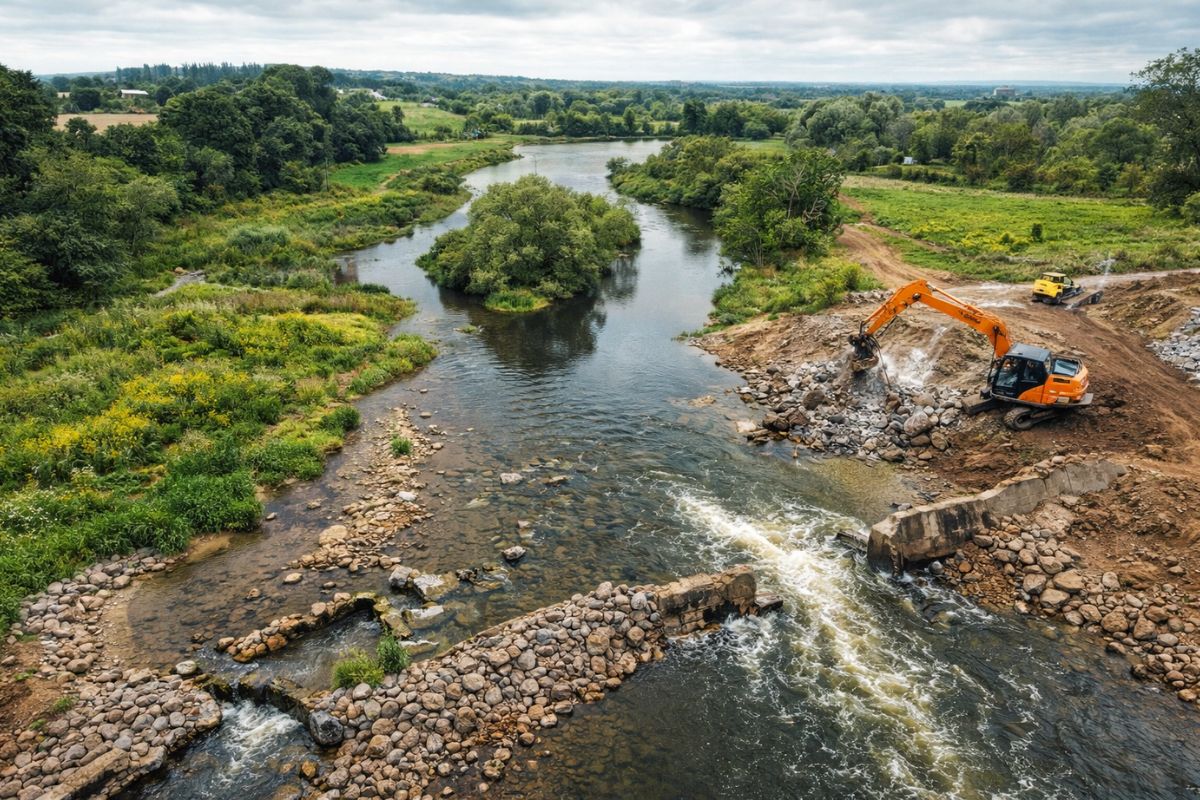


In Rivers Explored for Centuries, Dams and Flow Control Structures Fragmented Habitats, Worsened the Ecological State, and Blocked Fish Migration. Projects Led by Specialized Contractors Remove Artificial Falls, Build Temporary Diversions, Stabilize Banks, Create Sediment Deposition, Reduce Pollution, and Strengthen Resilience to Floods and Droughts.
River restoration gained prominence in Great Britain because degradation became the norm: less than half of the rivers in the UK are in good condition for fish populations, and only 14% achieve good ecological status. In this scenario, dams and artificial barriers became one of the most visible bottlenecks, blocking natural flow and strangling biodiversity.
With the pressure to recover natural waterways, projects began to tackle what had been treated as “untouchable infrastructure” for decades. The logic is straightforward: when a structure ceases to fulfill a modern function, it starts to cost dearly in risk, maintenance, and environmental impacts. And, in many cases, the most efficient route is to remove the concrete and return the river to what it always tried to be.
A Country Full of Barriers: Why Dams Became the Main Target

Great Britain lives with a gigantic volume of artificial obstacles: there are more than 20,000 flow control structures in rivers across the UK.
-
Attracting around 250,000 people a year, a lighthouse 200 meters from the sea, on a 60-meter high cliff, on the North Sea coast in Denmark, becomes one of the most impressive examples of how nature can threaten historical buildings.

-
The narrowest house in the world is only 63 centimeters wide, but inside it can accommodate a bathroom, kitchen, bedroom, office, and even two staircases.

-
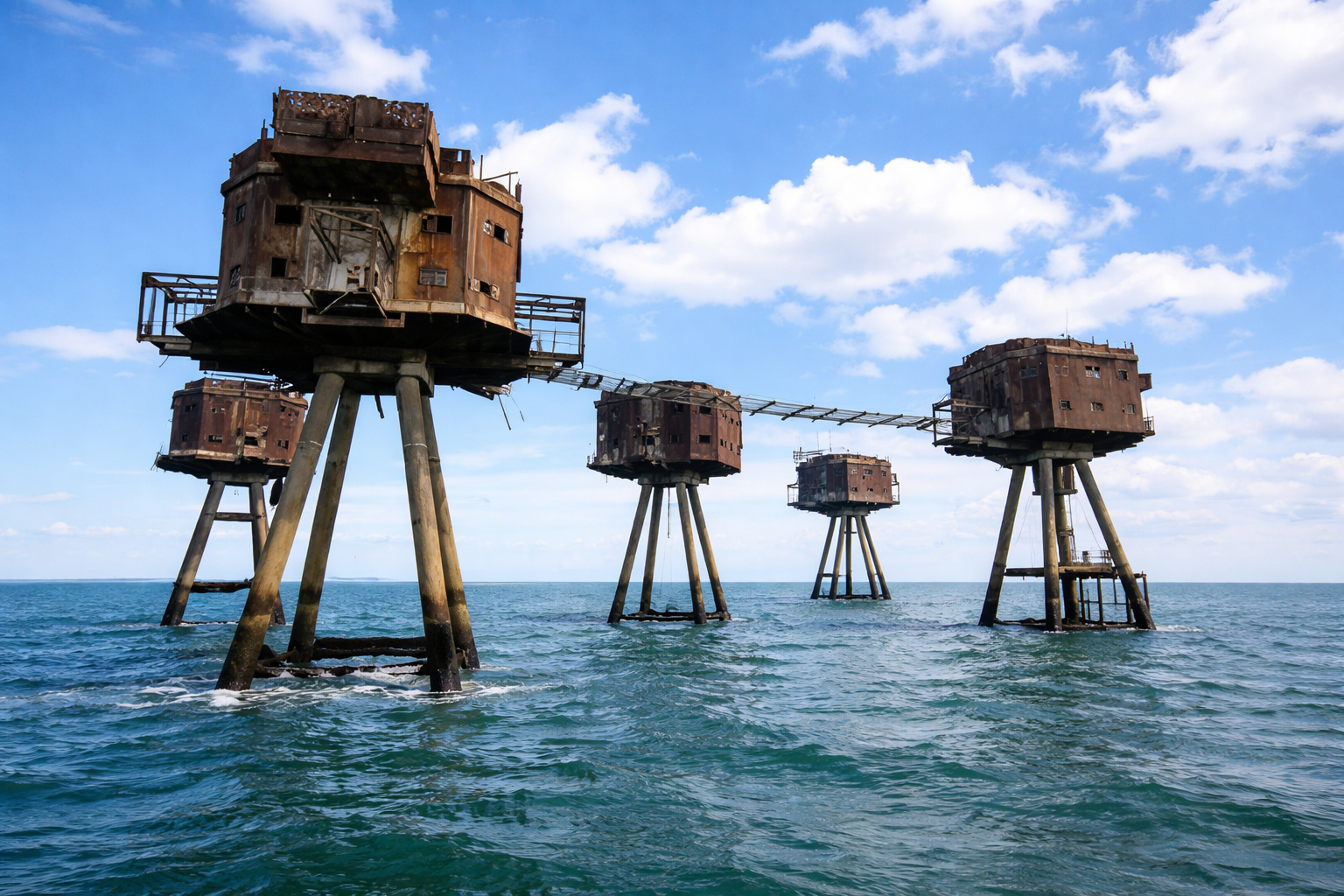
In the middle of the sea, these enormous concrete and steel structures, built by the British Navy to protect strategic maritime routes, look like they came straight out of a Star Wars movie.
-
For years, no one could cross a neighborhood in Tokyo because of the tracks, but an impressive solution changed mobility and completely transformed the local routine.


The most striking figure is the portrait of fragmentation: less than 1% of rivers are free of artificial barriers.
Many of these dams were born out of historical industrial needs, such as creating water falls to power mills, controlling flow rates, or diverting water for human uses.
However, over time, many of these structures became obsolete, and obsolescence is not neutral: they begin to pose a risk to public safety and a significant threat to biodiversity.
The impact is not just “a fish that can’t pass.”
The barrier alters the entire river: it changes the flow rhythm, traps sediments, impoverishes the bed, and interferes with the creation of refuge and spawning areas.
When the water stops, the ecosystem loses dynamics and resilience.
Dovecliff: The Removal of a 70-Meter Dam That Reopened a River After Almost 900 Years

Among the most emblematic projects is Dovecliff, where a 70-meter dam was removed in one of the largest such operations in the UK.
It had been historically built to create a waterfall capable of powering mills, an engineering design that made sense at the time but has now become an environmental blockage.
To carry out the removal with the river still “alive,” a decisive step was necessary: constructing a temporary diversion channel 150 meters long and 10 meters wide.
This diversion allowed for water control during the intervention and created safe conditions for the most aggressive phase of the work.
The demolition occurred with a hydraulic breaker, followed by significant reconstruction on the riverbanks.
The goal was not just to demolish but to reconfigure the environment so that the watercourse could return to a more natural behavior.
The result was a structural change in the stretch: the river began to benefit from a more natural curve, with better sediment deposition and new spawning areas.
The ecological gain was also clear: greater diversity of fish species and, above all, the possibility of migration throughout the length of the river for the first time in almost 900 years.
This detail, almost 900 years, explains the magnitude of the historical blockage.
It was not a recent interruption; it was a secular scar on the functioning of the ecosystem.
Removing Obsolete Dams Is Seen as an Efficient Strategy with Lasting Effect
The reasoning behind these projects is pragmatic: tearing down decommissioned dams tends to be an effective cost strategy with long-term benefits to improve the state of the rivers.
This happens because removal addresses the root cause of the problem, not just the symptoms.
Instead of “compensating” for the barrier with additional structures, like improvised passages, restoration gives the river the right to reorganize itself, dynamically rebuilding the bed, banks, and sediments.
Lake District: The Challenge of Removing a Dam Where Vehicles Hardly Enter
The removal of dams is not limited to accessible areas.
In the Lake District, the intervention involves a remote river and a decommissioned dam, with a central challenge: access.
The site has vehicle restrictions and limitations of the National Park that prevent traditional solutions, such as opening temporary roads.
In practice, this forces the team to rethink methods, logistics, and impact.
Therefore, the highlighted approach is the search for minimally invasive methods to remove the structure and reopen the river to wildlife.
This type of project exposes a little-discussed reality: not all restoration is done with heavy machinery.
In sensitive environments, the strategy involves reducing footprint, controlling movement, and executing without creating new damage.
Chalk Rivers: Why England Has Rare and Delicate Ecosystems in Collapse
Besides dams, the UK faces an old river design problem: many rivers have been artificially “straightened” to gain agricultural land.
This has particularly affected the limestone water rivers of England, the so-called chalk rivers, which are rare and have delicate ecology.
These rivers have been impoverished by a package of combined pressures: historical channel straightening, pollution, and excessive water extraction.
The result is an ecologically poorer habitat and also more fragile in the face of extremes, becoming vulnerable to devastation in events such as floods and droughts.
Hampshire: Reconfiguration of the Course, Wetlands, and Flow Diversity to Reconstruct the River
In Hampshire, there is a program aimed at restoring these rivers.
The actions are practical and focused on natural processes, not on “ornamentation” of the banks.
The work includes:
- removal of invasive plant species, which dominate areas and suffocate local diversity
- creation of wetlands on riverbanks, helping to recover ecological functions and buffer extreme events
- remodeling of the course, addressed as reconfiguration, done through excavations and construction of structures in the riverbed
The goal of this reconfiguration is objective: to create greater diversity of natural flow and sediment deposition in healthier patterns, promoting ecological growth and reinforcing the resilience of the system against floods and droughts.
In other words, it is not enough to remove the barrier.
It is necessary to recreate conditions for the river to function again as a river, with heterogeneity, variation, and refuge areas.
Pollution and Overflows: Why Restoration Needs to Look at the Whole Basin
Even with the removal of dams and reconfiguration of stretches, the river remains vulnerable if the watershed continues to discharge problems.
The need for a basin approach includes measures against pollution sources linked to the water sector, especially stormwater overflows.
The cited actions address the issue directly and indirectly:
- Directly, with additional capacity for stormwater reservoirs and natural solutions with reed beds in sewage treatment plants, enhancing filtration and reducing pollutant load in the system.
- Indirectly, with flood management programs, such as tree planting, that slow down stormwater flow and reduce the volume entering the sewer system.
This logic ties restoration and sanitation together: it is pointless to free the river if the river continues to receive what suffocates it.
Channel Maintenance and Bank Stabilization: The “Invisible Side” That Keeps the River Standing
There are also a set of maintenance interventions that sustain the health of the river system and protect water infrastructure from failures:
- channel maintenance, to preserve flow and reduce obstructions
- bank stabilization, reducing erosion and risk of collapse
- erosion management programs, preventing dangerous events and protecting water sector assets
These programs include actions such as removal of debris and waste, controlling excessive vegetation growth, and removing obstructions that reduce flow.
The highlight is the use of sustainable methods, with solutions like earthen levees, Flex MSE vegetated bag systems, and locally sourced aggregates, reducing impacts and increasing compatibility with the environment.
Biosafety and Chemical Control: How to Prevent the Work from Becoming Another Pollution Source
A critical point in works near water is not to turn the intervention into a new source of pollution.
Therefore, the methodology incorporates strict biosafety measures and chemical control to ensure that pollutants do not enter watercourses during work on drinking water and sewage facilities.
This closes the cycle: remove dams, reconfigure the river, reduce pollution at the source, maintain channels and banks, and protect the watercourse during the work.
It is an attempt to reconstruct the river as a system, not as a scene.
With so many dams still scattered across Great Britain, do you think demolishing more concrete should become a priority, even when these structures are part of the “history” of cities and landscapes?






Excelente me gusta lo que an echo
Excelente noticia en favor de la recuperación del medio ambiente y disminución del impacto ambiental creado por el hombre