





 Portuguese
  English
  Spanish
  6 min of reading
  7 comments


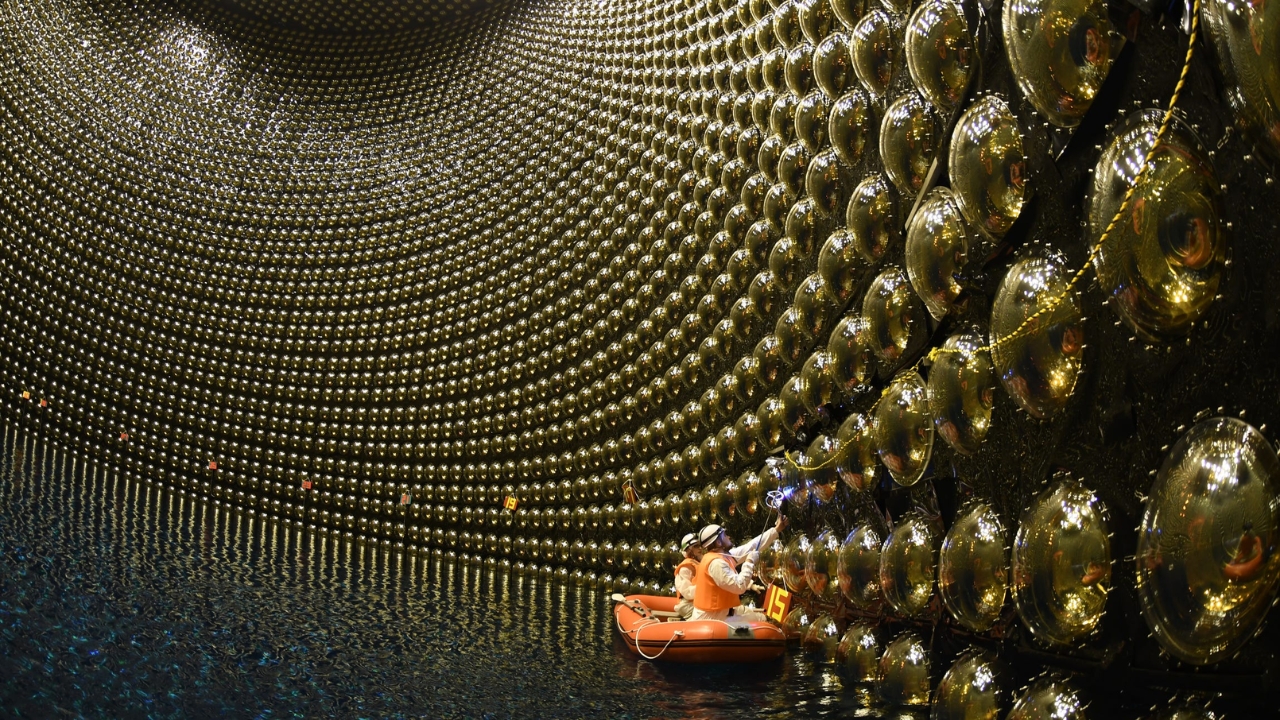


Scientists Are Testing a Graviton Trap With Superfluid Helium, Lasers, and Ultrasensitive Resonators to Search for Real Signs of Quantum Gravity, Something That Could Change Physics Forever
Modern physics has been grappling with a problem that seems simple in words but is almost impossible in practice for over 100 years. Gravity and quantum mechanics do not fit together perfectly. And while both theories work with impressive precision within their own domains, when the universe enters extreme conditions, such as black holes, singularities, and the early moments of the cosmos, the equations make it clear that a piece is missing.
That is why a new experiment, which is already circulating as one of the most ambitious of the moment, has started to draw attention. The idea is to build the world’s first graviton trap, a system designed to try to detect, for the first time, real evidence of gravity in its most quantum behavior.
It’s not an exaggeration to say that this touches the heart of the mystery. If it works, even partially, it could open a door that has been closed for decades. To test in the lab something that has been considered practically impossible to measure until now.
-
The Himalayas continue to grow to this day, with tectonic plates advancing 5 cm per year, mountains rising up to 10 mm annually, and the 2015 earthquake that killed 9,000 people may have increased the risk of an even larger seismic mega-event.

-
At an altitude of 400 km by astronauts from the International Space Station, Paris transforms at night into a golden mesh so precise that it reveals the outline of the Seine River, avenues, and entire neighborhoods like a luminous map drawn over the Earth.

-
iPhone 17 reaches historic low price with 256 GB, 120 Hz display, and drops to R$ 5,703 on Shopee, featuring A19 chip, dual 48 MP cameras, battery life of up to 30 hours, and advanced AI features.

-
Trip to Mars getting closer: Pulsar Fusion, from the UK, advances with plasma ignition in fusion engine and could drastically reduce space travel time, making crewed missions faster, safer, and economically viable.

What Is a Graviton and Why Catching It Would Be Historic
The graviton is a hypothetical particle. In theory, it would be the quantum unit of gravity, just as the photon is the quantum unit of light. The problem is that, if it exists, detecting it would be a technical nightmare because gravity is the weakest force in the known universe.
So weak that, even with advanced instruments, any signal would be buried among the noise of a regular lab.
This is where the concept of a trap comes in. This graviton trap does not mean that someone has already caught a graviton and put it inside a box. What it means, in practice, is something much more interesting. To create an extremely controlled experimental system, in terms of temperature, vibration, and stability, so that gravity, if it exhibits quantum behavior, can leave a detectable signature.
The Idea Behind the Trap: Superfluid Helium, Ultrasensitive Resonators, and Lasers to Measure What No One Has Been Able to Measure Before
The reason this project is attracting so much attention is the chosen approach. Instead of looking for signals in deep space or in gigantic cosmic events, the proposal attempts to measure the almost impossible within a lab, reducing interferences to a minimum.
The experiment relies on a combination that is not random.
Superfluid helium, because in this state it can exhibit unusual properties, helping to reduce internal losses and create physical conditions where vibrations become cleaner.
The ultrasensitive resonators, which function as structures capable of responding to tiny variations. The idea is for the system to be so delicate that any abnormal disturbance would show up in the data.
And the high-precision lasers, used for both control and reading, because when the goal is to detect signals at the edge of possibility, there is no room for approximations in measurements.
In practice, what scientists want is to create a scenario where the experiment is not noisier than the signal they are trying to find. Because in this type of search, the greatest enemy is not the lack of theory. It’s the noise.
What Garnered Attention Worldwide and Why This Became News
According to the website Interesting Engineering, which publicized the topic and popularized the term graviton trap, the proposal uses an experimental approach based on extreme cooling conditions and measurements to try to detect effects compatible with gravity in a quantum regime.
In other words, this is not an announcement of a definitive discovery, but a project that aims to create a physical scenario where gravity leaves some kind of observable mark, even if indirect.
The Most Brutal Part Is Not the Theory: It’s Overcoming the Noise of the Real World
When someone talks about detecting gravitons or quantum gravity, many people imagine giant telescopes or satellites in space. But here the challenge is different. The enemy is the environment.
In the real world, there are interferences that seem small until you try to measure something that is practically invisible.
A minimal vibration, a temperature fluctuation, electromagnetic noise, a microscopic change in the equipment’s support. All of this can be stronger than any signal that this experiment is trying to observe.
That’s why projects at this level usually require infrastructure that seems exaggerated. Vacuum chambers to reduce air interference. Extreme vibrational isolation, as even nearby footsteps can affect the result. Rigorous thermal control, as heat turns into noise and noise destroys signals. Ultra-high precision optical instrumentation, as there is no margin for error.
And this is where superfluid helium comes in as a key piece. Working with extreme temperatures is not a luxury. It’s a strategy to reduce physical chaos until the system becomes quiet enough to measure the impossible.
Why This Experiment Became a Real Attempt to Unite Gravity and Quantum Physics
The reason is simple and gigantic at the same time. It aims directly at the greatest chasm of modern physics.
On one side, General Relativity, by Einstein, describes gravity as the curvature of space-time and works very well for planets, stars, galaxies, and the universe on a large scale.
On the other side, Quantum Mechanics describes particles, fields, probabilities, and the behavior of the subatomic world with absurd precision.
The two theories are extremely successful, but together they do not fit easily. And when the universe enters extreme conditions, this difficulty turns into contradiction.
For a long time, quantum gravity has been a topic trapped in theories and equations, not due to lack of importance but because no one knew how to test it in practice.
Now, the idea behind the graviton trap is precisely to change that. To build a system where gravity is not just elegant mathematics but something that can leave an experimental mark. Even if indirect. Even if small. Even if it takes years.
Have They Caught a Graviton? Not Yet, and That Is Not the Most Important Thing
Here is the point that separates serious science from easy exaggeration.
No, the project has not announced that they have caught a graviton. No, there is no photo of a captured graviton. No, there is still no confirmed detection.
But what exists is already big enough to become a topic worldwide. There is an experimental proposal that seeks to approach the problem through a realistic path. If it’s not possible to see the graviton directly, maybe it’s possible to measure its effect by altering something extremely sensitive.
And this, in itself, is already a leap.
Because for decades the question was whether it would ever be possible to prove it. Now the question begins to change. What if it finally becomes possible to really try?
What May Come Next: Fundamental Science That Propels Technology Into the Real World
It may seem a topic only for physicists, but history shows that when science masters extreme measurements, technology always benefits.
If this type of experiment forces improvements in cryogenic systems, resonators, and ultrasensitive sensors, laser reading with ultra-high precision, and mechanical and thermal noise control, this could eventually impact very concrete areas.
High-precision industrial sensors. Advanced measurement instruments. Metrology, with ultra-fine measurements. Applied quantum technologies.
Many modern innovations started this way. First as lab craziness. Then as real technology that reaches the world.
An Idea That Seems Impossible, Until It Ceases to Be
The graviton trap is not a promise of immediate discovery. It is something more dangerous to common sense. A serious attempt to make measurable what once seemed untouchable.
And if at some point this type of experiment observes an effect compatible with quantum gravity, even if it’s just an indirect signal, a statistical pattern, a small signature, the impact would not just be a viral news item.
It would be a historic event.
Because it would mean that, for the first time, the universe would be allowing gravity to enter the quantum world, and that we managed to see it happen.










Caso haja ocontrole do gravitom, o levitar seria uma realidade?
Cara, essa imagem é de outra coisa. Não é um detector de gravitons, é um detector de neutrinos chinês. E o detector de gravitons só está no papel ainda.
Fonte: https://www.stevens.edu/news/building-the-worlds-first-graviton-detector
Detectando o gráviton será incrível. modo gravitonico é o modo temporal tem a mesma origem quântica (espaço tempo) o gráviton não é o portador da gravidade seria o portador de interação geométrica do espaço tempo. Denteo do buraco negro o modo gravitonico transmita em modo temporal (causalidade congelada) o domínio gravitonico vai até o horizonte de eventos curvando o espaço tempo ao limite c. Abaixo do horizonte de eventos o graviton transmita em modo temporal a causalidade congela.