





 Portuguese
  English
  Spanish
  9 min of reading
  43 comments


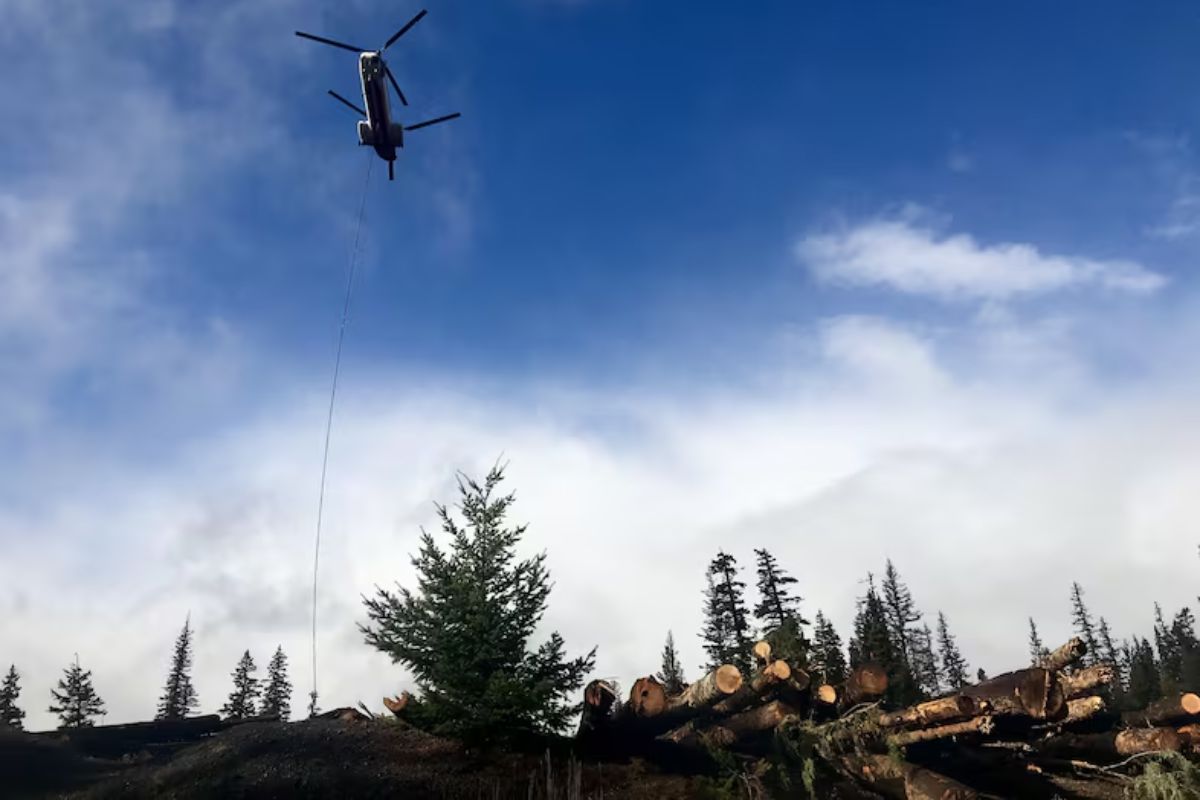


In Washington, More Than 6,000 Logs Are Placed Back by Helicopter Along 38 Km of Rivers and Creeks in Areas Without Road, Connecting Floodplains, Retaining Gravel and Reviving Ecosystems.
In the remote rivers of the Northwest United States, helicopters have begun doing something that for decades would have been considered absurd: bringing logs back into the water. The operation takes place in the central part of Washington state and is part of the largest river restoration project ever undertaken in the region, aimed at correcting damage caused by historical mismanagement that transformed rivers and creeks into fast, shallow channels poor in habitat.
The plan places more than 6,000 logs in isolated rivers and creeks, reopening backwaters, gaps, and pools, reactivating infiltration in floodplains and restoring conditions for species like salmon and bull trout to swim, rest, and spawn. It is a direct attempt to reverse decades of practices that “cleaned” the wood from rivers, accelerated the water, and disconnected the natural sponges that once functioned as such.
When Wood in Rivers Was Seen as an Enemy
Almost 40 years ago, Scott Nicolai began working on stream restoration by doing the opposite of what he does today: removing logs from the water.
-
The most famous volcano in the world could paralyze one of the largest metropolises on the planet: Japan accelerates emergency plans for the eruption of Mount Fuji, which could bury Tokyo in ash for over two consecutive weeks.

-
The United States has a serious problem with its F-35s: China is already producing fighters at a pace that exceeds American capacity and could manufacture up to 300 aircraft per year before the end of the decade, shifting the global military balance.

-
Remains with battle wounds of over 100 soldiers from the Roman Empire are found beneath a football field in Vienna, leaving everyone surprised.
-
Elon Musk notes Brazil and lowers the price of his internet, Starlink, promising to connect all corners of the country with affordable plans, 10,000 satellites, and 1 million active users in the national territory!


The prevailing mentality was straightforward and practical, but today it is viewed as an ecological mistake: if there was a large pile of logs, it was interpreted as a barrier to fish and an obstacle to the “good flow” of the stream.
The goal was to let the water flow “clean,” without impediments, as if the best river was the fastest and straightest possible.
This view eventually guided a type of intervention in which rivers came to be treated as drainage infrastructure, rather than living systems. Logs were removed, banks were simplified, and the riverbed lost its irregularities.
Over time, the results became evident: less shelter, fewer deep pools, less gravel retention, less food in the water, and more difficulty for species dependent on cool, complex environments.
What Has Changed and Why Are Logs Being Placed Back Now

Today, Nicolai, as a biologist specializing in habitats for the Yakama Nation, is at the center of a logical turnaround. Wood has come to be regarded as an essential part of river ecosystems because it performs multiple functions simultaneously, in an integrated way:
- Wood Adds Complexity to Rivers: It creates shadows, backwaters, and gaps that serve as shelter.
- Wood Creates Pools: By altering flow, it allows water to carve out deeper areas.
- Wood Stores Gravel: And gravel is the “floor” where fish like salmon and bull trout spawn.
- Wood Becomes a Food Base: Aquatic insects crawl all over the wood, feeding on the algae that grow on it, and these insects become food in the river’s food chain.
In other words, putting logs back in rivers is not “clogging” the water. It is reconstructing ecological architecture.
The Largest River Restoration Project in the Northwest in Numbers and Territory

The project operates in more than 38 kilometers of rivers and creeks in the Yakama Reservation and in ceded lands, involving different types of ownership and management: private property, the U.S. Forest Service, and the state departments
of fish and wildlife and natural resources of Washington.
The focus is on restoring rivers and creeks that have been degraded by a set of historical actions, directly cited as causes of the problem:
Overgrazing, which alters vegetation and bank stability.
Construction of railways and dams for timber extraction, which modifies the course and dynamics of rivers.
“Cleaning” of creeks by biologists, removing logs and simplifying habitat.
The director of the Yakama Nation’s Department of Natural Resources, Phil Rigdon, summarizes the pivot as an effort to learn from past mistakes and seek a better way to manage the situation of rivers.
Why Helicopters Entered the History of Rivers
Conducting large-scale restoration requires a volume of material and access. However, many stretches of the rivers chosen are no longer accessible by road. In some places, roads have ceased to exist.
In others, there was never a viable road access.
The consequence is that any traditional restoration, with trucks and machinery, would be limited precisely where the need is greatest.
This is where helicopters come in as a tool of ecological engineering. They can pick up logs from storage areas and deposit them directly into remote sections of the river. In practice, they replace the role of the road.
The process has a precise technical choreography:
- The helicopter arrives at the storage area where the logs are gathered.
- A long cable hangs below the aircraft.
- The pilot carefully attaches the cable to four “normal-sized” logs.
- He lifts the load and flies to the target section.
- In one described case, the transportation distance is about 2.4 kilometers to a section of the Little Naches River where roads no longer reach.
On the ground, biologists use pink and blue flagging tape to indicate to pilots exactly where the logs should be placed.
The sound of the rotors can be heard from afar and serves as a warning for everyone to get out of the way.
There is a specific goal mentioned for a point in the project: 1,000 logs must be placed in the Little Naches River.
What Type of Wood Is Being Dumped into the Rivers and Where Does It Come From
The logs are not random. The mentioned mix includes Douglas fir, grand fir, and cedar.
And the origin also forms part of a broader strategy: the wood comes from a harvest used by The Nature Conservancy to thin forests in higher areas.
This detail changes the meaning of the operation: it is not simply “throwing logs into the river,” but rather using an already available resource from forest management to restore lost functions in rivers.
Reese Lolley, director of forest restoration and fires at Nature Conservancy in Washington, describes the vision as restoring the entire landscape, aquatic and terrestrial, with guiding questions for the logic of the project: how to restore forests, how to manage them, and how to use part of the harvested wood to restore creeks and floodplains.
He adds an operational point: the helicopter also allows access to wood from areas that are difficult to reach, where it is neither feasible nor economical to build roads.
Thus, the same helicopter that brings wood to the rivers also facilitates the removal of wood from where it exists, but would be impossible to transport.
Some of that wood could have been sold. Other logs would have no market. Instead of becoming waste, it becomes ecological infrastructure within the rivers.
Why Logs in Rivers Can Prevent Creeks from Drying Up
A phrase sums up the practical ambition of the project: it would be “what will prevent our creeks from drying up.” The logic behind this is explained directly by the hydrological functioning of wood.
When logs are placed in rivers, they:
- Slow Down the Current
- Allow Water to Accumulate in Certain Points
- Increase Water Infiltration into the Aquifer
Nicolai compares these areas to sponges.
Wood helps spread water across floodplains, allowing it to be absorbed and slowly released back into the creek. This creates additional storage and helps to cool the water that is warming up.
The contrast with the past is direct: when tractors passed through the creek “cleaning” and making the water run faster, the floodplains were disconnected from the river.
Rivers and creeks were treated as drainage, to remove water from the land, and not as systems that should retain water in the landscape.
Rivers, Warming Climate, and the Urgency of Storing Water
The project is not just about fish.
It is described as vital as the climate warms, because water storage in the river system becomes crucial during periods of heat and drought.
Faster, simplified rivers tend to:
- Lose Water Faster
- Heat Up More Easily
- Provide Less Shelter and Fewer Cold Pools
Rivers with wood, pools, and connection to floodplains tend to:
- Retain Water in the System
- Release it Slowly
- Maintain Cool, Deep Areas
Restoration, therefore, seeks to return the river to functioning like a river, not a channel.
The Scene of the Dry River and the Ecological Memory of Gravel
Towards the Little Naches River, the group crosses a dry riverbed. The image reinforces the size of the challenge: there are stretches where water is not present as it should be.
Still, Nicolai identifies physical signs of what the river once was. Seeing gravel under wet leaves, he interprets that as evidence that salmon used to live there and, with luck, will return to live there in the future.
This detail is important because it connects the project to a concrete biological goal: to restore the minimum conditions for rivers to once again support spawning cycles.
Where It Happens, Who Is Involved, and How the Operation Is Organized
The project takes place in central Washington, in rivers and creeks in the Yakama Reservation and ceded lands, involving multiple jurisdictions.
It is funded by eight different agencies, including the Bonneville Power Administration, and has the collaboration of six partner organizations, including:
- The Nature Conservancy
- Mid Columbia Fisheries Enhancement Group
The involvement of different entities indicates the scale of the effort: it is not a small test; it is a planned intervention to change the dynamics of dozens of kilometers of rivers.
The Human and Symbolic Dimension: The Ceremony by the River
By the banks of the Little Naches River, while helicopters were working, tribal leaders held a ceremony and offered a prayer for the project to succeed and for the land to return to what it was before.
Former tribal president Jerry Meninick described the idea simply: to bring back what rightfully belonged to that land.
This passage transforms the project into something beyond technical: it has a dimension of identity and restoration, because rivers and the associated fish are part of the life and history of the local community.
What It Means to “Restore Rivers with Wood Placed Forcibly”
The project tests, on a real scale, whether placing wood in rivers with heavy logistics can restore degraded ecosystems.
The ecological reasoning behind this strategy, based on what has been described, is to chain effects:
- Logs create complexity
- Complexity creates pools and shelter
- Pools and shelter favor fish
- Logs retain gravel
- Gravel favors spawning
- Logs feed the insect chain
- The insect chain supports the ecosystem
- Logs slow down the water
- Slow water infiltrates
- Infiltration recharges the aquifer
- Aquifer slowly releases water
- Slow release keeps rivers active and cool
The operation also connects forest management and river management, using thinning wood to fulfill a restoration function.
Why This Type of Restoration Draws Attention
What makes the story extraordinary is not just the helicopter, but the complete inversion of mentality: what was once seen as a “barrier” is now recognized as a vital structure for healthy rivers.
Instead of pursuing “clean and fast” rivers, restoration seeks rivers:
- Irregular
- With shelter
- With pools
- With stored gravel
- With connected floodplains
- With infiltrating and returning water
- With lower temperatures
- With habitat capable of sustaining salmon and bull trout
The scale, the numbers, and the logistics show that it is not a punctual adjustment.
It is an attempt to reconfigure the functioning of rivers across an entire region.
Do you think this type of intervention in isolated rivers should become the norm to recover degraded ecosystems, or could it create new risks and problems in the long term?






Beavers? Would they not accomplish the same goals?
The AI assist was terrible, but the information is very exciting. I think that the plan makes great sense and I am very optimistic about it. I think that Biologists should complete the plan in the Little Naches river and see how it works before it becomes a standard plan.
Absolutely artificially generated content. Terrible job with your A.I. here guys