





 Portuguese
  English
  Spanish
  4 min of reading
  1 comment


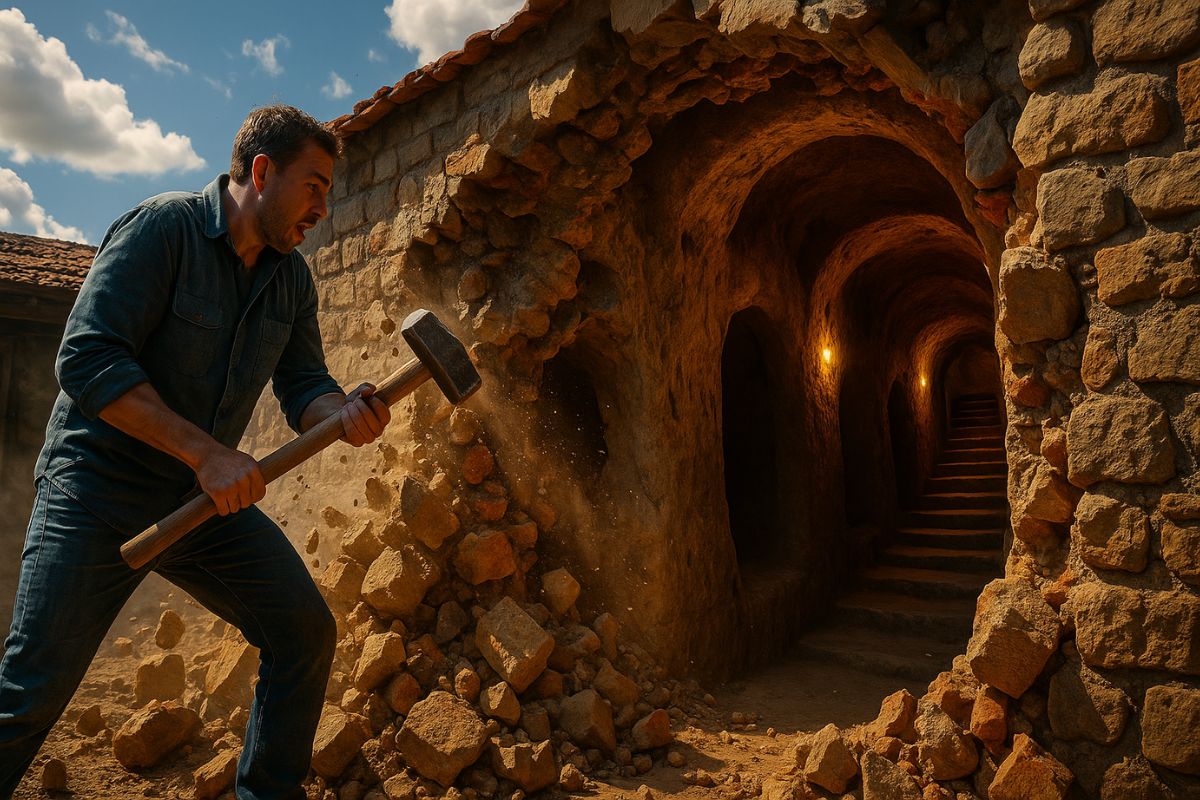


The Accidental Discovery of an Underground City Capable of Housing 20,000 People, with 18 Floors and Complete Infrastructure, Revealed One of the Largest Underground Complexes in the World and One of the Most Fascinating Mysteries of Cappadocia.
In 1963, a resident of Cappadocia, Turkey, experienced one of the most unexpected episodes in modern archaeological history. While tearing down a wall in his basement to investigate the disappearance of his chickens, the man discovered the entrance to Derinkuyu, an underground city with 18 floors, featuring tunnels, churches, schools, wineries, and homes that could accommodate up to 20,000 people.
The accidental find revealed an impressive ancient complex, carved into volcanic rock, that served as refuge for entire peoples during wars and religious persecutions. Decades later, Derinkuyu would be recognized by UNESCO as a World Heritage Site, becoming a symbol of the ingenuity and resilience of ancient civilizations.
The Discovery That Began with a Domestic Mystery
The case began when a resident of the small town of Nevşehir, in central Cappadocia, noticed that his chickens were disappearing through a crack in the basement wall.
-
Beneath 25 km of ice, a moon of Jupiter hides an ocean with more water than all the seas on Earth and may have the necessary conditions to support life, according to studies supported by NASA.

-
The appliance that should cool your home may be driving up your electricity bill when installed with the wrong power, forcing the device to work harder and consume much more than necessary.
-
Airbnb now offers private car service to pick you up at the airport in 125 cities around the world with a fixed price and no extra fees: the platform aims to become a complete hotel within your smartphone.

-
Japan tests for the first time a hydrogen-powered engine for large cargo ships and achieves over 95% of the fuel’s energy at full load, paving the way to equip a 17,500-ton cargo ship already planned for 2027.


Curious, he decided to tear down the wall with household tools and found a narrow tunnel leading to a dark and deep corridor, completely unlike any modern structure.
As he advanced, he realized it was an ancient passage, with rooms carved into the rock and openings that seemed to lead to other levels.
The site, soon recognized by archaeologists, was one of the 600 entrances to Derinkuyu, the largest known underground city in Turkey.
An Underground City with 18 Floors and 85 Meters of Depth
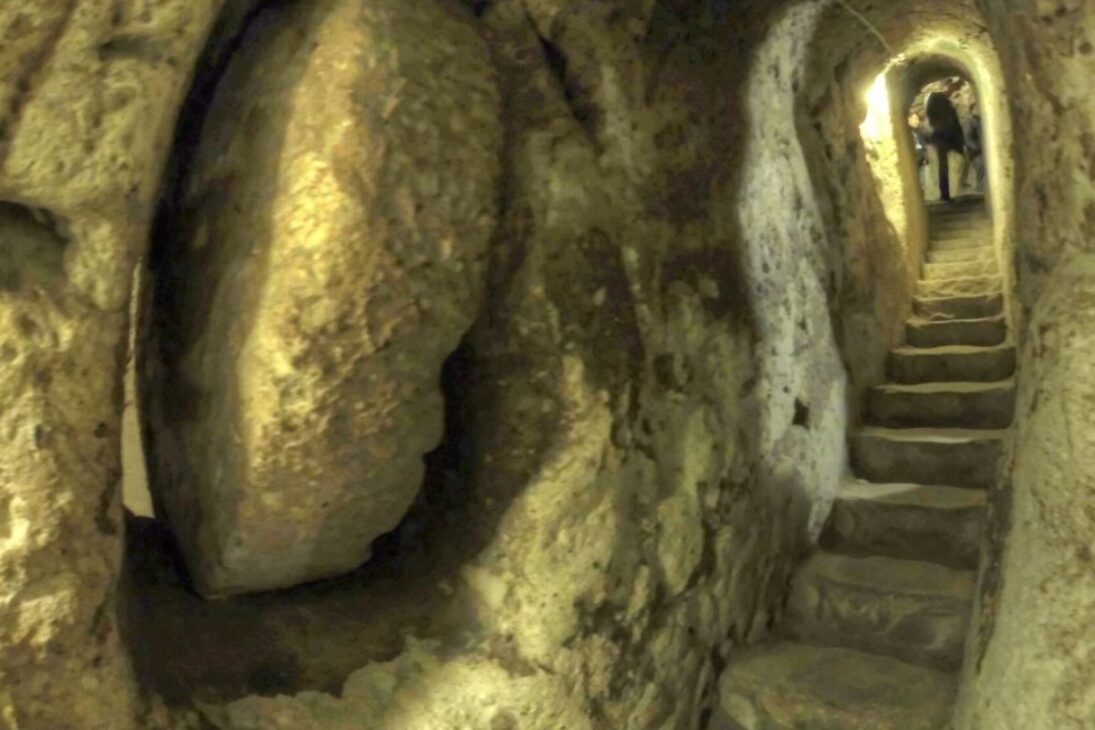
With about 85 meters of depth and 18 interlinked levels, Derinkuyu impresses with its complexity.
Carved into soft volcanic rock, the city features narrow tunnels and labyrinthine passages designed for both habitation and defense.
Archaeological records indicate that Derinkuyu could house up to 20,000 people simultaneously, along with their animals and supplies.
There were houses, missionary schools, churches, stables, food storage facilities, cellars, and kitchens.
The ventilation system, with over 50 ducts and a central shaft of 55 meters, ensured the circulation of fresh air even in the deepest levels.
The city also had independent water wells, which were not connected to the surface to prevent poisoning during enemy sieges—a survival strategy that demonstrates the high degree of planning by its builders.
Ingenious Defenses and Advanced Technology
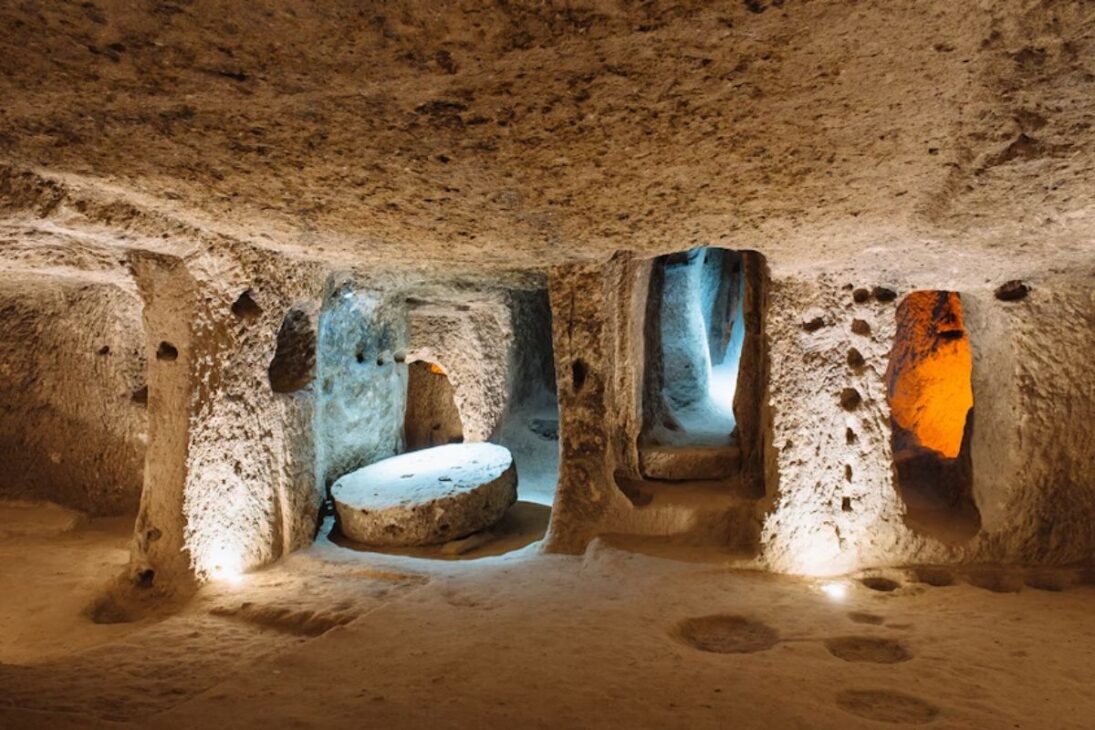
In addition to being a refuge, Derinkuyu was a subterranean fortress. The passages were intentionally narrow, forcing invaders to advance in single file, which facilitated their neutralization.
At strategic points, circular stone doors, weighing up to 500 kg, could be rolled into place to completely block the advance of enemies.
These doors, which could only be opened from the inside, protected hundreds of chambers and hidden rooms.
In many tunnels, there were traps and escape routes, indicating a highly organized military and civil structure.
The engineering of Derinkuyu is so advanced that researchers believe the original construction dates back to the 8th century BC, likely initiated by the Phrygians and later expanded by Hittites and Byzantines.
Religious Refuge and Symbol of Resistance
During the Byzantine period, Derinkuyu was used as a refuge for Christians fleeing Roman persecutions and, later, Arab invasions.
Excavations revealed underground churches with altars, carved crosses, and baptismal rooms, demonstrating its role as a spiritual refuge.
The city operated as a self-sufficient community: storing grains, making wine, housing missionary schools, and providing common living spaces.
For over two thousand years, Derinkuyu was inhabited by different peoples, surviving wars and changes of empires until it was completely abandoned in the 1920s, when the Greek population was expelled from the region.
The Archaeological Legacy and Global Recognition
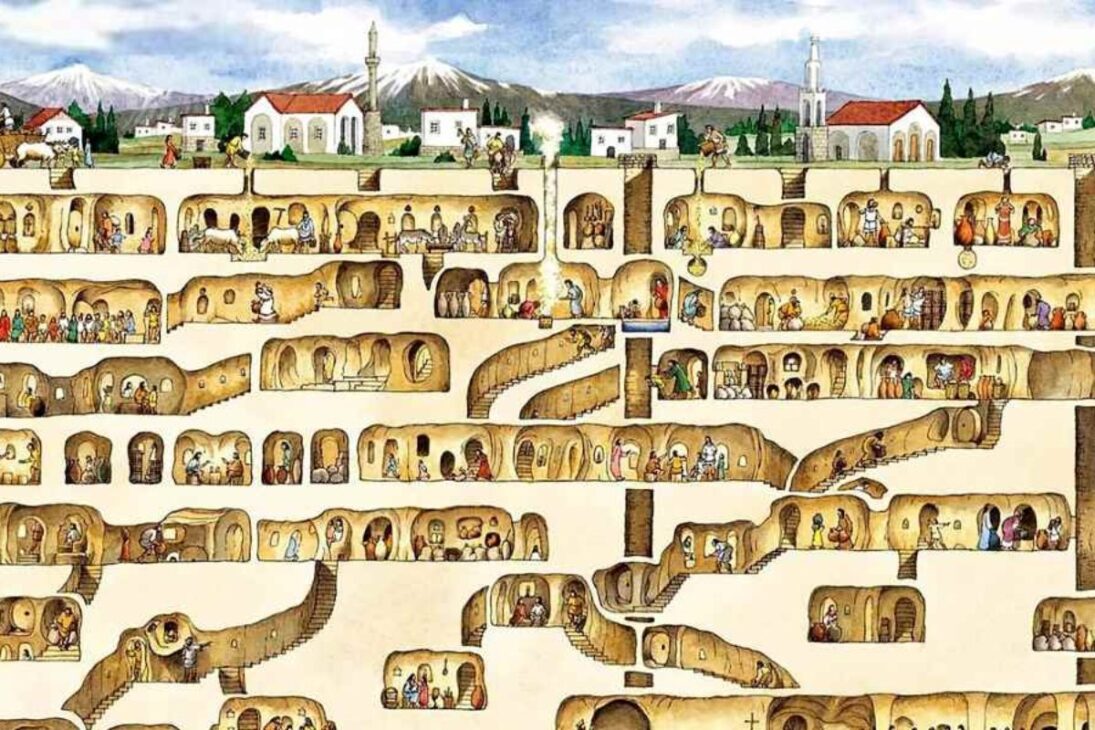
Officially rediscovered in 1963 and opened to the public two decades later, Derinkuyu became one of Turkey’s main archaeological attractions.
In 1985, it was declared a UNESCO World Heritage Site, along with the Göreme National Park.
Today, only eight of the eighteen floors are open for visitation, but estimates suggest that the underground network of Cappadocia exceeds 200 interconnected cities with tunnels up to nine kilometers long.
The story of Derinkuyu shows that archaeology still holds discoveries capable of redefining our understanding of human history and that the ingenuity of ancient civilizations continues to challenge modern technology.
Would you explore an underground city with 18 floors beneath the earth? Or do you think constructions like Derinkuyu still hide undisclosed secrets? Leave your opinion in the comments—we want to know if you would have the courage to descend to the last level of this mysterious city.






Great article, thank you for sharing these insights! I’ve tested many methods for building backlinks, and what really worked for me was using AI-powered automation. With us, we can scale link building in a safe and efficient way. It’s amazing to see how much time this saves compared to manual outreach.