





 Portuguese
  English
  Spanish
  4 min of reading
  0 comments


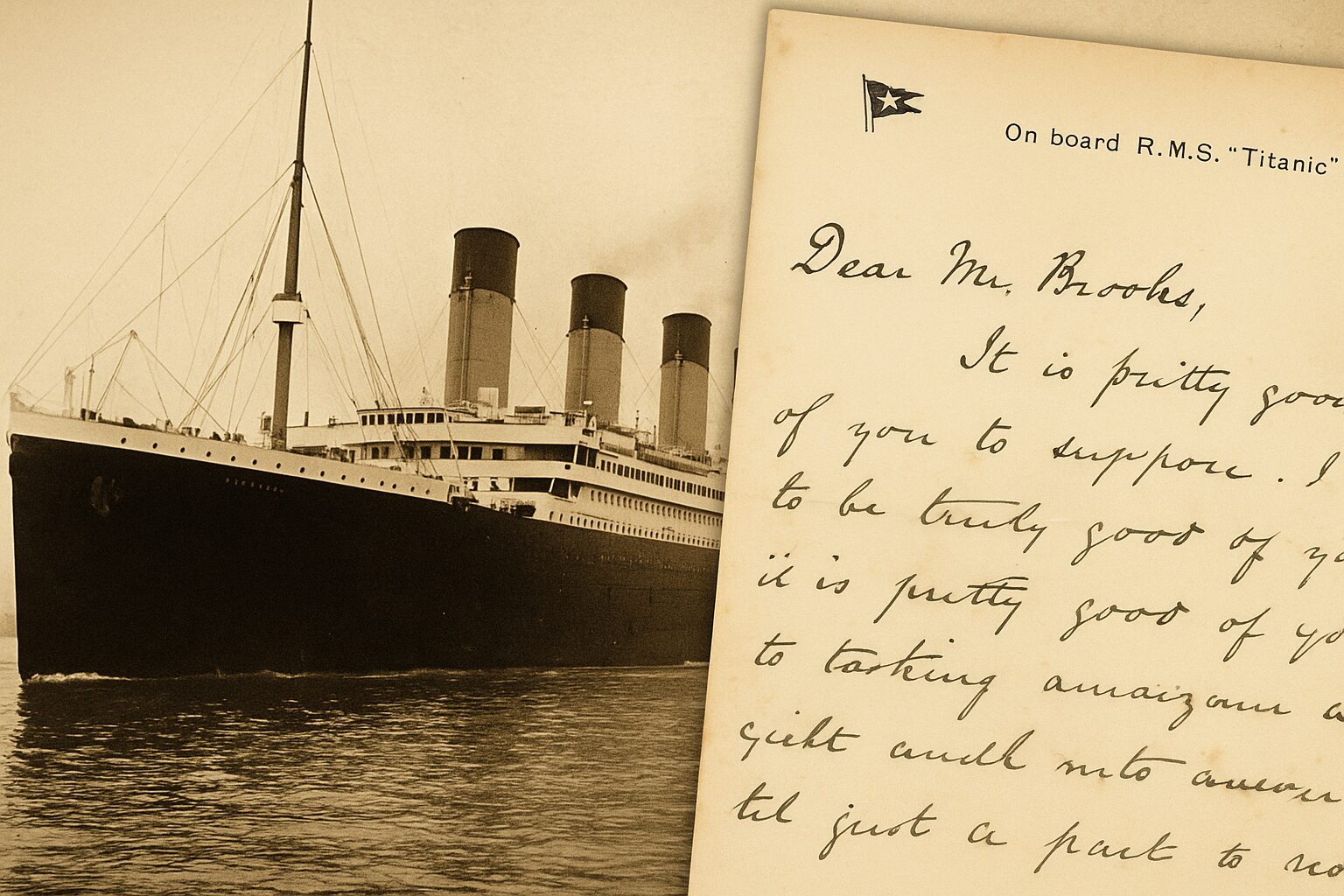
Document Written By Archibald Gracie Aboard The Titanic Was Auctioned For About US$ 399 Thousand In The United Kingdom; Letter Is Considered A Unique Item Of Historical Value.
On April 10, 1912, Archibald Gracie boarded the Titanic bound for the United States.
Settled in a first-class cabin, he took the first moments on board to write a letter to a friend.
What seemed to be just an initial reflection about the ship ended up becoming one of the last records before the tragedy that would mark the history of navigation.
-
Sleeping at different times each day can be a bomb for your heart and even double your risk of having a heart attack.

-
Without help and without heavy machinery, a woman builds a house from scratch with stone, wood, and cement, erects a chimney, creates a complete leisure area, and transforms an empty lot into her dream home.

-
Couple transforms abandoned house after years of being closed; residence was overgrown with weeds, had a green pool, and a deteriorated structure in the interior of Rio de Janeiro.

-
Hidden marks on the walls of the site associated with the Last Supper of Jesus for centuries have been deciphered in Jerusalem, revealing medieval inscriptions left by pilgrims, European nobles, and travelers from the Middle East.
The letter, sent by Gracie before the sinking, was recently sold at auction in the United Kingdom.
The document reached a value of around US$ 399,000, according to the auction house Henry Aldridge and Son, responsible for the sale.
The auction took place on April 26, in Wiltshire, England.
Writing Aboard
Gracie wrote the letter while the Titanic was still being prepared to cross the Atlantic.
The text was brief, but with a tone that today seems prophetic: “It’s a beautiful ship, but I will wait until the end of my journey before judging it,” he stated.
The content was addressed to AP Brooks, a European ambassador, who received it at the Waldorf Hotel in London.
The correspondence was posted on April 11, when the Titanic stopped in Queenstown, Ireland — now known as Cobh — and was resent the next day, already in London.
The paper still bears the letterhead of the White Star Line, the company responsible for the Titanic, with the words “Aboard the RMS Titanic”.

Henry Aldridge and Son
Rare And Symbolic Item
For Andrew Aldridge, the auctioneer responsible for the sale, pieces like this help preserve the memory of the passengers. “The stories of these men, women, and children are told through memorabilia,” he stated in an interview with NPR.
The identity of the buyer was not revealed. The seller was identified as a direct descendant of the letter’s recipient.
According to the auction house itself, there is no other known record of correspondence sent by Gracie during the crossing.
This makes the document a “truly exceptional piece, museum-worthy.”
The Story Of Gracie
Archibald Gracie was born in January 1858, in the city of Mobile, in the state of Alabama, United States.
He studied elementary school in New Hampshire and even attended the U.S. Military Academy at West Point, but did not complete the course.
After that, he enlisted in the Army and became a colonel in the Seventh Regiment of New York.
Before boarding the Titanic, Gracie had traveled to Europe on the Oceanic.
Instead of returning to the American continent on the same ship, he decided to book a cabin on the Titanic, which was about to make its maiden voyage.
In the letter sent to Brooks, Gracie fondly mentions the previous ship: “Although she does not possess the elaborate style and variety of amusements of this great ship, her seaworthiness and yacht-like appearance still make me miss her.”
Activities Before The Disaster
During the crossing, Gracie enjoyed the comfort offered to first-class passengers.
He spent a good portion of his time accompanying women traveling alone, visiting the library, swimming in the pool, conversing with other passengers, and even playing squash on the ship’s courts.
On the night of April 14, Gracie went to bed early but woke up around 11:40 PM upon realizing the engines had stopped.
Upon leaving the cabin, he noted the gravity of the situation. He quickly went back to put on his life jacket and escorted the women he was with to the lifeboats.
Even after that, he remained on board to help evacuate other women and children.
When all the lifeboats had been launched into the sea, Gracie joined the crew in rescuing collapsible lifeboats. Soon after, the ship sank.
Survivor Of The Disaster
Gracie was dragged underwater by the force of the sinking, but managed to return to the surface and climb onto one of the collapsible boats, which was overturned.
He shared the space with several other men. Many of them did not survive the intense cold of the night.
Later, in the morning, the survivors of the boat were rescued by other lifeboats and then picked up by the ship Carpathia.
In an interview with the New York Tribune, Gracie described the experience as the most difficult of his life.
“The hours that passed before we were rescued by the Carpathia were the longest and most terrible I’ve ever experienced,” he reported. “Practically without any feeling due to the cold water, we were nearly falling from exhaustion.”
Last Months Of Life
After the rescue, Gracie returned to New York and began to write a book about what he had experienced.
The title, The Truth About The Titanic, was published the following year. Gracie did not have time to see the completed work.
With health weakened by hypothermia and already suffering from diabetes, he died on December 4, 1912, eight months after the disaster.
The letter sold recently remains one of the last vestiges of that crossing. A physical reminder of one of the most remarkable episodes in maritime history.










Seja o primeiro a reagir!