





 Portuguese
  English
  Spanish
  5 min of reading
  0 comments


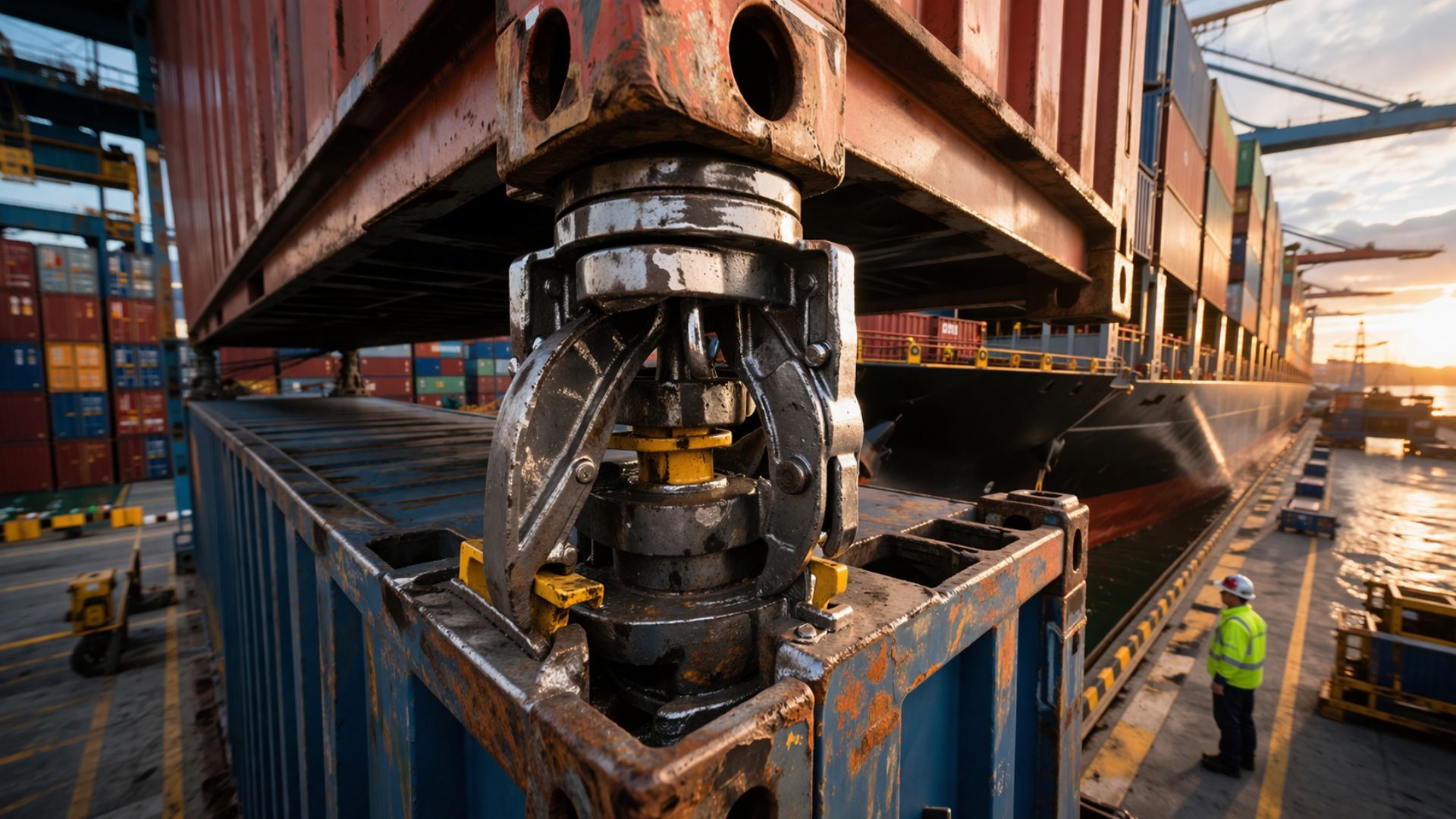
Invisible piece on the deck began to influence cargo capacity, port operation time, and logistical efficiency on giant ships, making the automatic twistlock one of the most strategic components of contemporary naval engineering and global goods movement.
A discreet piece, fitted between containers on the deck, began to influence two central decisions of long-haul navigation: how much a container ship can load and how long it takes to complete loading and unloading.
In the latest fully automatic models from MacGregor, the twistlock operates with locking and unlocking during crane movement, without requiring the same sequence of manual interventions that still characterizes older systems.
This advancement helps explain why a small component gained strategic status on increasingly larger ships.
-
Magnets on the refrigerator door may seem harmless, but there is a little-observed detail that raises questions about energy consumption and makes many people wonder if it affects the electricity bill.

-
In Botswana, a salt flat of up to 16,000 km² that was once an African megalake spends months as an absolute white desert, but during the rainy season it transforms into a shallow sea that reappears from nowhere and can be seen from space in the middle of southern Africa.

-
The United Kingdom is transforming toilet paper removed from sewage into an ambitious and surprising project that could forever change the way cities and industries view one of the most unthinkable everyday waste products.

-
The USA launches a colossal ship with over 63,000 tons, 272 meters in length, and capacity for 1,000 beds and 11 operating rooms: a floating hospital for crises in different oceans.

In the case of the ACV-1 Hippo, presented by the manufacturer as a fully automatic twistlock, the proposal combines automatic coupling, prevention against accidental drop, and application on vessels of different sizes, including the largest ships in the global fleet.
The logic is straightforward: fewer steps at the dock and fewer stacking restrictions mean more productivity throughout the commercial journey.
Automatic twistlock and the function between containers
The twistlock is installed at the standardized corners of the containers to join one unit to another and limit movement during loading, crossing, and unloading.

Although it seems like a detail in the scale of a mega cargo ship, this piece acts at the point where the structural safety of the stack meets the operational efficiency of the ship, as any slack or limitation of resistance interferes with both the behavior of the cargo at sea and the final design of the stowage.
On the ACV-1 Hippo, MacGregor reports breaking load of 500 kN in tension, 420 kN in shear, and 2,000 kN in compression, with a body made of high-strength steel and hot-dip galvanization to withstand the corrosive environment.
The type approval certificate issued by Bureau Veritas records maximum fastening load of 250 kN in tension in automatic mode, load test of 325 kN, and maximum vertical slack of 12 millimeters under 250 kN tension.
Vertical slack of 12 millimeters and gain of space on the deck
Among the less visible aspects for someone observing a loaded ship from the dock, the so-called vertical slack is one of the most important.
Every lock of this type leaves a small distance between one container and another, and this space influences the movement of the stack during the journey, the loads transmitted to the securing system, and the height effectively available for stacking on the deck.
MacGregor maintains that the Hippo keeps vertical slack of 12 millimeters, a level that, according to the company itself, is equivalent to that of semi-automatic twistlocks and avoids loss of capacity associated with larger slacks.
This data appears both on the product’s technical page and on the Bureau Veritas certificate and has become a relevant commercial argument because it preserves useful height for stowage without increasing the safety commitments required by classification rules.

It was precisely at this point that the equipment gained importance on the A19 class vessels of Hapag-Lloyd.
MacGregor reports that its ACV-1 twistlocks were selected for six 19,900 TEU ships of this series and associates the choice with increased capacity and improved operational efficiency.
In subsequent material, the company states that the set allows for an extra layer of containers, something around 600 additional TEUs per ship, maintaining the same loading plan and the same cargo mix.
How automation accelerates port operation
The gain is not limited to the number of boxes loaded.
As the fully automatic twistlock locks and unlocks during crane movement, the operation reduces manually executed steps on the deck, shortens the ship’s stay time at the terminal, and helps accelerate the turnaround of the vessel between one port call and another.
On routes where hours of docking influence port windows, fleet utilization, and the final cost of the journey, this time savings becomes immediate value for the shipowner.
Hapag-Lloyd itself framed the adoption of the equipment within this operational efficiency key.
In the announcement of the order, released on June 30, 2025, the shipping company stated that it seeks solutions capable of advancing the efficiency of its operations, while MacGregor associated the supply with increased capacity, operational gain, and reduced environmental impact.
Although the commercial focus is on productivity, the technical reasoning behind the choice depends on the balance between strength, automation, and precise control of the slack between containers.
Stowage rules and safety in mega cargo ships

This balance has gained importance as ships have increased in size and stowage has begun to require more refined calculations.
DNV reports that its latest lashing and stowage rules use a three-dimensional model of the container to capture twisting forces, deformations in hatch covers, and securing bridges more accurately, as well as dynamic efforts related precisely to the slack of the twistlocks between the stacked units.
In practice, this means that the expansion of mega cargo ships does not depend solely on hull, propulsion, or overall length.
Small parts, subjected to strict tolerances and international certifications, have begun to objectively influence the amount of cargo transported and the safe operational limits under different sea conditions.
On the ACV-1, MacGregor highlights approvals from DNV, Bureau Veritas, KR, ABS, and LR, as well as application in both retrofits and new constructions, which shows that the evolution of the twistlock has moved from accessory level to the center of fleet performance engineering.
Global maritime trade and logistical efficiency
The effect of this change goes beyond the deck.
UNCTAD highlights that more than 80% of the volume of global trade is transported by sea, so any advancement that allows loading more containers on the same ship, reducing manual work at the dock, and maintaining the safety requirements of classifiers ultimately impacts logistical costs, route frequency, and availability of goods in distant markets.
In this scenario, the lock that almost disappears in the visual scale of the ship has come to occupy a central space in the efficiency of global trade.






Seja o primeiro a reagir!