





 Portuguese
  English
  Spanish
  6 min of reading
  0 comments


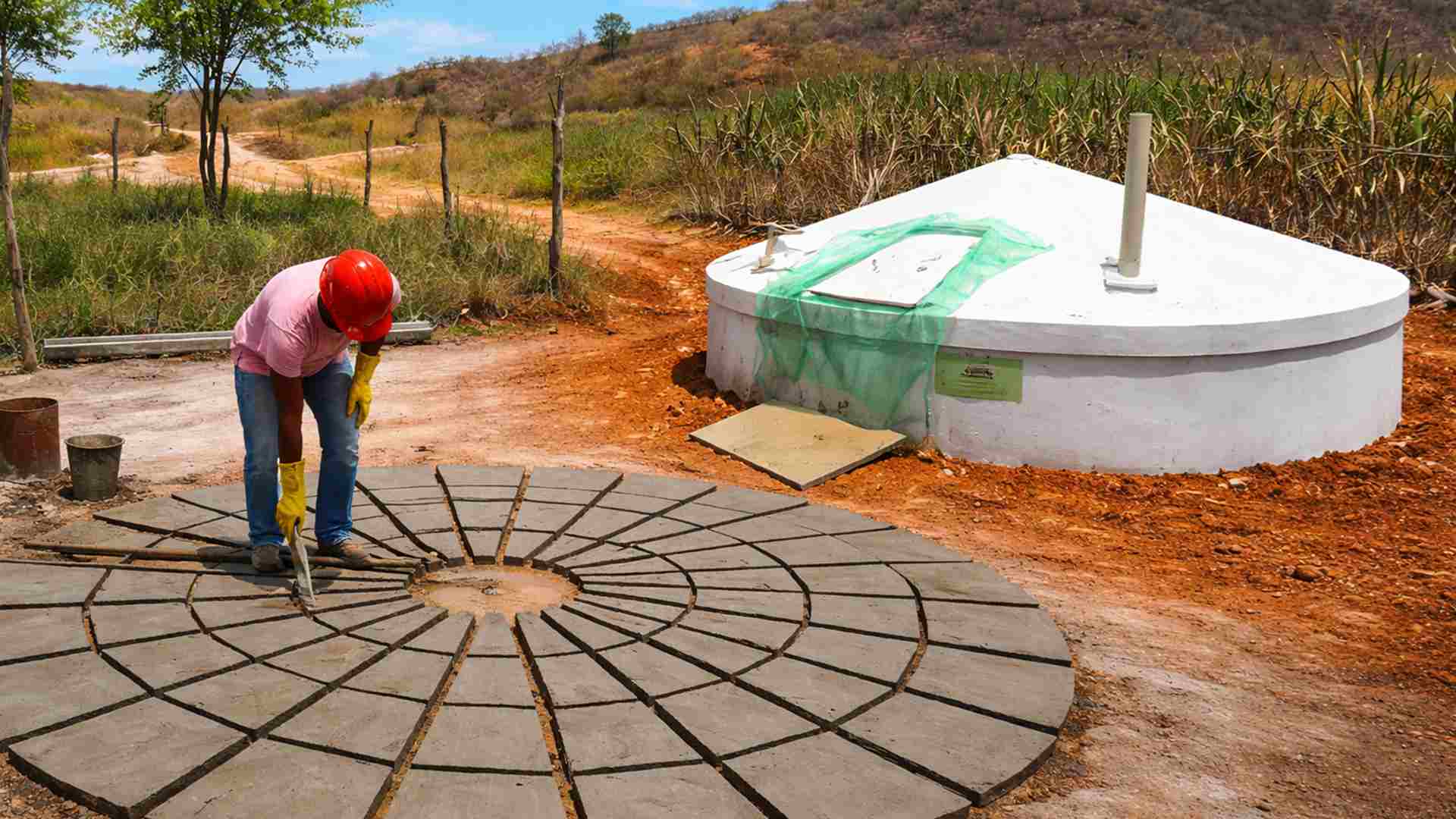
The step-by-step guide to building a water tank shows how families in the semi-arid region can store up to 35 thousand liters of rainwater with 60 by 50 centimeter plates, a 4.30 meter base, and simple materials, reducing dependence on external supply and increasing safety in domestic consumption
Building a water tank with cement plates is an alternative used to capture rainwater for domestic consumption, especially for drinking and cooking, based on the house’s roof and the family’s usage. The process requires the correct definition of the location, volume calculation, base preparation, plate molding, structure assembly, and subsequent care with coverage, water treatment, and maintenance of usage conditions.
The guidance presented by Ataíde, from Minas Gerais, has been taken to different regions of the country in activities related to family farming in the Brazilian semi-arid region. The work has been described as a simple, inexpensive technology adapted to the needs of families who depend on rainwater to ensure sustenance at home.
Before starting the construction, it is necessary to gather the basic tools used in the service. Among them are hoe, shovel, pickaxe, buckets, trowel, string, saw, tape measure, float, clamps, and the iron or wooden molds used to shape the wall and lid plates.
-
A woman went out for a regular walk and ended up finding a treasure buried for over 900 years, with more than 2,000 medieval silver coins compared by archaeologists to a lottery prize and considered one of the most significant finds in recent years in the country.

-
Scientists revealed 11 signs that very intelligent people exhibit in their daily lives, and most people have no idea that some of these common behaviors are directly linked to an above-average brain.

-
From space, Buenos Aires appears as a colossal spot of light surrounded by kilometers of darkness, revealing at a single glance the exact boundary between the metropolis and the countryside, seen from 400 km altitude.

-
NASA spent over 118 million reais to build a single bathroom that works in zero gravity, and it has just gone to space on the first crewed mission to the Moon in more than 50 years.

Location, measurements, and ground preparation for building a water tank
The location of the water tank should be next to the house but away from septic tanks and pigsties. This distance is necessary to avoid the infiltration of contaminated water and prevent problems both in the reservoir and in the structure of the residence.
The coverage of the water tank is also treated as a requirement of the system. The recommendation is to keep the structure closed to prevent the entry of dust, leaves, dirt carried by the wind, and even animals that may fall into the water and compromise its purity.
The volume of the reservoir is defined based on the roof of each house and the amount of water that the family needs to use. In the cited case, a 35 thousand liter water tank requires an external measurement of 4.30 meters in width, a calculation used as a basis for the circumference of the structure.
To build a water tank, the ground needs to be leveled before any stage of the base. When the terrain is uneven, the guidance is to remove soil and throw the excess out until the surface is regular, because the weight of the water can force the structure to one side and cause damage.
The marking starts with a central point on the ground and with the outline of the circumference that will guide the excavation and assembly. This line defines the diameter of the water tank and serves as a reference for the subsequent stages, from the base to the placement of the plates.
The mass used in the construction cannot contain soil, animal feces, rotten wood scraps, or other impurities. The guidance is that all material must be clean, because any contamination or residue can cause problems later in the wall of the water tank.
Molds, plates, and mixture ratios in construction
The wall plates are molded in molds that are 60 centimeters high by 50 centimeters wide. These molds can be made of iron or wood, with wood being used to facilitate the work of farmers.
In preparing the mass for the wall plates, the recommendation is three parts of sand to one part of cement, with gravel in the mixture. Water should be added to bind the material without making the mixture too thick during molding.
The lid plates are produced only with sand and cement. The supporting structure of this part includes the beams that will receive the pieces and ensure the correct assembly of the water tank’s cover.
Once ready, the plates should be watered three times a day. In two days, they will be ready to be lifted, but removal requires care to avoid breaking, with support on the ground and gentle movement until the piece detaches from the sand.
The water inlet is also prepared during the plate manufacturing phase. The opening is made with a pipe placed in the still-new plate, leaving the passage ready for the connection of the tubing that will carry the water captured from the roof.
At the base of the water tank, the recommended mixture is four parts of sand to one part of cement, with two wheelbarrows of gravel. The layer applied should be about five centimeters thick and needs to be well leveled immediately after placement.
Another care pointed out is to check for the presence of ants and insects at the base location. If these animals are present, it is necessary to eliminate them before concreting, as they can puncture the still-soft mass and create leaks when the water tank receives water.
Assembly of the wall, reinforcement, and finishing
The first row of plates is positioned over the base already marked with the diameter of the water tank. As the plates are thin and wide, the guidance is to use support rods to prevent falling and breaking during assembly, especially in windy areas.
The joints between the plates need to be tightened correctly so that each piece remains in its proper place. The procedure must be done precisely to prevent the wall from becoming misaligned or having gaps that compromise the structure’s resistance.
After the initial assembly, the wall receives new layers of mass for reinforcement and finishing. The final paste is applied with a ratio of three to one, in a vertical motion, to provide better sealing and consolidate the surface.
Braces are also placed to reinforce the wall during drying. The description shows that this step is used to provide support while the mass is still fresh and the structure is in the process of fixing.
At the top, the opening of the lid is made with about 80 centimeters. In this area, a metal frame and a structure on the ground are assembled to receive the access opening of the water tank.
The beams used in the lid are mounted on a concrete wheel and must be tied with rebar. The height of the support needs to consider the slope of the cover to allow for proper drainage and avoid overloading in inappropriate points.
The concrete for this part is described with a ratio of two to one. After an initial drying, the lid plates are mounted on the already tied structure, with a firm path for the placement work to be completed.
Use of water, materials, and practical impact
To build a water tank, the average consumption reported is 12 cubic meters of sand, two cubic meters of gravel, and one bag of cement for every thousand liters of water. The report itself emphasizes that this calculation can vary according to the mass used and the conditions of each region.
The water stored in this type of reservoir is not intended for irrigation. The recommendation presented is that the first rainwater washes the roof, removing accumulated dust and dirt, and only after that should the piping be connected to fill the water tank with the water that will be used for drinking and cooking.
The treatment of the water also integrates the functioning of the system. The mentioned guidance includes the use of products such as chlorine and fluoride, applied by trained personnel and monitored by the community to maintain the water in suitable conditions for use.
In the assessment presented by Ataíde, the construction of the water tank alters the routine of families in regions where water scarcity is significant and rain falls during specific periods of the year. The existence of the reservoir reduces dependence on the municipality and truck delivery, while ensuring access to water inside the home.
The report also associates the dissemination of this model with the reality of small properties, where many families do not have the same conditions as large landowners to seek water through other means. In this context, building a water tank appears as a solution aimed at family farming, with a simple technique and cost adapted to the local situation.
At the end of the explanation, the technology is presented as a practical response to safely store rainwater with a defined purpose. Within this process, building a water tank depends on an appropriate location, clean material, correct measurements, careful assembly, and controlled use of the water intended for the family’s consumption.









Seja o primeiro a reagir!