






 Portuguese


Hyundai Bayon 2027 to Be Produced in Brazil with 1.0 Turbo Engine, 6-Speed Automatic Transmission, and Mini Creta Design.
The Hyundai Bayon 2027 is already spotted camouflaged on Brazilian roads as Hyundai prepares another SUV to roll off the assembly line in Piracicaba, located in the state of São Paulo. According to Quatro Rodas, the model will be the brand’s new entry-level utility vehicle in the country, positioned between the recently launched i20 and the Creta. Under the hood, it is expected to feature the well-known 1.0 turbo flex engine generating 115 hp and 17.5 kgfm of torque, paired with a six-speed automatic transmission.
Prototypes spotted in Brazil also start to reveal how Hyundai plans to differentiate the Bayon from the i20. With a unique body measuring approximately 4.20 meters, the SUV will feature a higher hood, split headlights, and a roof rack, alongside design elements that visually link it to the Creta and Kona.
Production will be concentrated in Piracicaba, where the factory has ramped up to an annual capacity of 215,000 vehicles. When it hits the showrooms, the Bayon will compete in the same segment as the Volkswagen Tera, Fiat Pulse, Renault Kardian, and Jeep Avenger.
-
BYD Prepares “Giant Seagull” with Bigger Wheelbase, Range Up to 420 km, Roof-mounted LiDAR, and No Traditional Instrument Panel

-
BYD Unveils Truck Capable of Traveling from São Paulo to Belo Horizonte with Battery Charging in 30 Minutes, Delivers 1,000 hp, Carries 44 Tons, and Utilizes 1.5 MW Megawatt Charging

-
New Chinese SUV Nearing 16.4 Feet Receives 30,000 Orders in 1 Hour, Features Extended Range, Huge Trunk, and Huawei Technology: Meet the Arcfox Alpha T7
-
BYD Unveils 1,200 hp Sedan Measuring 5.09 Meters, Offering 1,100 km Range and 0 to 100 km/h in 2.7 Seconds with 122.5 kWh Battery



Hyundai Bayon Arriving in 2027 to Fill the Gap Below the Creta
Hyundai is reorganizing its Brazilian lineup around a new generation of compact vehicles. The i20 has taken a middle-ground position between hatchback and crossover, while the Bayon will serve as the proper SUV of this new family, featuring a taller body and more rugged appearance.
The commercial debut is expected during the first half of 2027, with local production in Piracicaba. Automotive Business also suggests that the first quarter is likely to be the launch window, emphasizing that this new urban utility vehicle will have minimal time between the start of production and its arrival at dealerships.
The positioning will be carefully calculated. Below it will be the i20, currently sold for around R$ 100,000 (about US$20,000). Above, the Creta starts at over R$ 150,000 (about US$30,000). The Bayon is specifically designed to fill this gap, preventing competitors from dominating the space between conventional hatchbacks and larger compact SUVs.
1.0 Turbo Engine Expected to Deliver 115 hp and 17.5 kgfm
In Brazil, the Bayon is expected to use the 1.0 turbo flex three-cylinder engine from the Smartstream family, already utilized by the national i20.
This engine outputs 115 hp and 17.5 kgfm of torque and will be paired with a six-speed automatic transmission. This strategy reduces production costs as the engine, transmission, and various suppliers can be shared between the two products manufactured at the same facility.

Quatro Rodas suggests that the Bayon will initially not feature the aspirated 1.0 engine reserved for the more accessible versions of the i20. It is also unlikely to use the more powerful 1.6 turbo found at the top of the Creta family.
This positions the 1.0 turbo as the likely sole engine option at launch, reinforcing the intermediate positioning of the utility vehicle.
Six-Speed Automatic Transmission Will Be Standard with the Turbo
The 1.0 turbo engine will always be paired with a conventional six-speed automatic transmission, a solution already familiar in Hyundai’s portfolio.
This combination aims to balance cost, comfort, and efficiency without resorting to the complexity of a dual-clutch gearbox in a product designed to compete in the most competitive market segments.
In the i20, the same mechanical setup is used in the more sophisticated configurations. Hyundai may even leverage calibrations, peripheral components, and part of the already localized electronics for the hatch.
K3 platform will also be shared with the i20
Beneath the bodywork will be the K3 platform, a global base used in Hyundai and Kia’s new family of compact vehicles.
The Bayon will share this architecture directly with the i20 and will also anticipate solutions that may appear in the next generation of the Creta.

Utilizing a common platform allows for sharing structure, suspension components, electronic systems, and mounting points without necessitating that the models have the same design.
It is precisely this characteristic that enables Hyundai to produce a hatch and an SUV in the same manufacturing facility while maintaining distinctly different external identities.
New SUV will be about 4.20 meters long
The expected dimensions place the Bayon directly in the entry-level compact SUV segment.
Reports from Brazil indicate approximately 4.20 meters in length, 2.60 meters in wheelbase, and about 1.60 meters in height.
This means it will be larger and taller than the i20 but still smaller than the Creta.
The wheelbase of roughly 2.60 meters will be particularly important for rear space, allowing Hyundai to offer a family-friendly cabin without excessively enlarging the vehicle’s exterior.
In size, it will be close to the Volkswagen Tera, Fiat Pulse, and Renault Kardian, which are precisely the models it aims to compete against.
Design will be closer to Creta and Kona than to i20
The prototypes seen on Brazilian roads already reveal part of the new identity.
The front will feature a split headlight design, with upper position lights and the main headlights installed lower within the bumper. The hood will be tall, reinforcing the SUV feel.
The sightings also suggest a vertical light signature connecting parts of the front assembly, a solution that aligns the new utility vehicle with Hyundai’s most recent design language.

The roof rack will be another important element. While the i20 maintains a profile closer to that of a low crossover, the Bayon will use this feature to reinforce its sporty utility vehicle proposal.
The most evident inspiration appears in the Creta and Kona, especially in the way the lights and bumpers are visually separated.
Rear Promises to Be One of the Most Distinct Parts of the Car
Hyundai is also preparing an unusual solution for the rear.
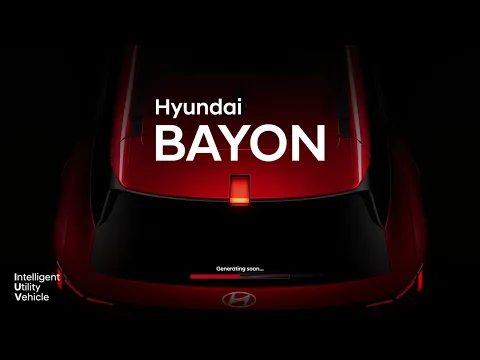
Prototypes indicate that the position lights will be located near the rear window, in a high area of the body, while the brake lights will be installed lower down, at the ends of the bumper.
This separation partially resembles the current Kona and allows for a unique visual signature, distinguishing the Bayon from both the Creta and the i20.

The window line rises sharply after the rear doors, while the C-pillar is expected to be wider and extended, creating a more robust SUV appearance.
This design will help prevent the car from being perceived merely as a lifted version of the hatchback.
Interior Will Feature Two 12.3-Inch Screens from the i20
The connection to the i20 will be much more evident inside the cabin.
Spy shots and reports indicate the adoption of two interconnected screens, similar to the 12.3-inch screens used in the higher versions of the national hatchback.
The steering wheel will also be shared. In the new Brazilian i20, Hyundai replaced the traditional central logo with a Morse code representation of the letter “H,” a feature expected to appear in the Bayon as well.
Air vents, physical controls, and part of the dashboard design may also be shared.
This strategy reduces costs without requiring Hyundai to develop all interior components from scratch for two sequentially launched models.
Disc Brakes on All Four Wheels Expected to Be Part of the Package
Another technical element indicated for the SUV is the use of disc brakes on all four wheels.
This solution stands out in a segment where some entry configurations still use drums at the rear.
In addition to braking performance, the K3 platform paves the way for a more recent generation of electronic assistance systems.
Specialized sources point to the possibility of an ADAS package with advanced features in the upper versions, following Hyundai’s strategy to enhance active safety systems in its new products.
Jeep Avenger to Increase Pressure Starting in 2027
The Jeep Avenger will be especially significant as it is also slated for local production.
As a result, the Bayon and Avenger will enter the market around the same time, competing for buyers seeking a smaller, more affordable SUV compared to traditional models like the Creta, T-Cross, and Compass.
Quatro Rodas explicitly places the Jeep among the main competitors of the upcoming Hyundai.
The competition will involve pricing, fuel efficiency, safety features, connectivity, and interior space, while performance will show relatively smaller differences in the base models.
For Hyundai, having a turbo flex engine and locally produced automatic transmission provides a significant cost advantage.
Production in Piracicaba Required Expansion to 215,000 Cars per Year
The arrival of the Bayon is part of a much larger industrial movement.
Hyundai announced that its Brazilian factory has been upgraded to exceed 215,000 vehicles of annual capacity, operating with a structure ready to accommodate new products.
The brand maintains an investment cycle of approximately R$ 5.5 billion (about US$ 1 billion) in Brazil until 2032, aimed specifically at renewing and expanding its national lineup.
Piracicaba is already responsible for the HB20 and Creta and also received the new i20.
With the Bayon, the unit will operate an even larger family of locally produced vehicles, sharing engines, platforms, suppliers, and production processes.
Bayon Could Replace Space Currently Occupied by HB20S
The new offensive may also trigger significant changes in the current lineup.
Reports from the specialized press indicate that the Bayon will take over part of the space associated with the HB20S in the factory, following a transformation in the Brazilian market towards SUVs and crossovers.
Hyundai, on the other hand, currently keeps the HB20S in its catalog and continues to offer the sedan as a 2026/2027 model.
The reorganization is expected to take place gradually as the production volume of the Bayon increases.
The commercial logic is clear: i20 at the base, Bayon above it, and Creta occupying the upper tier.
Creta May Move Up a Category to Make Room for its Smaller Sibling
The arrival of the new SUV will also enable Hyundai to reposition the Creta.
At approximately 4.20 meters, the Bayon will go head-to-head with the most affordable SUVs. The Creta can continue to evolve in size, features, and price without leaving a gap below it.
The K3 platform of the new family is also expected to be used in the future generation of Creta, creating a sort of technical staircase within the range.
This will allow for technology sharing while maintaining clear differences in dimensions, engines, and finishes.
In practice, the Bayon will be the SUV for those looking to enter the brand at a lower cost, while the Creta will maintain a more sophisticated positioning.
Possible Electrification on the Horizon
Although the Brazilian launch is expected with the 1.0 turbo flex engine producing 115 hp, Hyundai’s electrification strategy opens the door for other solutions over the commercial lifespan.
During development, there were indications of a potential future 48-volt mild hybrid system, similar to technologies utilized by the manufacturer in other markets.
However, the launch configuration will be crucial to keep the Bayon competitively priced.
Using the already produced and market-known 1.0 turbo engine reduces costs and simplifies maintenance, while an electrified version may arrive later at a higher positioning.
Hyundai Bayon to Become the New Entry-Level Model in the Brand’s SUV Lineup
The final strategy is to make the Bayon one of the most important models in the Brazilian operation.
The SUV is expected to launch in 2027 with production in Piracicaba, approximately 4.20 meters in length, 2.60 meters between axles, and a 1.0 turbo flex engine producing 115 hp connected to a six-speed automatic transmission.
The design will follow a unique path, featuring split headlights, a raised hood, roof rails, and elements inspired by the recent design language of the Creta and Kona.
Inside, the strategy will be to share technology with the i20, including the steering wheel, dashboard architecture, and digital screens of up to 12.3 inches.
Domestic production will take place within an expanded factory capable of more than 215,000 vehicles per year, completing the equation.
With Volkswagen Tera, Fiat Pulse, Renault Kardian, and Jeep Avenger already competing or entering this same segment, the Bayon arrives to fill the gap in Hyundai’s lineup: a true compact SUV below the Creta, manufactured in Brazil, designed to make the entry segment one of the most competitive battles of 2027.


