





 Portuguese
  English
  Spanish
  4 min of reading
  0 comments


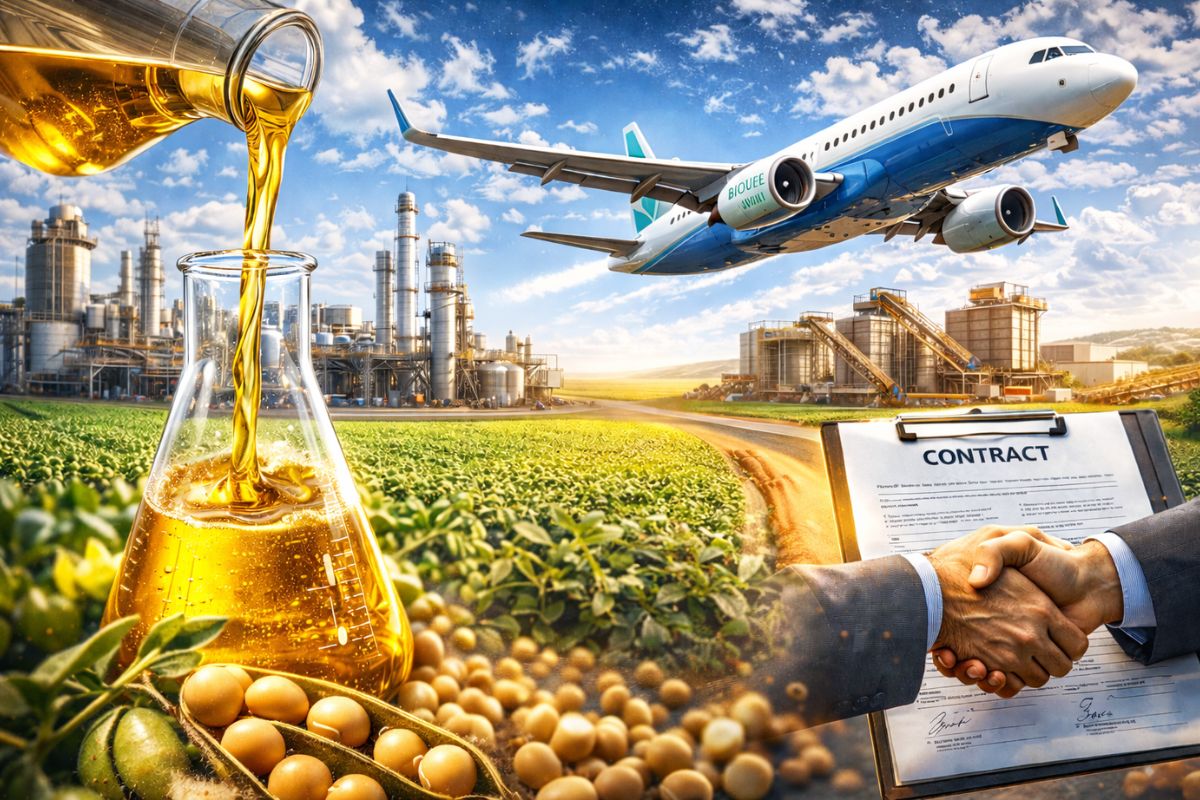
With Corsia in mandatory phase, sustainable aviation fuel accelerates demand, values soybean oil, and pulls long contracts that provide predictability to the producer.
Soy has always been treated as a commodity, with prices dictated from outside and tight margins here. However, starting in 2026, this logic begins to turn upside down as the grain starts to feed a chain where the final product is fuel for global aviation.
The engine of this turnaround is regulatory and market-driven at the same time: Corsia enters a phase of mandatory compliance and pushes airlines to offset emissions. The result is a race for SAF, and those who deliver the right input for this fuel start to compete for premiums, long contracts, and a new place in the value distribution.
From commodity discount to oil premium
For decades, Brazilian producers sold soy in the most well-known model: scale, grain export, and little value capture in refining.
-
Brazilian agribusiness advances in four countries at the same time, gains space to sell fruits to Cuba, and opens shipments of meat, seeds, and feed to new markets.

-
At least two ships loaded with fertilizers for Brazil are stranded in the Strait of Hormuz amid the conflict with Iran, and Brazilian importers still do not know when the shipments will arrive.

-
Brazilian agribusiness found in China more than just a giant buyer: it was US$ 55.3 billion in 2025.
-
Brazilian nanotechnology surprises by transforming soybean seeds into intelligent structures that accelerate germination and may change the future of agricultural productivity in the country.

The change comes when SAF, the sustainable fuel for aviation, becomes the most accepted way to meet emission requirements on international routes.
The central point is the mismatch between supply and demand. The data indicates that SAF still represents less than 1% of the kerosene consumed by global aviation.
With urgent demand, a premium is born for those who can supply soybean oil as an input, and cited estimates indicate a premium of 40% to 80% above the food price in part of this market.
How soybean oil becomes airplane fuel with HEFA

The dominant technological route described is HEFA, hydroprocessed esters and fatty acids, which is responsible for more than 80% of the SAF produced.
In simple terms, vegetable oil enters a reactor with hydrogen under high pressure and temperature, and the molecules are reconstructed into paraffinic hydrocarbons.
The result is a fuel “drop in,” compatible with the kerosene used today. It can be mixed with conventional fuel without requiring changes in engines or infrastructure, which accelerates adoption and reduces entry barriers in aviation.
Bio-refineries alongside crushers and the logistics that change the game
The Brazilian turnaround, according to the data, is logistical and industrial: installing bio-refineries directly next to soybean crushers.
When oil is processed close to the source, transportation costs and emissions drop, improving the carbon score of the final product.
And this detail affects the price. The logic presented is straightforward: the lower the carbon intensity of the process, the higher the value of the fuel, because international buyers pay premiums calculated based on this indicator.
Why Brazil enters strongly in this race
The data organizes the Brazilian advantage into three pillars.
The first is the Northern Arc, with modernized ports that shorten the journey by up to 40% compared to longer road routes. For a fuel of high value and liquid transport, this efficiency becomes a competitive advantage.
The second is agricultural practices cited as a differential, such as no-till farming on over 35 million hectares, in addition to integration systems.
The effect is soy with lower carbon intensity, and the text mentions that a fuel produced with this soy can be certified with a footprint up to 80% lower than that of fossil kerosene.
The third pillar is ethanol infrastructure: network, regulation, expertise, and commercial relationships that allow adaptation and scaling without starting from scratch when it comes to energy and logistics for supply.
Long contracts and the producer moving away from the Chicago price


The text describes a movement of joint ventures between cooperatives and international aviation players, with a clear design: the cooperative provides input, volume, and traceability; the airline provides capital, technology, and long-term offtake contracts, in some cases for 15 years.
This format changes the day-to-day life of the producer because it replaces part of the volatility with predictability. Instead of being stuck with the typical commodity discount, the farmer locks in conditions with guaranteed spread and demand, with a chance to capture value from the fuel and also add revenues from carbon credits generated by good practices, cited as varying between 15 and 60 per ton of CO2 avoided.
The structural pressure of SAF and the new “dual market” for oil
The data also points to adoption targets for aviation, with increasing SAF requirements over time, which increases pressure on vegetable oil stocks. This creates a dual scenario, food versus air energy, with two buyers competing for the same product.
For Brazil, the reading is strategic: maintain leadership in soy and, with the consolidation of the SAF chain in the national territory, gain space as an exporter of sustainable aviation fuel.
There is even a cited projection of capacity of up to 10 billion liters per year by 2035 using the installed crushing capacity, without expanding planted areas.
In the end, the promise is simple and powerful: the field becomes the starting point, the biorefinery becomes the transformation link, and the airport becomes the destination.
And the producer who enters early into this logic can stop being just a grain supplier to become a supplier of strategic energy in the form of fuel.
Have you heard of any SAF or bio-refinery project in your region that could transform soy into fuel?








Seja o primeiro a reagir!