





 Portuguese
  English
  Spanish
  8 min of reading
  0 comments


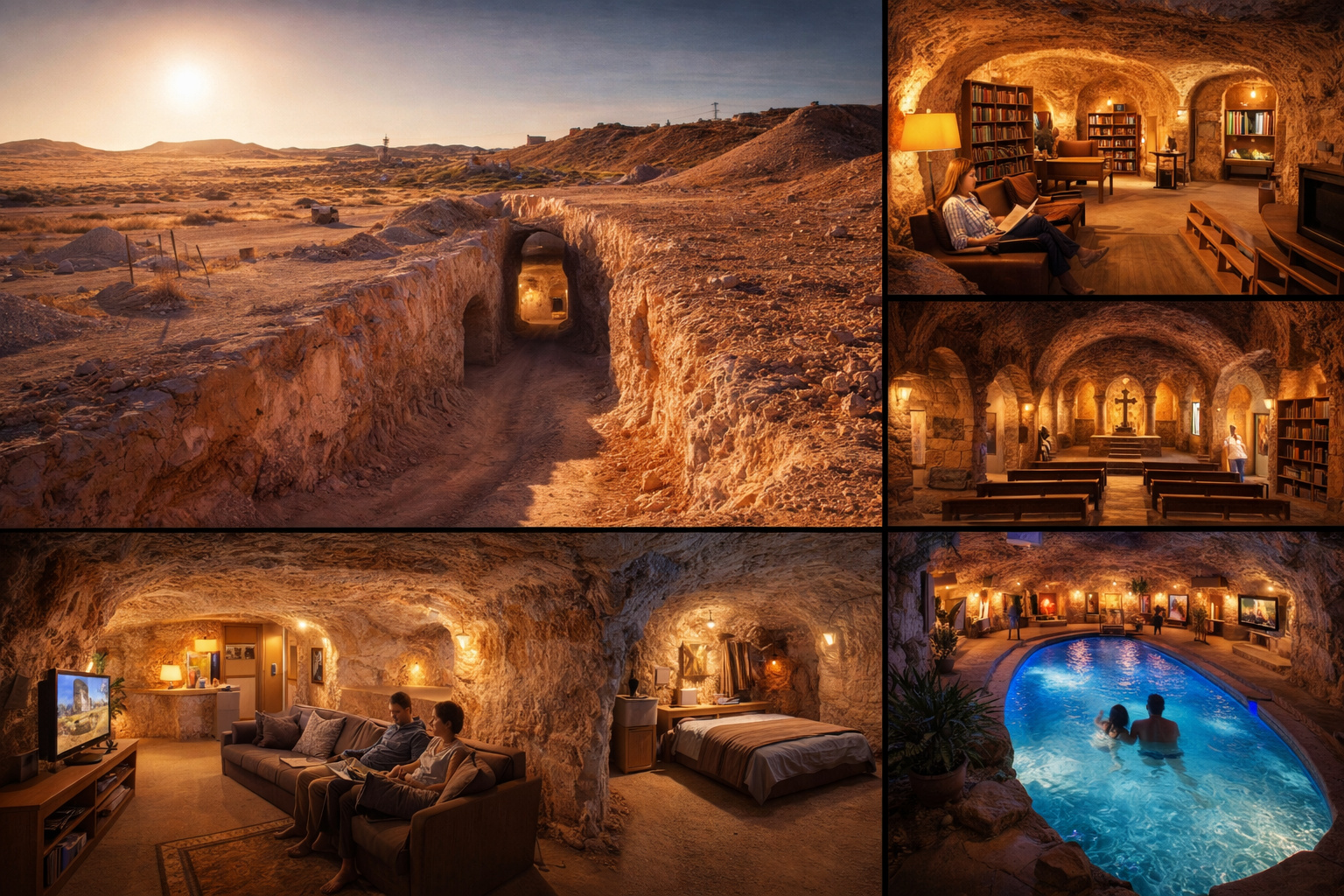
In Coober Pedy, a subterranean city in Australia, residents live in adapted old opal mines, maintaining a constant temperature and natural thermal comfort, while leading the world’s opal production.
Located 846 kilometers north of Adelaide, in the southern Australian desert, there is a city where life happens underground. On the surface, Coober Pedy looks like a post-apocalyptic scene — red earth, dust, sand hills, and no natural trees. Below, three-bedroom houses, bathrooms, kitchens, living rooms, internet, and running water are dug into the rock, at a constant temperature of 22 to 24°C all year round.
According to the Encyclopaedia Britannica, Smithsonian Magazine, and Wikipedia, the city is called the “Opal Capital of the World” because 70% of all opals on the planet come from there. And most of its residents literally live inside holes dug into hills — not out of poverty, but because the rock solves the problem that air conditioning cannot: a desert where thermometers exceed 50°C in the shade.
A teenager, an opal, and the beginning of it all
On February 1, 1915, Willie Hutchison, a 14-year-old boy, was accompanying his father and two partners on a failed expedition in search of gold in the interior of Australia. While the men went out to look for water, Willie stumbled upon pieces of opal simply lying on the surface of the ground. Subsequent investigations revealed an abundance of the gemstone beneath the arid land.
-
The park houses one of the oldest cave systems in the world: formed 400 million years ago, it includes over 220 km of caves, giant underground rivers, and rare species that exist only there, between Vietnam and Laos.
-
The Israeli Air Force trains pilots for modern warfare with the M-346 Lavi, simulating real combat, in-flight refueling missions, advanced virtual integration, and rigorous training to operate F-35I, F-15I, and F-16I in high-threat scenarios.

-
An employee of a paper factory disobeyed the Nazis’ order to destroy the party files, hid millions of records, and today these documents are revealing family secrets that Germany preferred to keep hidden for decades.

-
No more expensive plaster: a technique that adheres panels directly to masonry speeds up renovations, cuts costs, and gets everything ready for painting.

The news spread. Miners began to arrive — many of them soldiers returning from World War I in search of a second chance. A settlement emerged and was officially named Coober Pedy in 1920. The name comes from the Aboriginal term kupa-piti, which means “hole of the white man.” The Aboriginal peoples of the region, who had lived there for thousands of years as nomadic hunter-gatherers, call the place Umoona — “long life.”
The problem: 52°C in the shade
The first miners tried to live on the surface. They built conventional houses, as they would in any other town. The desert said no. In summer, temperatures can reach 52°C in the shade — when there is shade, which is rare in a treeless landscape. The relative humidity rarely exceeds 20%. At night, in winter, the desert cools drastically. The thermal oscillation makes life on the surface an exercise in endurance.
The solution came from what the miners already knew how to do: dig. If they spent the day inside tunnels digging for opal at a comfortable temperature, why not live there too? Using the same mining tools, they began to excavate homes in the sandstone hills — the “dugouts,” as they are called locally. The rock keeps the internal temperature between 22 and 24°C all year round, with no heating in winter and no air conditioning in summer.
A three-bedroom house dug into the rock
Excavating a three-bedroom dugout with a living room, kitchen, and bathroom in the hill costs approximately the same as building a conventional house on the surface. The difference is that the underground house does not need air conditioning — a brutal energy saving in a desert where electricity is expensive and infrastructure is limited.
The houses have electricity, running water, and internet. They have no windows, but residents describe the interiors as spacious and surprisingly cozy — the orange sandstone walls give a warm tone to the environments.

Some residents carve shelves directly into the rock. One resident built an underground swimming pool at home. The bar of a former crocodile hunter named “Crocodile Harry” — open to the public after his death in 2006 — has walls covered with eccentric art and random artifacts, including a fake crocodile and a giant woman sculpture.
Churches, bookstores, and museums underground
Life underground in Coober Pedy is not limited to residences. The city has churches carved into the rock — the Serbian Orthodox Church, built in the 1990s, has backlit stained glass and figures of saints sculpted into the sandstone walls. The Catacomb Anglican Church, hand-dug in the 1970s, is simpler. The Catholic Church of St. Peter & Paul, inaugurated in the 1960s, is cross-shaped.
There is also Underground Books, a bookstore located in an old mining shaft. The Underground Art Gallery showcases local Aboriginal art, didgeridoos, and dot paintings. The Umoona Opal Mine & Museum is an old opal mine turned museum, where visitors can walk through the original tunnels and learn about mining. And the Desert Cave Hotel offers underground rooms for tourists — an experience that Smithsonian described as “underground serenity.”
The grassless golf course
If life underground in Coober Pedy is unusual, life on the surface is surreal. The city’s golf course has no grass — it is played on bare earth, with squares of carpet that players carry to use as tees. Night games use balls that glow in the dark. Before a tree-planting initiative, the tallest tree in the city was a metal sculpture made of scrap.
Signs around the city alert pedestrians to “unmarked holes” — remnants of abandoned opal excavations that dot the landscape like lunar craters. The local drive-in cinema asks viewers to “leave your explosives at home.” And a thin layer of red dust covers everything — cars, buildings, clothes, and faces — as a permanent reminder that the entire city is, literally, a hole in the desert.
250,000 mine entrances and 45 nationalities
Until 1999, more than 250,000 mine shafts had been excavated in the Coober Pedy region — a number so large that they pose a real danger to residents and tourists. The population is about 2,500 people from over 45 different nationalities — Europeans, Asians, Greeks, Serbs, Croats, Aboriginals — creating one of the most multicultural communities in Australia, in the midst of the most inhospitable place on the continent.

Mining has prohibited excavation in the residential area, but many miners circumvent the rule by “expanding” their homes — a euphemism for continuing to dig for opal disguised as home renovation. Britannica notes that there may be millionaires living in Coober Pedy, but the information is kept in absolute secrecy — because revealing a valuable discovery would cause all surrounding land to be bought immediately.
Setting of Mad Max and Pitch Black
The lunar landscape of Coober Pedy attracted Hollywood. In 1985, Mel Gibson and Tina Turner filmed Mad Max: Beyond Thunderdome in the city. The post-apocalyptic setting — red sandstone hills, dust, absence of vegetation, and holes everywhere — required almost no set intervention. The film Pitch Black, starring Vin Diesel, also used Coober Pedy as a location. The city has become synonymous with alien landscapes in cinematic culture.
The water that comes from 2 km deep
The water in Coober Pedy comes from the Great Artesian Basin — one of the largest underground aquifers in the world, which extends beneath almost a quarter of the Australian continent. The water is pumped from over 2 kilometers deep and treated before distribution. The costs are the highest in South Australia, exacerbated by aging pipes and losses in the system.

Rain is rare — annual precipitation is extremely low — and there are no rivers or lakes in the region. The entire existence of the city depends on fossil water pumped from an aquifer that formed millions of years ago. It is a structural irony: Coober Pedy lives off two underground resources — opal and water — and both are finite.
The energy that comes from the sun that drives people away
In 2017, Coober Pedy opened a hybrid solar power plant that provides electricity to the city. The same sun that makes the surface uninhabitable and drives people underground now generates the energy that powers their underground homes. The irony is complete: the sun is the villain that created the need for the dugouts and the hero that provides the electricity to light them.
The model for a warmer planet
Coober Pedy is not just a tourist curiosity — it is an involuntary laboratory for the future. As global temperatures rise, the idea of building underground housing to escape extreme heat becomes relevant. Researchers note that rock and soil absorb and retain heat stably, maintaining constant temperatures without the need for artificial heating or cooling — an energy efficiency that no air conditioning system can match.
BBC Future Planet observed that the troglodyte lifestyle may seem eccentric in winter, but its logic becomes crystal clear in the Australian summer, when birds drop dead from heat on the surface. The question that Coober Pedy raises is not “why would anyone live underground?” — it is “why don’t more people live there?”
Anyone can dig — and maybe get rich
A Coober Pedy tradition that attracts tourists from all over the world is “noodling” — the practice of sifting through the discarded sand hills from mining in search of opals that heavy equipment did not detect. No license is required, no sophisticated tools are needed — just a bucket, a sieve, and patience. Valuable opals have been found in heaps that had been declared exhausted.

The precious opal from Coober Pedy is known for its variety of colors and iridescent shine — flashes of red, green, blue, and orange that change with the angle of light. The black opal, rarer, can be worth thousands of dollars per carat. In 2009, a potentially significant shale oil discovery was made in the vicinity of the city, in the Arckaringa Basin, with estimates ranging from 3.5 to 223 billion barrels — but opal remains the resource that defines the identity and economy of the city since 1915.
The hole of the white man that became home
Coober Pedy was born from an accident — a boy stumbled upon opals while his father searched for water. It grew as a miners’ camp that discovered living inside the mine was more comfortable than living outside. It became a city with churches, bookstores, art galleries, and swimming pools, all excavated in rock at a constant 23°C in a desert that exceeds 50°C on the surface.
The Aboriginal name — kupa-piti, “hole of the white man” — was a literal description. More than a century later, it remains the most accurate possible description of a city where all life happens underground, fueled by opal, fossil water, and the sun that drove everyone underground.







Seja o primeiro a reagir!