





 Portuguese
  English
  Spanish
  4 min of reading
  0 comments


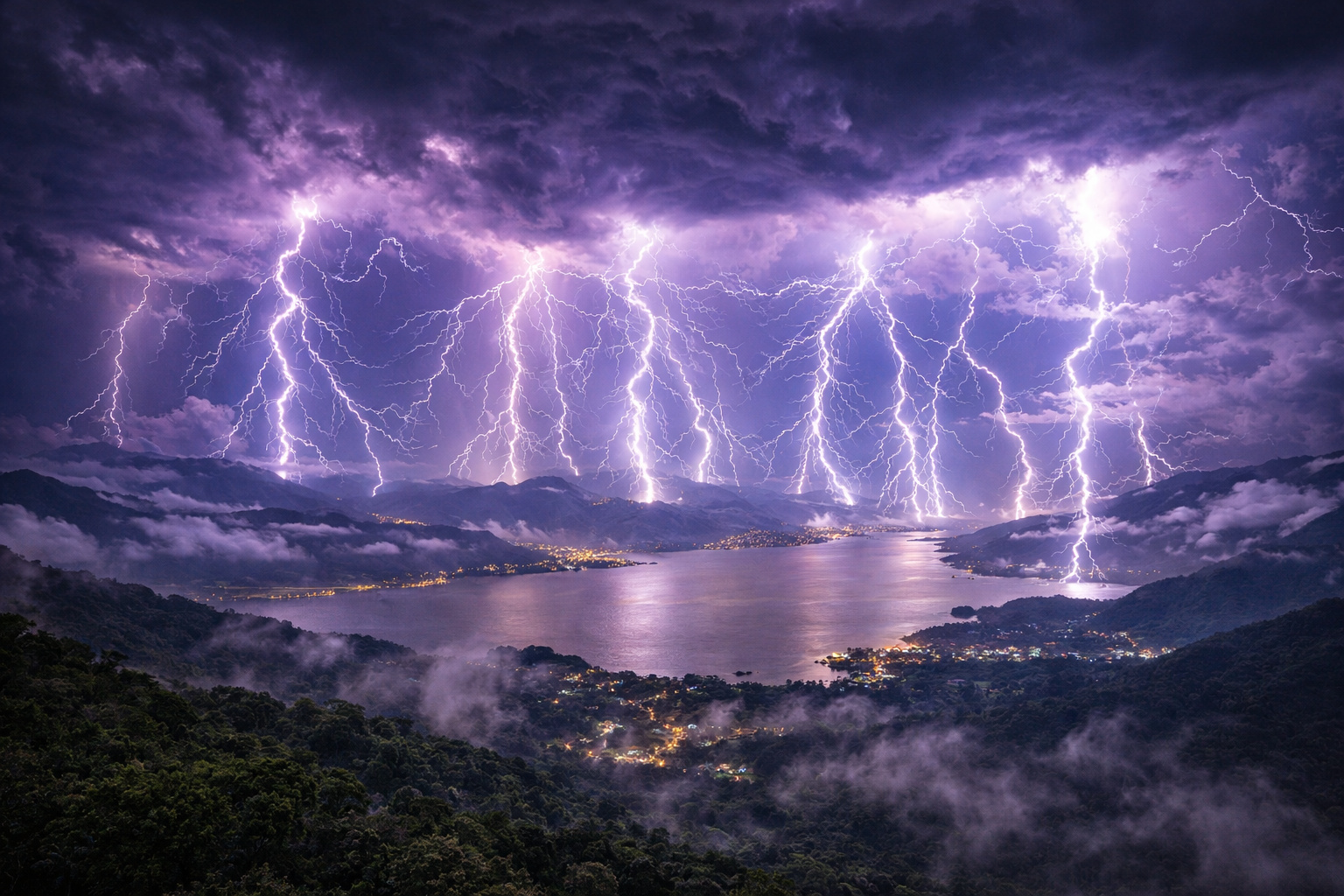
Lake Maracaibo, in Venezuela, is home to the Catatumbo Lightning, considered by NASA to be the largest lightning hotspot in the world, with almost daily electrical activity.
There is a point on the planet where the sky is practically never silent. In the northwest of Venezuela, around Lake Maracaibo, a specific region stands out as the area with the highest concentration of lightning in the world. Known as Catatumbo Lightning, this phenomenon impresses not only by its frequency but also by the intensity and regularity with which it occurs.
According to data from NASA Earthdata, the location registers about 250 electrical discharges per square kilometer per year, a number far above the global average. This pattern places the region as the primary lightning hotspot on Earth, surpassing any other known point.
This extreme behavior is not occasional. On the contrary, it is a persistent atmospheric system that repeats throughout the year with impressive regularity.
-
Goodbye slow and expensive internet: new laser-powered wireless technology reaches 360 Gbps and uses half the energy of Wi-Fi!

-
Yale researchers decipher the “magnetic chaos” of 600 million years and prove that changes in the Earth’s poles followed a structured and predictable pattern!
-
Astronomers identify the planets with the best real conditions to host extraterrestrial life in the universe and reveal the priority targets for the James Webb Telescope!
-
Student finds dragonfly wing from the dinosaur era that was hidden for 75 million years in a park in Canada!


Storms that dominate the sky for almost the entire year
What makes the phenomenon even more extraordinary is its frequency. Images and data analyzed by NASA satellites show that storms over Lake Maracaibo occur on average 297 days a year, which is practically every night during certain times.


This means that, during many periods, the sky in the region remains illuminated for hours on end, creating a continuous natural spectacle. It is no coincidence that the phenomenon has been called the “lighthouse of Maracaibo,” as its brightness can be seen from great distances.
Moreover, scientific studies indicate that this electrical activity occurs mainly at night when atmospheric conditions favor the formation of charged clouds and intense discharges.
Why this region concentrates so many lightning strikes
The explanation for this phenomenon lies in the unique combination of geographical and climatic factors. The Lake Maracaibo region functions as a true “natural laboratory” for storms.
According to NASA and scientific studies, the process begins with the influx of warm, moist air from the Caribbean Sea. This air moves inland and encounters the mountainous terrain around the lake, especially the Andes Mountain Range and the Perijá Mountains.
These formations act as natural barriers, trapping the air and forcing it upward. This movement generates atmospheric instability and favors the formation of highly energized storm clouds. With the heat accumulated during the day and intense humidity, the result is a perfect environment for constant electrical discharges.
A phenomenon confirmed by scientific studies
The classification of the region as the most active on the planet is not just a visual observation. It has been confirmed by studies based on satellite data, such as the TRMM (Tropical Rainfall Measuring Mission) from NASA.
These analyses showed that Lake Maracaibo has an average density of about 233 to 250 flashes per km² per year, consolidating its position as a global leader in atmospheric electrical activity.
Academic research, such as the study “Characterization of the lightning activity of Relámpago del Catatumbo,” also reinforces these numbers and highlights the uniqueness of the phenomenon in the global context.
A natural spectacle that goes beyond science
Despite all the scientific explanation, the Catatumbo Lightning remains one of the most impressive natural phenomena on the planet. During certain nights, hundreds of lightning strikes can occur in succession, illuminating entire clouds and transforming the sky into a true light show.
This spectacle not only attracts the attention of scientists but also of tourists and local residents, who coexist with the phenomenon as part of their daily lives.

At the same time, it serves as a reminder of the complexity of the Earth’s atmosphere and how natural factors, when combined in a specific way, can generate unique events on a global scale.
One of the most extreme environments in the Earth’s atmosphere
The combination of heat, humidity, and terrain makes Lake Maracaibo one of the most extreme environments on the planet when it comes to electrical activity.
There, the atmosphere functions almost like a closed system of storms, where the ideal conditions are constantly renewed. This continuous cycle explains why the phenomenon not only exists but remains active over decades.
In the end, the Catatumbo Lightning is not just the place with the most lightning on Earth. It is also one of the clearest examples of how the planet still holds phenomena capable of surprising even modern science.





Seja o primeiro a reagir!