





 Portuguese
  English
  Spanish
  4 min of reading
  0 comments


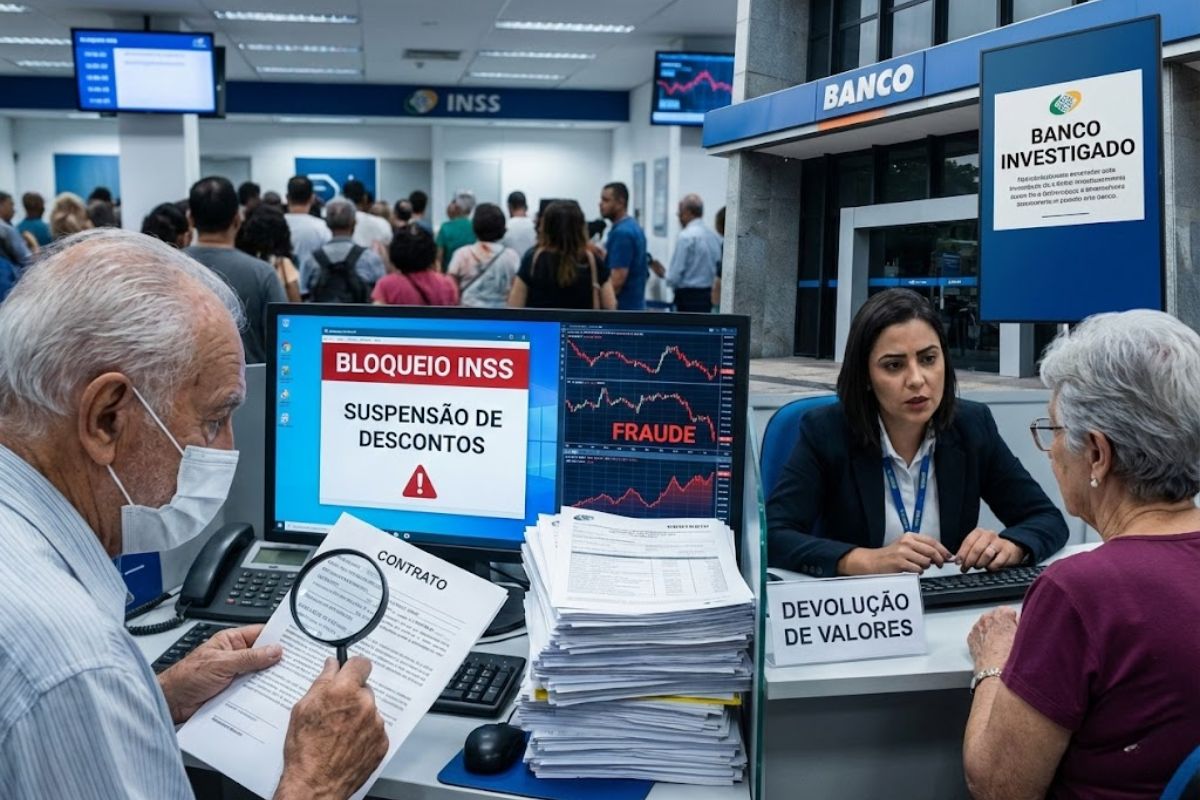
INSS Blocks Bank Upon Suspending Payments of Consigned Loan from Banco Master, in Liquidation Since November, After Signature Verification Failures. Agency Identified Irregularities in 254 Thousand Operations, Above R$ 2 Billion, Prohibited New Offers Since September 2025 and Discusses Refund in Meeting of January 19 Today
The INSS blocks bank and places Banco Master at the center of a crisis that directly affects retirees and pensioners across Brazil, after identifying suspicions in consigned loans with discounts applied to pension benefits.
The measure involves the suspension of monthly payments that would be directed to the bank through these discounts, in addition to the promise of refund of amounts if there is no proof of signature and validity of the contracts indicated as irregular.
What Did INSS Block and How the Block Affects Deductions from the Benefit
The block determined by INSS falls on the resources that, month after month, would be transferred to Banco Master from direct discounts made on the payroll of pensions and retirements.
-
“No one will make us change the Pix,” says Lula after the US report.

-
Lula responds directly to Trump and says that Pix is from Brazil and will not change under pressure from anyone, after a report from the United States pointed out the Brazilian payment system as an American trade barrier.

-
Amazon has just announced a new fee on all deliveries, and your online purchases will become more expensive starting April 17, including for those buying from the United States here in Brazil.

-
He sold his share for R$ 4 thousand, saw the company become a giant worth R$ 19 trillion, and missed the opportunity of a lifetime.


In practice, the agency interrupted this flow to prevent funds from continuing to be transferred while the documentation of the contracts is being questioned.
The central point of the case is the bank’s inability to <strongprove the authenticity of the contracts signed with beneficiaries.
According to INSS, the documentation sent contained flaws that prevent the validation of the signature and the regularity of the operations.
The Size of the Problem: 254 Thousand Operations and More Than R$ 2 Billion in Credit
INSS reported identifying irregularities in about 254 thousand credit operations, a volume that puts more than 250 thousand benefits under review.
The amount involved, according to the presented data, exceeds R$ 2 billion, elevating the case to the level of an uncommon financial crisis linked to consigned loans associated with pension benefits.
This volume helps explain why the decision was not limited to an internal investigation.
In addition to halting payments, INSS has begun to directly discuss contractual proof, since the impact of the discount on benefits is immediate for those who rely on this monthly payment.
Why Did INSS Consider the Contracts Fragile and What Was Pointed Out in the Documentation
INSS’s justification is based on the lack of sufficient proof of signature and validity.
The president of the agency, Gilberto Waller Júnior, stated that the documentation sent presented flaws and summarized the issue directly:
“The documents submitted had insufficient data to prove the signature and the validity of the contracts.”
The technical point, based on what was reported, is that the analysis required elements capable of confirming the regularity of the hiring.
Without this confirmation, INSS treats the operations as suspicious and conditions any continuation on effective proof of legality.
The Timeline: Prohibition in September 2025, Break in October and Liquidation in November
The case did not begin in 2026. In light of the irregularities and the volume of complaints received, INSS prohibited Banco Master from carrying out new consigned credit operations.
This restriction has been in effect since September 2025, indicating that the problem was already being treated as a risk prior to the suspension of payments.
In October, INSS announced that it would not renew the Technical Cooperation Agreement that allowed Banco Master to offer consigned credit to retirees and pensioners.
This move reinforced the block and opened the way for the review of contracts considered suspicious.
Subsequently, with the liquidation of Banco Master officially confirmed in November, INSS began addressing the issue directly with the liquidator of the institution, changing the interlocutor and making the discussion more connected to the formal process of closing and auditing the bank.
What May Happen Now and How INSS Promises to Refund Money
With the bank in liquidation, INSS announced that a meeting is scheduled for January 19, 2026 to discuss the proof of the contracts.
The focus is singular: to verify whether there is sufficient documentary evidence to support the operations that generated discounts on benefits.
If legality is not confirmed, the agency’s promise is to cancel the consigned loan and refund the withheld amounts. Gilberto Waller Júnior summarized the commitment with a straightforward statement:
“If the signature and authenticity of that contract are not proven, INSS will cancel the consigned credit, and the amount that was withheld will return to the pockets of our retirees.”
Who Is at the Center of the Crisis and Why the Case Is Treated as Exceptional
The affected public, according to the presented data, consists of retirees and pensioners of INSS who contracted loans with Banco Master.
The seriousness of the case is supported by three mentioned pillars: volume of operations, billion-dollar financial sum, and flaws in signature verification.
The combination of automatic deductions from pension benefits and contested contracts creates the most sensitive possible scenario, because the effect of the deduction does not depend on a payment slip or external collection: it directly appears in the monthly payment, which increases the pressure for a swift review and a clear resolution.
Do you believe that INSS blocks bank early enough to protect retirees and pensioners, or should this review have occurred before reaching 254 thousand operations?









-

Uma pessoa reagiu a isso.