





 Portuguese
  English
  Spanish
  5 min of reading
  10 comments


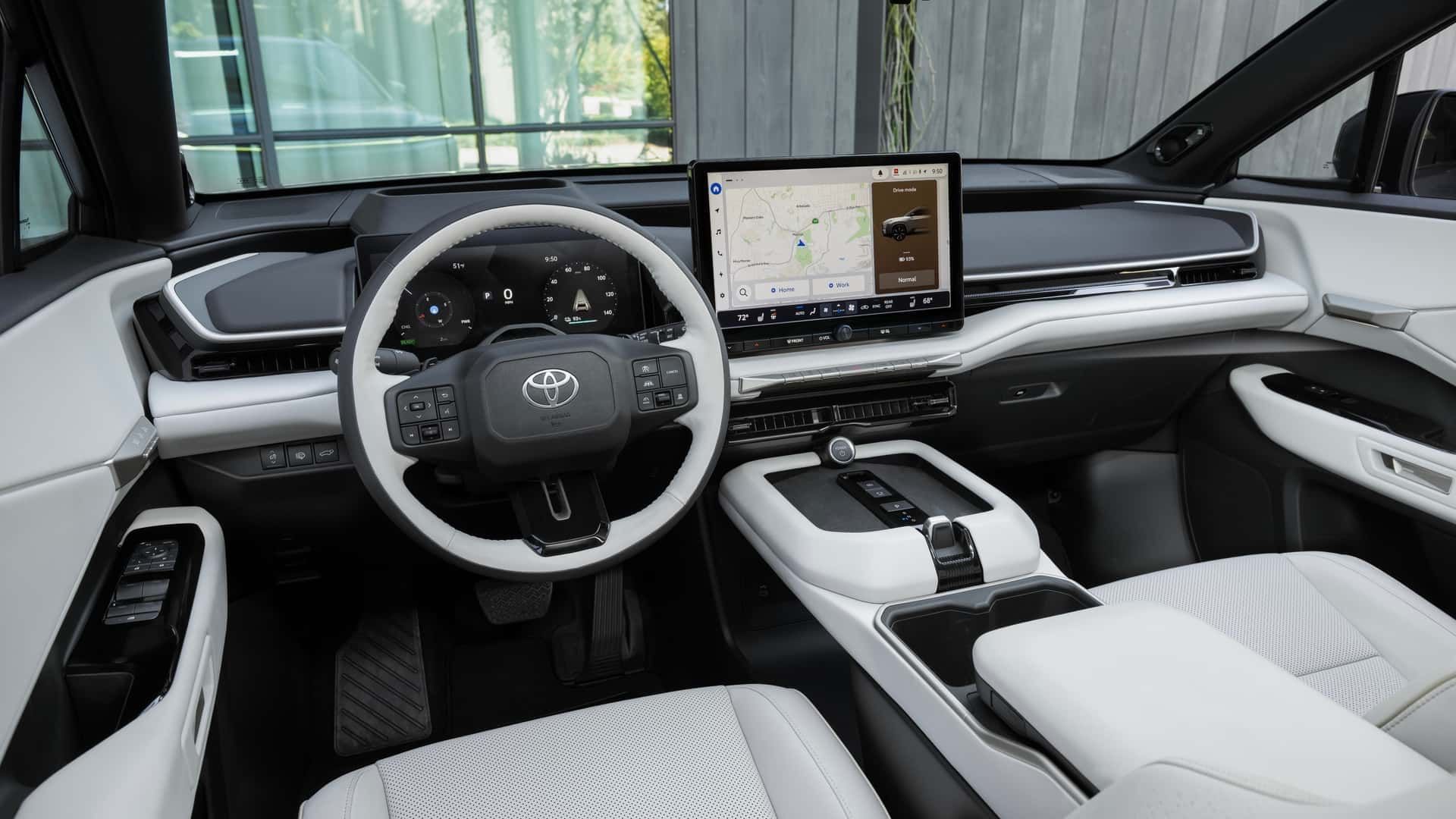


Seven-Passenger Electric SUV Launches New Phase for Toyota in the US with Up to 515 km of Range, 343 hp of Power, 95.8 kWh Battery, AWD, and a System Capable of Supplying External Power in Emergencies.
Toyota confirmed in the United States the arrival of a new generation of the Highlander powered exclusively by electricity, with up to seven seats, 95.8 kWh battery, and an estimated range of up to 515 km, targeting the three-row family SUV segment which currently has rivals such as Kia EV9 and Hyundai Ioniq 9.
Despite the “kinship” mentioned in the title with the Corolla Cross for being SUVs of the same brand, the Highlander is a utility vehicle of superior size and purpose, and now occupies a higher tier in Toyota’s electric lineup, which also sells the bZ4X in the American market.
First Fully Electric Highlander
The Highlander is a well-known name for the North American audience, originating in the early 2000s and characterized by combustion and hybrid versions, but the new generation changes the strategy by adopting only an electric powertrain at launch, maintaining the focus on family use and capacity for seven occupants.
-
The car stored for 38 years: when opening the barn door, what appears is breathtaking and looks like a scene from a movie!

-
Fiat works miracles in the Brazilian market, lowers the price of its 0 km hatch to R$ 69,990, reestablishes the model as the cheapest car in the country, and reignites the battle against Kwid and C3.
-
Chevette with cooking gas: How the gas cylinder ends up being used in cars clandestinely and why this makeshift solution can result in leaks, explosions, damaged engines, and seized vehicles.

-
Fiat launches the new 2027 Toro hybrid with 48V, 176 hp, an electric motor of 15.5 hp, a 0.85 kWh battery, up to 7% fuel savings, 8% fewer emissions, and possible exemption from IPVA.

In official communication, Toyota refers to the model as “2027 Toyota Highlander”, without setting “Highlander EV” as a commercial designation, and highlights that the project has been redesigned to be the brand’s first three-row electric vehicle in the US, with a new style and a more technologically advanced cabin.
The utility will be produced in Georgetown, Kentucky, while the battery modules will come from the Toyota Battery Manufacturing North Carolina complex in Liberty, North Carolina, in an arrangement that reinforces the strategy of localizing the electric vehicle supply chain in the country.

When presenting the model, David Christ, an executive from Toyota Motor North America, stated that the new Highlander is designed to be “a stylish and high-tech leader” in the medium SUV segment, with a spacious interior and updated technologies for everyday use.
Declared Power, Battery, and Range
The lineup will have two versions, XLE and Limited, with the XLE offering front-wheel or all-wheel drive options, while the Limited always comes with all-wheel drive, and the battery offerings vary depending on the configuration, with 77.0 kWh at the base and 95.8 kWh in the longer range versions.
In the models with all-wheel drive, Toyota claims 338 hp and 323 lb-ft of torque, numbers that, when converted commonly in Brazil, appear as about 343 hp and approximately 47.7 kgfm, while the front-wheel drive versions come to 221 hp and 198 lb-ft.
For range, the manufacturer indicates estimates reaching 320 miles with the 95.8 kWh battery in the XLE AWD and Limited AWD versions, equivalent to about 515 km, while the XLE FWD with 77.0 kWh is rated at 287 miles, close to 462 km.
The XLE with all-wheel drive and a 77.0 kWh battery has an estimated range of 270 miles, around 435 km, and Toyota emphasizes that the numbers can vary due to climate, driving style, and other factors, which is standard in preliminary estimates for the segment.
Tesla Standard Charging and V2L Technology
One of the key points of the project is the adoption of the North American Charging System (NACS) connector, a standard popularized by Tesla and adopted by several brands in the US, expanding access to fast chargers in that market, in a choice different from the CCS more common in other countries.

The Highlander also debuts, according to Toyota, the vehicle-to-load (V2L) function in a brand model sold in the United States, with the potential to power external equipment and act as a backup in emergencies, although the company emphasizes that this depends on the purchase of bidirectional accessories.
In addition to V2L, Toyota states that the SUV will feature charging management resources linked to functionalities like Charge Assist and ECO Charge, aimed at scheduling charging during lower tariff hours or when there is more availability of renewable energy, with more details promised later.
Hammerhead Design and Technological Interior
In terms of appearance, the new Highlander adopts a front associated with the nickname “Hammerhead”, with LED lighting signature that crosses the front, marked fenders, and flush door handles to improve aerodynamics, seeking to differentiate the SUV in a segment that prioritizes efficiency and space.
Inside, Toyota confirms a 14-inch multimedia center and a 12.3-inch instrument panel, as well as USB ports in all three rows, configurable ambient lighting, and the option of a fixed glass panoramic roof, which the brand describes as the largest in its lineup.
The trim uses SofTex, Toyota’s synthetic material, with heated front seats as standard, ventilation as optional, and heated second-row seats available depending on the version and packages, reinforcing the focus on comfort for urban use and long trips without sacrificing practicality.
In terms of internal utilization, the brand claims that the third row can be fully folded down, forming a flatter floor, and announces superior capacity of over 45 cubic feet behind the second row with the last row lowered, a value that corresponds to about 1,274 liters.
Safety and Driving Assistants

The electric Highlander will come with Toyota Safety Sense 4.0 (TSS 4.0), including features such as pre-collision with pedestrian detection, adaptive cruise control, lane departure alerts and assistance, and sign reading, according to the list presented by the manufacturer for the new model.
Toyota also mentions the Star Safety System and confirms assistances such as automatic emergency braking for parking in front and behind, blind spot monitoring with rear cross-traffic alert, in addition to convenience features like a smart key and rear seat reminder, common in the segment.
Production and Start of Sales
The manufacturer informs that sales are expected to begin at the end of 2026 and move into early 2027, without disclosing prices for now, and the official expectation is to detail prices closer to the start of commercialization, in a market where the transition to electric vehicles is still gradual.
In the meantime, the Grand Highlander remains as a larger alternative with combustion and hybrid engines, and Toyota treats the new electric Highlander as part of the growth of its electrified vehicle lineup, trying to balance range, space, and access to fast charging via NACS.
With a declared range that can reach 515 km in specific versions, seven seats, and the possibility to supply power to equipment and emergencies via V2L, the electric Highlander promises to attract families that prioritize practicality in their daily lives and longer trips.
If Toyota can deliver on the promised range and technological experience, what will weigh more in the American buyer’s decision for a three-row electric SUV: price, charging network, real space in the third row, or trust in the name Highlander?







Carros cada vez maiores para vagas e garagens cada vez menores. Parece piada!
Pois é. Os engenheiros não estão se dando conta disso!
Vagas, garagens e aptos, estão cada vez menor, não por falta de adequação aos veículos e necessidades familiares, mas, principalmente, ao bolso dos compradores, que, no caso do Brasil, está cada vez mais apertado.
Eu acho que pensam somos o povo mais rico do mundo ou simplesmente ****, pra pagarmos o valor quase que dobrado…
O carro é para americano e lá é outro padrão né… Pra nós se vir vai ser em 2029 e vai ser pra alguém que tem uma mansão já custando possivelmente o preço de uma Ferrari.
Esqueceu de comentar sobre o conforto dos ocupantes da terceira fileira.Quero crer que seja mais confortável do que os carros de montadoras no Brasil,que “malema” acomoda 2 crianças e olhe lá. Já presenciei um “brigueiro” de crianças,porque nenhuma queria ir lá atrás nos banquinhos da disciplina.Nem criança quer sentar naquilo lá.Realmente tem coisas que são feitas só pra Inglês ver, principalmente aqui no Brasil.