





 Portuguese
  English
  Spanish
  3 min of reading
  0 comments


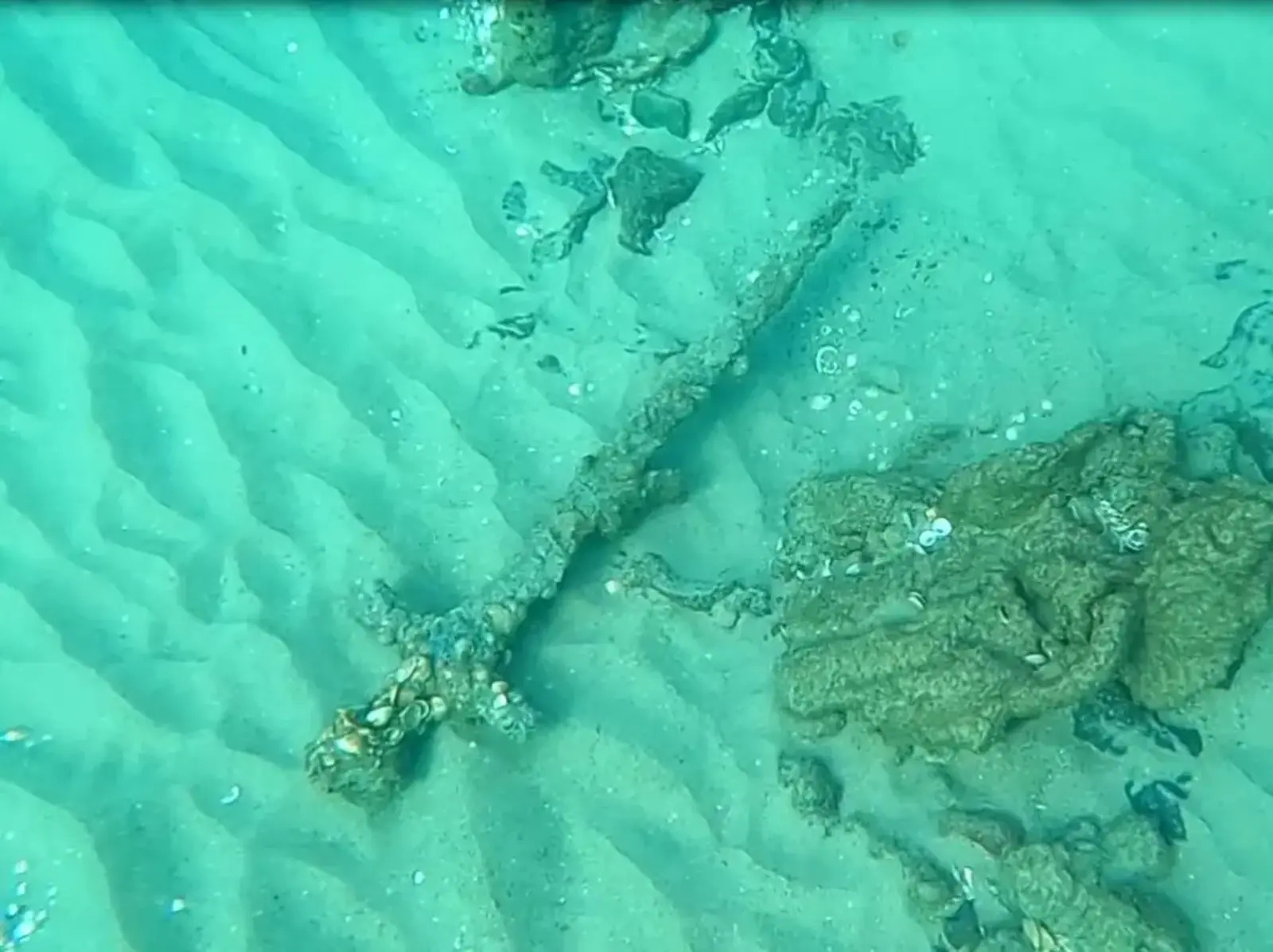
Student of Haifa University accidentally found a 12th-century sword on the coast of Dor, revealing new evidence about the Crusades
A student from Haifa University accidentally found a 12th-century sword on the coast of Dor, in northern Israel, while diving. The find, linked to the Crusades, may enhance the understanding of maritime anchorages and the lives of warriors from that period.
Discovery on the coast
Shlomi Katzin was swimming near Dor when he noticed a group of divers using metal detectors.
A student of maritime civilizations, he suspected they were antiquities thieves and managed to drive them away from the area.
-
Elderly woman finds giant 3-meter, nearly 10 kg boa constrictor under her sofa at home in Búzios.

-
The water loses strength, the fish disappear, and entire families begin to live on the edge while dredging machines extract sand from rivers to supply a metropolis with over 20 million inhabitants driven by the construction of skyscrapers, overpasses, and residential areas.

-
A man renovated a caravan spending less than R$15,000, transforming the vehicle into a small and functional trailer using wood, wheels, metal plates, and wall installation, and surprises with the perfect result.

-
Children from emotionally cold homes reveal a shocking secret: early independence may hide deep traumas and silently and durably impact adult life.

Later, during the dive, Katzin saw the sword emerging from the seabed and acted quickly. He informed Professor Debbie Cvikel from the Department of Maritime Civilizations at Haifa University.
Cvikel contacted the Israel Antiquities Authority, the IAA. After approval for removal, the sword was sent to Elisha Medical Center for a CT scan.
Crusader sword
The sword found on the coast of Dor dates back to the 12th century and measures over a meter in length. Images show that the artifact has been heavily encrusted with shells over the centuries.
Even so, the object retains the unmistakable shape of a sword. For researchers, the find linked to the Crusades is extremely rare and helps illuminate the Crusader presence along the country’s coast.
Debbie Cvikel stated that only a handful of similar swords from the Crusader period are known in the Land of Israel.
She said that the discovery greatly aids in understanding maritime anchorages and the lives of the warriors.
Non-invasive examination
Eyal Berkowitz, an imaging science specialist at Haifa University, said that the techniques used by the team were non-invasive and kept the artifact intact during the analysis.
According to him, the CT scan allowed for observation of the internal structure of the sword and its precise physical condition. The examination preserved the integrity of this rare artifact for future generations.
Symbolic value and context
Sarah Lantus from the Department of Maritime Civilizations emphasized that swords were symbols of knights, cavalry, and also of the Christian faith.
She stated that these weapons were among the most common used by the Crusader knights.
Lantus highlighted that the lives of these warriors depended on their swords. Therefore, they were valuable objects, cared for attentively and preserved over time.
The Crusades were a series of wars between Christian and Muslim forces between the 11th and 13th centuries. It all began when Pope Urban II called for the reconquest of the Holy Land in 1095.
The First Crusade resulted in the siege of Jerusalem in 1099. The discovery of the sword adds to other recent archaeological finds in the region, such as a 2,100-year-old sling bullet and a Christian artifact near the Sea of Galilee.
With information from New York Post.







Seja o primeiro a reagir!