





 Português
  Inglês
  Espanhol
  6 min de leitura
  2 comentários




With A Billion-Dollar Investment, Mark Zuckerberg Is Developing AI Smart Glasses That Don’t Depend on Giants Like Apple and Google. See How This Innovation Could Change The Way We Interact With Technology!
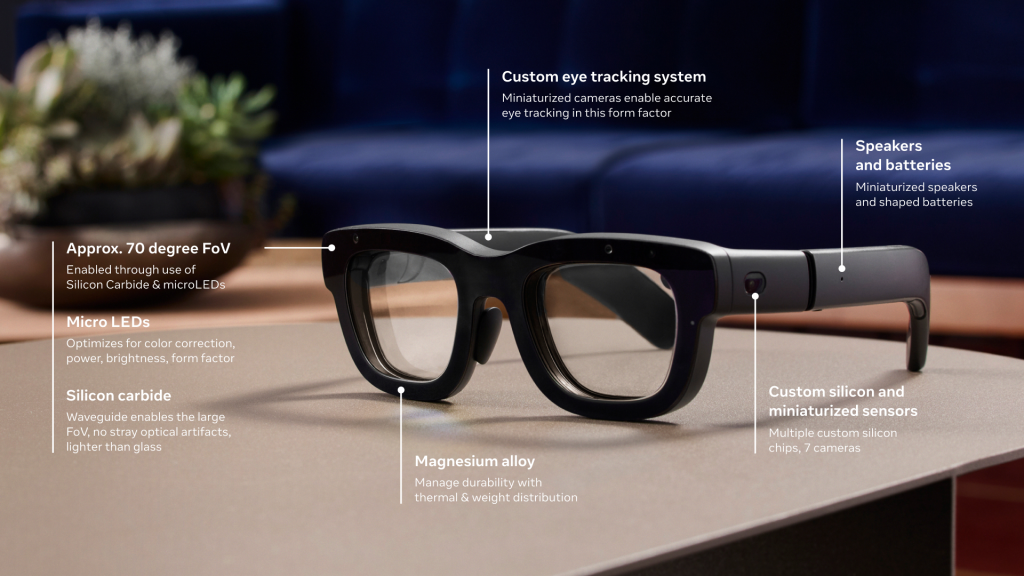
At the latest Meta event, focused on artificial intelligence and the metaverse, CEO Mark Zuckerberg unveiled to the world Orion, an innovative prototype of smart glasses that he described as the next big technological revolution. One of the billionaire’s goals is to drastically reduce reliance on Apple and Google.
Comparing the device to a “time machine“, Mark Zuckerberg expressed his confidence that these glasses will profoundly change the way we interact with the digital and physical worlds, allowing users to experience augmented reality (AR) like never before.
Since Meta, formerly known as Facebook, changed its name in 2021, Mark Zuckerberg has directed billions of dollars in investments toward the development of the metaverse and virtual (VR) and augmented reality (AR) technologies.
-
At over 8,800 meters above sea level, the summit of Mount Everest is made up of rocks that originated at the bottom of an ocean about 500 million years ago and were pushed to the highest point on Earth by the collision of tectonic plates.

-
Japan targets a remote island in the Pacific measuring only 1.51 square kilometers, located 1,900 kilometers from Tokyo, to store nuclear waste for up to 100,000 years, raising alarms at sea.

-
A 1,900-year-old papyrus found in the Judean Desert reveals a crime of the Roman Empire involving fraud, forgery, and a detailed court hearing.

-
New technology transforms the human body into a “machine”: centaur robot reduces effort when carrying up to 20 kg, improves balance during walking and impresses in practical tests in China.


However, many investors remain skeptical about the financial return from these massive expenditures, especially in light of the significant losses recorded by the company in recent years.
Mark Zuckerberg’s Battle Against Apple and Google
The main motivation behind Meta’s huge investments in AR and VR is Zuckerberg’s desire to reduce the company’s dependence on tech giants Apple and Google, which currently dominate the smartphone ecosystem and apps.
Apple, for example, with its control over the iOS system, implemented changes in 2021 that made it more difficult to track users through apps like Facebook and Instagram.
This measure directly affected Meta’s ability to measure the effectiveness of advertising campaigns, severely impacting the company’s revenue and causing an estimated loss of US$ 10 billion in 2022.
In light of this scenario, Mark Zuckerberg decided to seek greater autonomy for Meta by investing in the development of its own hardware and software platform.
The idea is that by completely controlling the devices and operating systems where its apps run, Meta can maximize its profits and reduce its vulnerability to changes imposed by other companies.
The introduction of Orion is part of this strategy. According to Mark Zuckerberg, these smart glasses have the potential to transform the way we interact with the digital world, projecting virtual objects into the user’s field of vision and enabling everyday tasks to be performed more intuitively and integrated.
Additionally, with a “neural interface” wristband, users will be able to control the glasses through small gestures, without the need to use a smartphone.


Mark Zuckerberg’s Investments in the Metaverse
Meta’s Reality Labs division, responsible for the development of the metaverse and AR/VR technologies, has reported multi-billion dollar losses in recent years.
In the first half of 2024, the division incurred a loss of US$ 8.3 billion, with sales of just US$ 793 million. Since 2019, losses have exceeded the US$ 50 billion mark, leading many analysts to question the long-term viability of this project.
Mark Zuckerberg, however, remains optimistic. He believes that investments in Orion and the metaverse will bring significant benefits in the future, especially if Meta can control the computing platforms that support its apps.
In a recent interview, he argued that if Meta owned these platforms, the company could double its profits.
Still, realizing this vision faces numerous challenges. Orion, for example, is just a prototype and faces a significant issue: production costs.
Currently, each unit of the glasses costs about US$ 10,000 to manufacture, an extremely high price that prevents large-scale commercialization. Additionally, privacy and security issues remain a central concern.
The smart glasses raise ethical questions about the use of embedded cameras and real-time data transmission. Google’s experience with Google Glass, launched over a decade ago, serves as a warning.
The project faced widespread criticism, with users being dubbed “Glassholes” due to privacy invasion concerns. Harvard students even conducted an experiment showing how Meta’s recently launched Ray-Ban glasses could be paired with facial recognition databases to identify people almost instantly.
The Success of Meta’s Ray-Ban Glasses

Despite the challenges faced by Orion, Meta has already reaped rewards from another product: its Ray-Ban smart glasses, which have become a surprising success.
Launched in 2021, these glasses sold around 700,000 units in the first year, with significant sales growth throughout 2024. This initial success demonstrates that there is indeed a promising market for augmented reality devices.
Meta has updated the Ray-Ban glasses with new features such as real-time language translation powered by artificial intelligence and personalized reminders.
These innovations have made the glasses more useful in everyday life, allowing users to perform simple tasks, such as taking photos or translating a menu, without needing to pull out their phone.
This type of practical functionality has been one of the main attractions of the Ray-Bans, and experts believe that Meta has succeeded in promoting the product through platforms like Instagram, where content creators creatively demonstrate its capabilities.
By listening to user feedback and continuously improving the design and functionality of the glasses, Meta has managed to build a loyal customer base.
Future Of Advertising at Meta
The major challenge for Meta is how to turn investments in the metaverse into a sustainable revenue source. Currently, 98% of the company’s revenue comes from digital advertising, and many analysts believe that developing devices like Orion and Ray-Ban is part of a strategy to expand this market to new platforms.
“The metaverse offers Meta the opportunity to create a new computing platform where it can expand its advertising capabilities and serve ads on new devices“, stated Ralph Schackart, an analyst at William Blair.
By integrating the metaverse with its main apps, such as Facebook and Instagram, Meta hopes to monetize user experiences more efficiently by offering even more personalized and immersive targeted ads.
However, Reality Labs remains a contentious point among investors, who are concerned about rising losses and the lack of an immediate return.
Analysts expect losses to continue increasing over the next three years before Meta can demonstrate a real return on the investments made so far.
The Competition in The Smart Glasses Market: Meta vs Apple and Google
Meta is not alone in the race for smart glasses. Apple, one of the company’s main rivals, launched its own virtual reality headset, the Vision Pro, in 2024, with a starting price of US$ 3,500. Although aimed at a specific niche of consumers, the Vision Pro signals that
Apple is also interested in exploring the potential of what CEO Tim Cook calls “spatial computing”, a term used to describe the future of interaction between the digital and physical worlds.
In addition to Apple, Google is also revisiting the smart glasses concept after the failure of Google Glass. The company has been exploring new versions of the technology, and rumors suggest that it is developing a new AR product that could directly compete with Meta’s devices.
The competition is fierce, but Meta seems to be ahead in the development of smart glasses aimed at the average consumer.
By adopting a more accessible and functional approach with Ray-Ban, the company has managed to build a significant user base, particularly among digital influencers promoting the product on social media.
The Future of Meta
While Meta still has a long way to go to turn Orion into a viable product for the mass market, smart glasses are a crucial part of Mark Zuckerberg’s vision for the company’s future.
By controlling its own hardware and software platforms, Meta hopes to reduce its dependence on companies like Apple and Google, ensuring greater autonomy and profitability in the long run.
However, the company will face significant challenges in the coming years, including reducing production costs, addressing privacy issues, and creating an application ecosystem that maximizes the capabilities of AR and VR devices.
Whether Meta will realize this ambitious vision remains to be seen. What is clear is that, for Mark Zuckerberg, control over the future of computing platforms is more than just a technological issue – it’s a strategy.






Mais uma ferramenta poderosa dentro de um poderoso projeto para a dominação completa da humanidade. De um lado as armas e de outro os meios de controle.
Outra matéria perfeita parabéns a todos.
http://www.rcwtv.com.br