





 Portuguese
  English
  Spanish
  6 min of reading
  0 comments


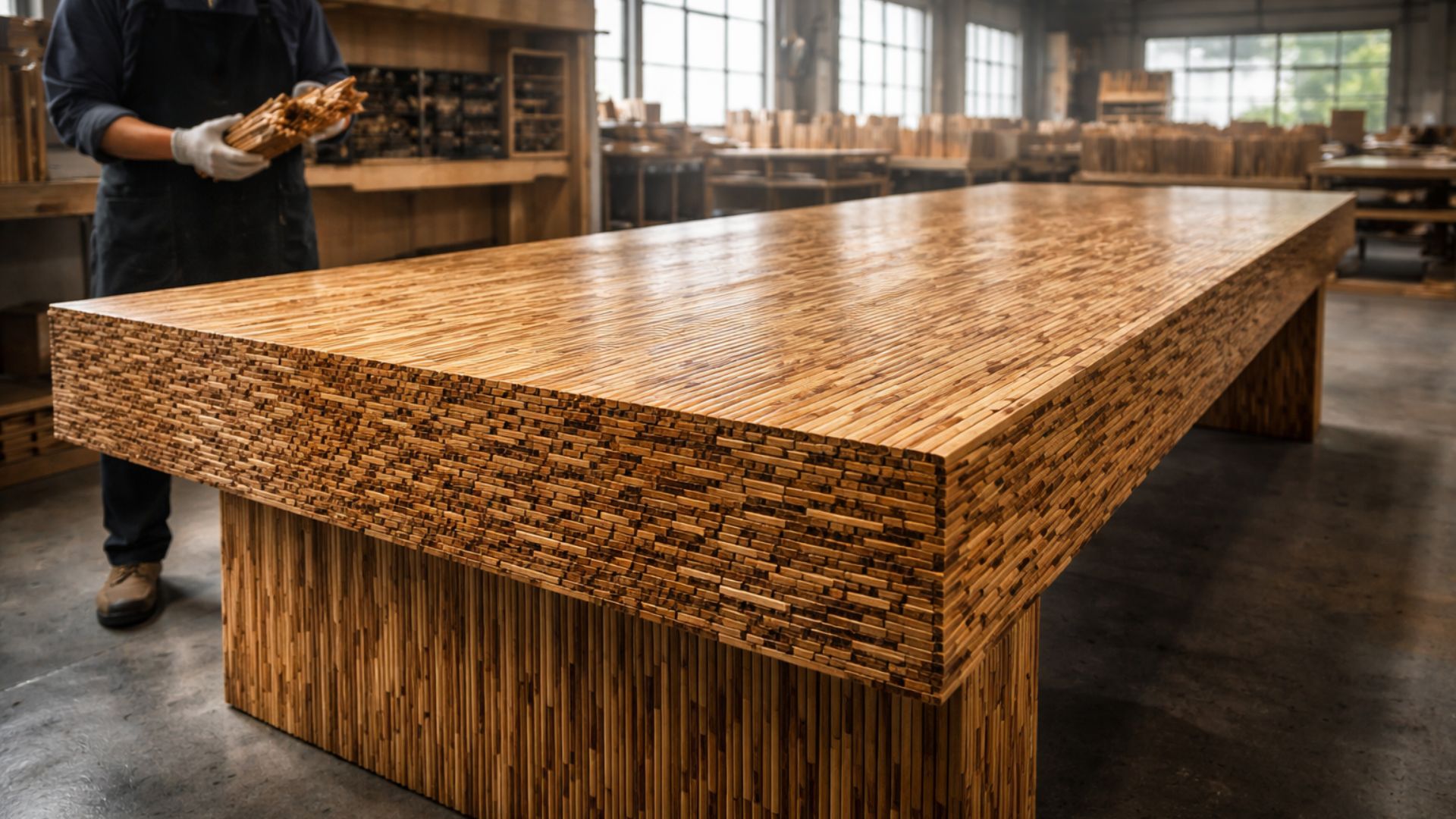
Daily waste gains new industrial function by being reused on urban scale in Japan, connecting restaurants, offices, and construction in a circular chain that transforms disposable chopsticks into furniture and high-use durable materials.
Disposable chopsticks, one of the most frequent wastes in the Japanese urban routine, have begun to supply a reuse chain aimed at producing furniture and interior components for commercial use.
The operation is led by ChopValue Japan, a subsidiary created in Tokyo in July 2024, which structured a local collection and industrial transformation model for the material into pieces intended for restaurants, offices, and other high-traffic environments.
The proposal gained traction because it acts on an item marked by immediate disposal and repositions it as a productive input.
-
Father wins a brand new car in a raffle he organized himself at church.

-
Embraer presents the KC-390 Millennium, the largest military aircraft in Latin America, capable of transporting 26 tons, evacuating 74 patients, conducting in-flight refueling, and operating tactical missions with advanced technology, showcased at FIDAE 2026.

-
A 25 km megacyclovia in SP will be part of a R$ 9.4 billion package that covers 520 km, 22 cities, and could generate 11,000 jobs in the interior of SP.

-
Israeli student accidentally finds a 12th-century sword, over 1 meter long, related to the Crusades period off the coast of Dor.

Instead of heading for incineration or the common waste flow, used chopsticks are collected from restaurants, shopping centers, airports, and companies, processed with heat, steam, and pressure, and converted into furniture and construction materials with commercial standards.
This is the design described by the Japan External Trade Organization, which monitored the company’s establishment in the Japanese market.
Microfactory and circular economy in Japan

The center of this model is the microfactory installed in Kawasaki, in Kanagawa Prefecture.
When the Japanese subsidiary was announced, the forecast was to start full-scale operations in spring 2025, with the logic of collecting waste from the surroundings and returning it to the same urban ecosystem in the form of new products.
The company presents this dynamic as a local-based circular manufacturing system, designed to reduce transportation and shorten the distance between collection, processing, and final use.
This arrangement helps explain why the initiative goes beyond a symbolic recycling action.
The resulting material is not treated as a souvenir or low-scale decorative piece, but as a densified composite aimed at surfaces, tables, coverings, signage, accessories, and tailored solutions for businesses.
On its institutional website, ChopValue states that this composite is produced using proprietary compression technology and can receive commercial finishing to enhance resistance to water, sunlight, and chemical agents.
The company also claims that the material performs comparably to woods traditionally used in the market.
According to the institutional description, the composite made from recycled chopsticks would be harder than maple, more resistant than oak, and as durable as teak.
Since these comparisons come from the company itself, they appear as part of the commercial presentation of the product, rather than as independent performance certification.
Partnership brings chopstick recycling to offices

The advancement of the operation in Japan began to attract attention when the project shifted its focus from just restaurants to expanding its ambition to offices.
In April 2025, ChopValue announced a strategic collaboration with KOKUYO, a traditional Japanese manufacturer of furniture and solutions for work environments.
Under the agreement, the Japanese company stated that it intends to structure a system for collecting used chopsticks generated in offices and incorporate this material into the development of corporate furniture intended for the local market.
The connection with the corporate world did not arise as a secondary detail.
In the same communication, KOKUYO linked the partnership to its goal of ensuring that by 2030, more than 80% of the group’s sales come from circular products.
The objective aligns with the company’s broader policy of expanding recycling, reuse, and product design initiatives with a material circulation logic.
Months later, the corporate front advanced with the entry of Takenaka Corporation, one of the largest construction companies in Japan.
In February 2026, the three companies announced a joint research and commercialization program to test the collection of disposable chopsticks in KOKUYO and Takenaka offices.
The proposal aims to transform this material into furniture and interior elements while assessing user and designer perceptions of spaces produced with recycled inputs.
In this arrangement, each partner occupies a specific front.

KOKUYO is involved in the development of furniture and internal components.
Takenaka explores potential applications in parts of buildings.
ChopValue Japan provides the collection system and processing of the material.
The partnership also aims to expand the use of these recycled inputs in future projects, as well as research on fire safety certification to broaden the use of circular solutions in different types of buildings.
Growth of chopstick recycling and global scale
The more structured presence of ChopValue in Japan is recent, but the numbers released by the company itself indicate rapid expansion.
In February 2026, the company reported that it had already recycled more than 4 million chopsticks in the country since the beginning of local operations and established partnerships with groups such as TORIDOLL Holdings, KOKUYO, and Takenaka.
In the same statement, the company mentioned completed deliveries for the Osaka Expo 2025 and for the flagship store of Koala Furniture in Aoyama.
On a global scale, the project has also grown since the first reports about the company.
In 2021, the World Economic Forum cited the figure of over 32 million reused chopsticks.
By 2025 and 2026, official statements and the institutional page of ChopValue began to record much higher levels.
The most recent data indicates over 279 million recycled chopsticks worldwide.
This difference shows that the older numbers became outdated in light of the recent expansion of the network.
Why chopsticks became strategic raw material
Part of the interest sparked by the Japanese case lies in the symbolic weight of the object itself.
The disposable chopstick is associated with a very short usage duration but is part of a recognizable consumption routine both inside and outside Japan.
When it reappears as table tops, panels, or office furniture, the leap from immediate disposal to durable application becomes almost intuitively visible.
This aspect helps translate the logic of the circular economy for consumers and companies. There is also an operational reason for the model to gain traction in the country.
In a statement released in 2026, the leadership of ChopValue Japan stated that Japan discards about 20 billion chopsticks per year.
This volume transforms a banal waste into raw material available on a large scale. The same company argues that the challenge now is no longer to prove the technical viability of the concept.
The focus has shifted to expanding execution with local partnerships, industrial standardization, and applications in hospitality, commercial spaces, and public environments.
In practice, what is underway in Japan is an attempt to reposition an object historically treated as an inevitable leftover from fast meals.
The chain begins with the separation of waste at consumption points. It advances to industrial conversion in Kawasaki.
And returns to the market in the form of furniture, coverings, and interior components for prolonged use.
By bringing this flow into offices and construction as well, the initiative seeks to demonstrate that materials seen as disposable can gain economic value and durable function without leaving the urban circuit in which they were consumed.






Seja o primeiro a reagir!