Portuguese
  Spanish


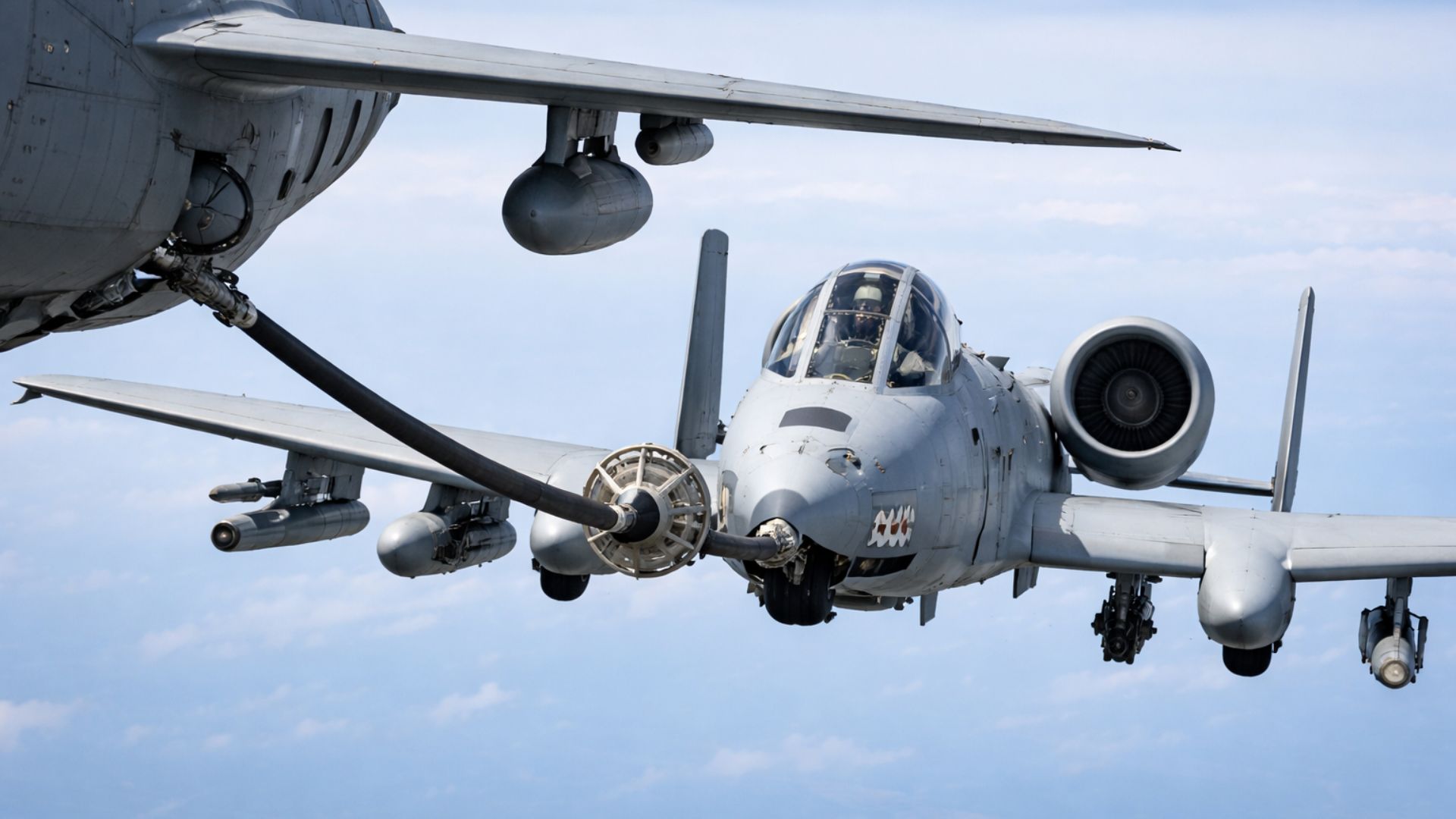

Accelerated movement of the US Air Force expands A-10 flexibility in combat, reduces dependence on specific aircraft, and creates new logistical possibilities with simple and quick adaptation, repositioning the role of tactical aircraft in modern air refueling.
The United States Air Force has accelerated the validation of a new in-flight refueling adapter for the A-10 Thunderbolt II, in direct response to an operational demand deemed urgent.
The piece converts, in a few hours, the standard boom-based system of the jet to the probe and drogue model, expanding refueling options in combat scenarios and reducing dependence on the KC-135, currently the main certified vector for this mission with the A-10.
The first refueling of this type occurred on April 2, 2026, and the official announcement of the program was made on April 7 and 8.
-
36-Meter Hydrogen-Powered Superyacht Arrives in Brazil to Debut German Engines and Showcase Future of Clean Navigation

-
Indian Students from Jaipur Win Top Prize at World’s Largest Science Fair with EcoFog, an Affordable Mesh to Harvest Fog Water Without Energy

-
Italy Sinks Massive 11-Story Concrete Structures in the Ligurian Sea to Create a 6.2 km Barrier, Clearing the Way for 400-Meter Ships in Genoa
-
Wireless Charging Roads for Electric Vehicles: Detroit Implements Coil Technology, France Successfully Tests 300 kW Transfer Near Paris



Expansion of A-10 in-flight refueling
The adapter is installed in the refueling receptacle located at the nose of the aircraft.
With this, the A-10 begins to operate with the probe and basket system, currently used by tankers with a profile closer to that of the attack jet itself.
According to the National Guard and Air Force Reserve test center, the modification was designed for field use, without relying on heavy maintenance structures, allowing flight line teams to install or remove the set according to mission requirements.

Operational limitations and urgent need
The gap arose at a time when planners began to work with fewer possible combinations between fighters and tankers.
The retirement of the KC-10 and the still-pending certification of the KC-46 for this specific mission left A-10 units heavily tied to the KC-135.
In the official assessment of the USAF, this arrangement restricted flexibility in the operational theater, especially in missions requiring close air support and combat search and rescue, where speed, altitude, and tactical positioning matter as much as the amount of fuel transferred.
Integration with C-130-derived aircraft
At this point, C-130-derived aircraft appear as a more fitting alternative to the A-10’s flight profile.
The official statement specifically mentions the HC-130 as a vector already used in the first refueling trial, conducted with support from the 418th Flight Test Squadron and approved by the in-flight refueling certification authority.
Additionally, defense publications indicate that the new configuration also paves the way for operations with other tanker variants of the Hercules family that use the probe and drogue system, such as the KC-130J and MC-130J.
Rapid response and field adaptation
The speed of the project was treated as a central part of the institutional message.
Lieutenant Colonel Luke Haywas, director of tests at the center responsible for the initiative, stated that normal acquisition procedures were maintained, but everyone involved worked with a sense of urgency to shorten every possible step.
Colonel Daniel Wittmer, commander of the AATC, said that the effort demonstrated how the testing structure can function as a rapid response mechanism when commanders in operation face immediate capability gaps.

Impacts on the employment of the A-10 in combat
In practice, the new arrangement gives the A-10 a greater margin of adaptation in expeditionary missions.
The jet has always been valued for its ability to operate close to the front line and for its role in close support, including in environments where the presence of rescue assets and special operations aircraft is frequent.
By accepting refueling via probe and basket, the model aligns more closely with the operational logic of tactical platforms that operate nearer to the action area, without relying exclusively on the network of large strategic tankers.
This change also gains weight at a time when the A-10 has returned to appear in real high-risk missions.
In recent days, the aircraft participated in actions related to the rescue of the crew of a downed F-15E in Iran, in an operation that involved dozens of aircraft and different layers of air protection.
Reports from the American press indicate that an A-10 even sustained damage during the mission, which reinforced the debate about the model’s continued role in combat search and rescue tasks and the need to expand its logistical alternatives in the air.
Strategic opportunity for the KC-390 from Embraer
For Embraer, the news does not represent an immediate sale but reinforces a strategic argument that has already been presented to the American market.
In February 2026, Northrop Grumman and Embraer formalized a partnership to offer the KC-390 Millennium as a tactical mobility and refueling aircraft aimed at dispersed operations and austere airfields.
The proposal includes the use of the existing probe and drogue system on the aircraft and, in parallel, the development of a boom solution to expand the commercial reach of the project within the USAF and among allies.
In this context, the adaptation of the A-10 does not automatically transform the KC-390 into a certified supplier for the American jet, but improves the operational environment for this type of platform.
This is because the Millennium was designed precisely for combined transport and refueling missions in scenarios less dependent on large bases, with conversion between functions in less than five hours, according to program executives.
The aircraft has also been presented as an option for operations on short or less prepared airfields, an attribute that project partners associate with the American doctrine of agile employment in combat.
Still, the distance between opportunity and actual incorporation remains significant.
What exists today, publicly and confirmed, is the demonstration that the A-10 managed to refuel via probe and drogue with an HC-130 and that the USAF treated this capability as a direct response to an operational need.
The formal expansion to other vectors, including the KC-390, will depend on specific certifications, technical integration, and acquisition decisions that have not yet been announced by the American Air Force.