





 Portuguese
  English
  Spanish
  4 min of reading
  0 comments



New Organic Thermoelectric Device Invented in Japan Collects Energy at Room Temperature Without Temperature Gradient, An Innovation That Could Transform How We Generate Energy Sustainably and Efficiently
A team of researchers from Japan has developed an innovative organic thermoelectric device that can generate energy at room temperature, without the need for a temperature gradient. This discovery promises to revolutionize energy harvesting technology, opening new doors for practical and sustainable applications.
The study, led by Professor Chihaya Adachi from the Organic Photonics and Electronics Research Center (OPERA) at Kyushu University – Japan, was recently published in the renowned journal Nature Communications.
What Are Thermoelectric Devices?
Thermoelectric devices, also known as thermoelectric generators, are materials capable of converting heat into electricity.
-
The coldest seawater ever recorded in Earth’s history was hidden under extreme ice 717 million years ago and reached an impressive -15°C.

-
China has launched the world’s first floating artificial island, a scientific structure designed to face open seas, test equipment weighing hundreds of tons, and reach depths of 10,000 meters.

-
China accelerates global science and may surpass the United States in 2 years with increased public investment, continuous growth, and direct impact on the global technological competition.

-
Scientific studies indicate that drought may be strengthening a much greater silent threat: more resistant superbugs.


This technology from Japan traditionally operates from the temperature difference between two sides of the device — one hot side and one cold side — creating the necessary temperature gradient to generate electricity.
These devices have been widely researched for their potential to capture and utilize waste heat in energy generation processes.
One of the most well-known examples of thermoelectric generators is found in space probes, such as the Mars Curiosity Rover and Voyager.
These probes are powered by radioisotope thermoelectric generators, where the heat generated by the decay of radioactive isotopes provides the gradient necessary for energy generation.
However, despite their great potential, the use of thermoelectric devices is still limited due to various factors, such as high production costs, the use of hazardous materials, and low energy efficiency.
The Innovation: Energy Generation Without Temperature Gradient
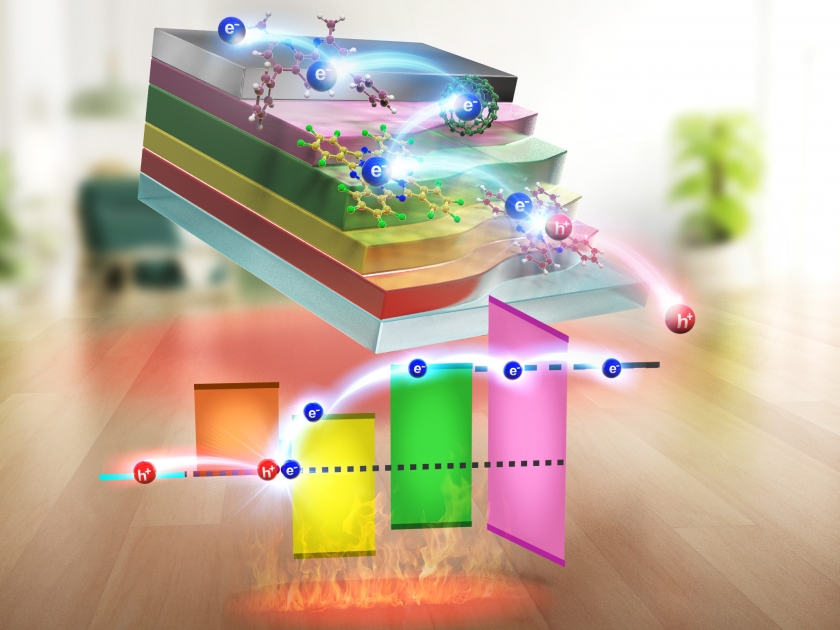
The advancement proposed by Adachi’s team lies in the ability to generate energy at room temperature, eliminating the dependency on temperature gradient.
“We were investigating ways to create a thermoelectric device that could collect energy directly from the ambient temperature,” Adachi explained. “Our lab focuses on the application of organic compounds, many of which have unique properties that allow for efficient energy transfer between them.”
The team focused on creating a charge transfer interface between organic materials. After testing various compounds, the researchers identified two key materials: copper phthalocyanine (CuPc) and hexadecafluoro copper phthalocyanine (F16CuPc).
Both were able to facilitate the transfer of electrons between each other, an essential element for thermoelectric energy generation.
Improvement of Thermoelectric Properties
To maximize the efficiency of the device, researchers incorporated fullerenes and BCP (bis(1,2-benzothiazol-3(2H)-one 1,1-dioxide), both known for improving electron transport.
This adjustment in composition resulted in an optimized device with specific layers of CuPc (180 nm), F16CuPc (320 nm), fullerene (20 nm), and BCP (20 nm).
The results were impressive. The device generated an open-circuit voltage of 384 mV, a short-circuit current density of 1.1 μA/cm², and a maximum output of 94 nW/cm², all at room temperature, without the need for a temperature gradient.
These numbers represent a significant advance for thermoelectric technology, especially considering that the device is based on organic materials, known for their versatility and low cost.
Next Steps
Although the development of thermoelectric devices has advanced considerably in recent decades, this new organic device could be a game-changer in the field.
In addition to being more accessible and environmentally safe, the device opens the possibility of use in a variety of scenarios where waste heat generation is not feasible.
According to Adachi, “Our new proposed organic device will certainly help advance the field of thermoelectric devices. We are excited to continue working on this project, exploring new materials and optimizing the technology. We may even achieve a higher current density if we increase the device area, which is uncommon for organic materials.”
This research also highlights the potential of organic compounds in various technological applications, from OLEDs to solar cells, reinforcing the importance of continuous innovation in this field.
The use of organic materials in energy generation devices is a growing trend that could transform not only the energy market but also how we utilize and distribute electricity.
With ongoing optimization and the application of new materials, researchers hope this technology can be used on a large scale, contributing to more sustainable and efficient energy solutions.
This innovation could mark the beginning of a new era in energy harvesting, where organic materials will play a key role in the transition to cleaner and more accessible technologies.









Seja o primeiro a reagir!