





 Portuguese
  English
  Spanish
  6 min of reading
  1 comment


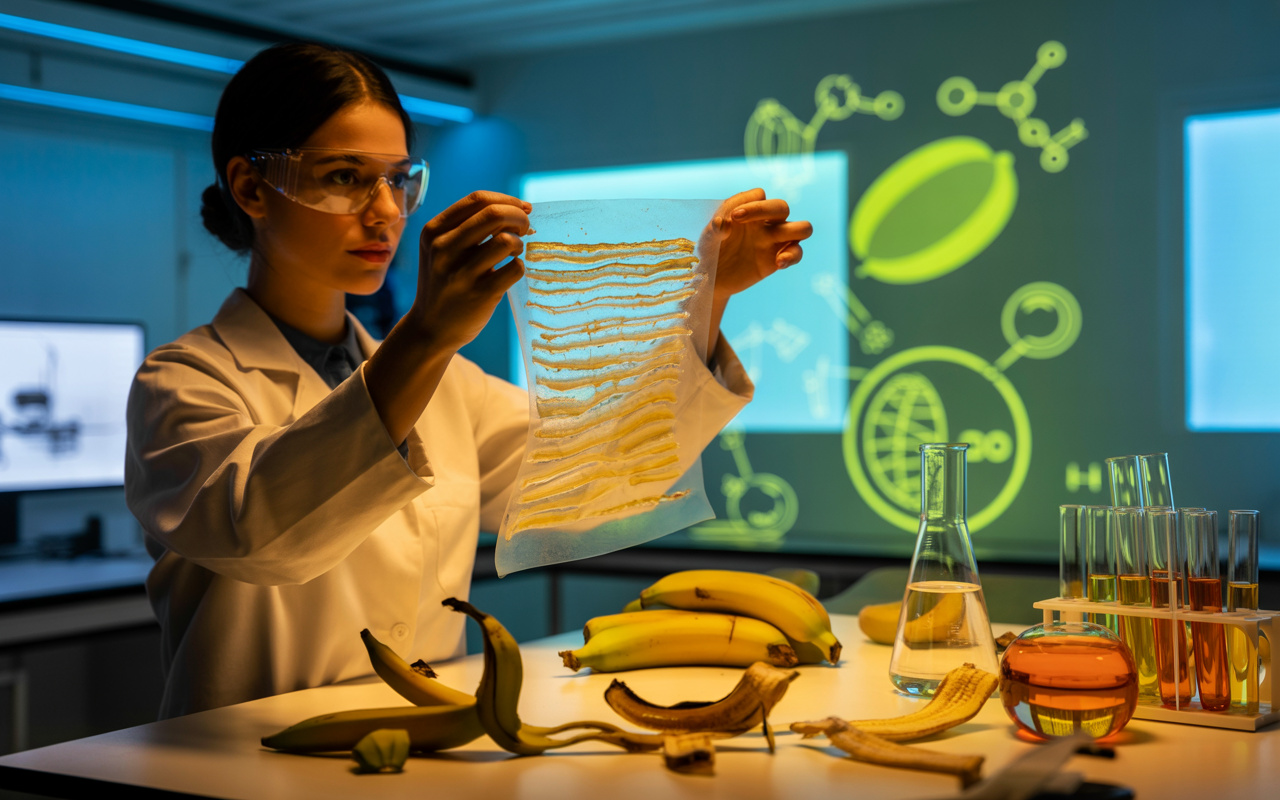


At 16 Years Old, Elif Bilgin Transformed Banana Peels into Biodegradable Plastic with Industrial Potential, Pointing to a New Path for Replacing Petroleum-Based Packaging.
In 2013, in Turkey, a high school student began an experiment that, over the years, would be cited in international debates on sustainable materials, circular economy, and the replacement of petroleum-based plastics. The young girl was Elif Bilgin, then just 16 years old, and her proposal was as simple as it was disruptive: to transform banana peel waste into biodegradable plastic with physical properties comparable to conventional synthetic polymers.
The idea was born from a everyday observation. At that time, supermarkets, markets, and food industries discarded tons of banana peels every day, while, at the same time, the planet faced an accelerated advancement of pollution from fossil-based plastics. What seemed like mere organic waste revealed itself, in Elif’s eyes, as potential raw material for a new generation of materials.
From Peel to Polymer: How Banana Plastic is Made
The process developed by Elif is based on a fundamental biochemical property of bananas: the high concentration of starch. Starch is already used industrially in the production of bioplastics from corn, cassava, and potatoes. In the case of bananas, the difference lies in the exclusive use of the waste, and not the fruit itself. The method generally involves:
-
They were brilliant! Scientists discover that our ancestors in China were already making super advanced tools 160,000 years ago, changing everything we knew.

-
Scientists unveil 3 million years of climate secrets hidden in the ice of Antarctica.

-
Ancient farmers created “aggressive plants” that changed nature forever.
-
Astronomers find a “backward” solar system that ignores all the rules of space and leaves scientists scratching their heads!


- controlled drying of the peels;
- grinding until fine starch-rich powder is obtained;
- extraction of starch using simple reagents;
- addition of natural plasticizers;
- thermal molding to form the polymer.
The result is a biodegradable, flexible, moldable plastic with sufficient mechanical resistance for applications in lightweight packaging, such as bags, wraps, and disposable containers.


Chemically speaking, it is a reinforced natural polymer, whose degradation occurs through microbial action in incomparably shorter timeframes than conventional plastic, which can take centuries to decompose.
Why Banana Became a Strategic Asset for Bioplastics
The case of the banana is particularly relevant because the fruit is among the most produced and consumed in the world. Tropical countries in Latin America, Africa, and Southeast Asia produce millions of tons per year. In this entire chain, a significant portion ends up as organic waste soon after consumption or industrial processing. Before Elif’s initiative, this waste largely went to:
- landfills;
- small-scale composting;
- irregular disposal.
By transforming the peel into an industrial input, the project reverses the logic: waste becomes raw material with added value. This is exactly the central principle of the circular economy applied to the materials industry.
Furthermore, unlike bioplastics made from corn or sugarcane, the banana-based model does not compete directly with food production, one of the main ethical dilemmas of the bioindustry.
The Global Plastic Industry and the Size of the Challenge
The project gains even more relevance when placed in a global context. Global plastic production exceeds 400 million tons per year, according to estimates from international organizations linked to the environment and the chemical industry. Of this total:
- a large portion comes from petroleum;
- only a minimal fraction is effectively recycled;
- millions of tons end up in rivers, oceans, and soils.
In parallel, regulatory pressure to replace fossil-based packaging with biodegradable or compostable materials is growing, especially in the European Union, North America, and parts of Asia.
It is in this scenario that solutions like banana plastic become strategic. They simultaneously address two global problems:
- the excess of plastic waste;
- the wastage of organic waste.
What Differentiates Banana Plastic from Other Biopolymers
There are various types of bioplastics in the market today, produced from:
- corn;
- sugarcane;
- cassava;
- wood cellulose.
The differentiating factor of the solution developed by Elif lies in three central points:
- use of waste, not food;
- low carbon footprint in the raw material;
- potential for decentralized production in tropical countries.
This means that small and medium industries could produce the material close to banana-producing regions, reducing logistics costs, generating local jobs, and decreasing dependence on global supply chains that are intensive in petroleum.

Possible Industrial Applications for Banana Plastic
From a technical perspective, the material developed from bananas does not aim to replace high-strength structural plastics, such as those used in the automotive or electronic sectors. Its focus is on segments of high volume and disposable use, especially:
- shopping bags;
- food packaging;
- plastic films;
- lightweight containers;
- single-use products.
These segments represent a significant portion of plastic pollution worldwide. By replacing exactly these items with a biodegradable alternative, the positive environmental impact is immediate and measurable.
Biodegradation and Real Environmental Impact
While petroleum-based plastic can remain in the environment for 100 to 500 years, starch-based biopolymers can degrade in weeks or a few months, depending on moisture, temperature, and the presence of microorganisms. In the case of banana plastic, subsequent studies showed that:
- the material fragments rapidly in humid environments;
- does not release persistent microplastics;
- integrates into the soil as organic matter.
This drastically reduces damage to marine fauna, terrestrial ecosystems, and human food chains, which are now contaminated by microscopic plastic particles.
The Strength of the Project Beyond the Creator’s Age
Although Elif Bilgin’s age has drawn attention, what sustains the importance of the project is not the age factor, but the technical robustness of the proposal. The young girl applied real concepts of:
- polymer chemistry;
- materials engineering;
- industrial repurposing;
- environmental sustainability.
The project has matured over the years, with tests of resistance, flexibility, and biodegradation. It is not a conceptual idea, but a functional material, with measurable physical properties.
Strategic Relevance for Developing Countries
Tropical countries, large producers of bananas, simultaneously concentrate:
- high volumes of organic waste;
- low industrial recycling capacity;
- high demand for cheap packaging.
The bioplastic model developed from bananas fits this profile perfectly. It allows for the creation of local production chains, reduces imports of fossil polymers, and transforms an environmental liability into an economic asset.
At scale, this can mean:
- cost reduction for small producers;
- generation of green jobs;
- reduction of urban and rural environmental impact.
Why This Invention Remains Relevant More Than a Decade Later
Even though it was conceived in 2013, Elif Bilgin’s proposal is today even more relevant than at the time of its creation. The plastic crisis has worsened, regulatory restrictions have advanced, and societal pressure for sustainable alternatives has increased.
Industrial projects that today use corn, sugarcane, or cellulose starch are following exactly the path that that Turkish student pointed out back in high school: the future of plastic necessarily passes through the bioindustry.
The difference of the banana-based model is the intelligent use of waste, something that reduces conflicts with food production and increases economic viability.
The transformation of banana peels into biodegradable plastic is not just a scientific curiosity. It represents a silent rupture in one of the most polluting industries on the planet. By demonstrating that a mundane organic waste can replace petroleum-derived polymers, Elif Bilgin’s work anticipates, on a symbolic scale, what the global materials industry will need to do in the coming decades: abandon petroleum as the absolute base and migrate to renewable, circular, and environmentally regenerative polymers.
More than a youthful invention, banana plastic has solidified as a technical symbol that the transition to sustainable materials is not only necessary—it is already possible, measurable, and economically viable when science and repurposing meet in the same project.






Parabéns a Elif pelo projeto. Iniciativas assim são sempre bem-vindas. Eu estou desenvolvendo um projeto semelhante utilizando soro de leite in natura para a mesma finalidade.