





 Portuguese
  English
  Spanish
  4 min of reading
  10 comments


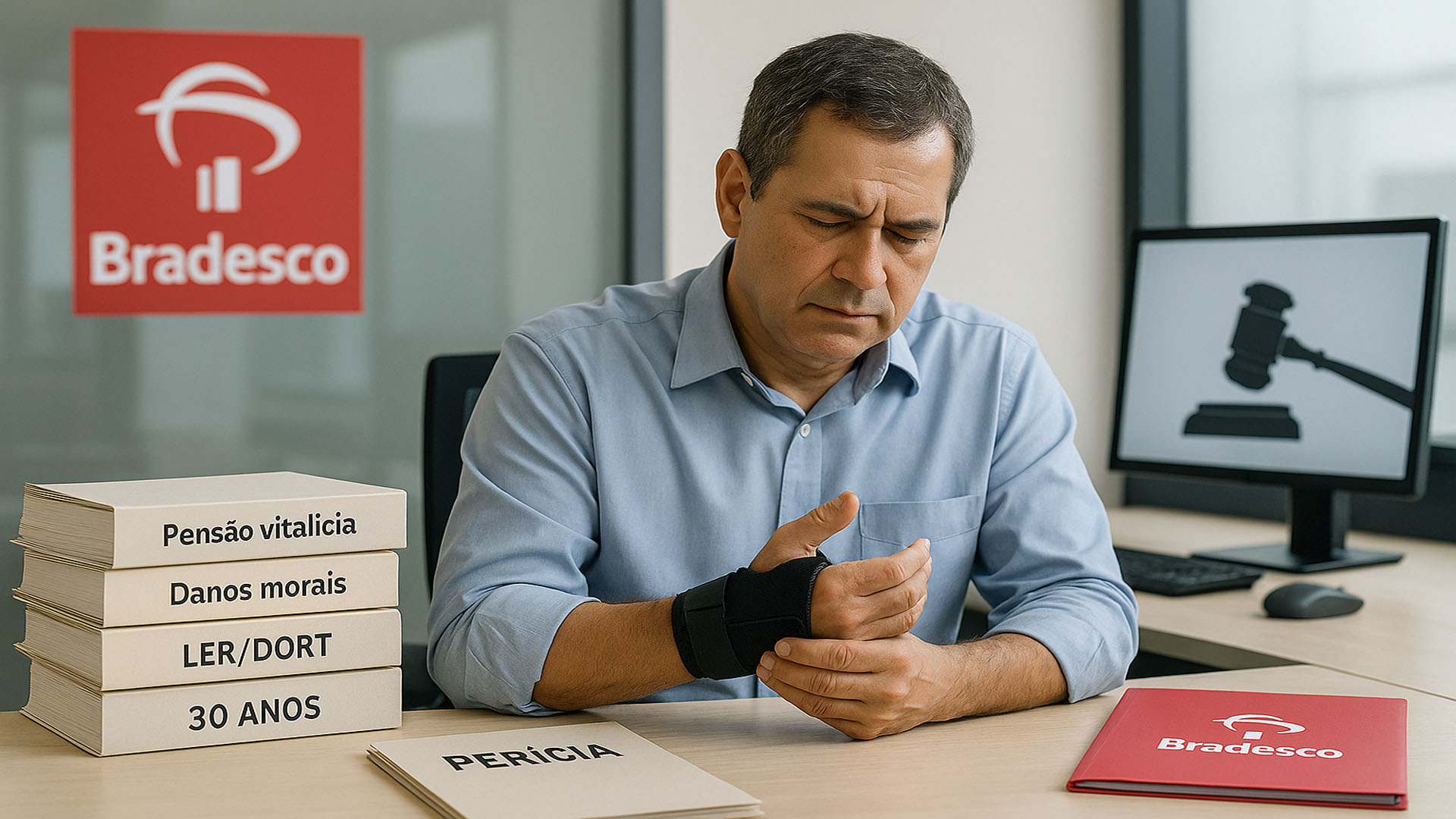


Ruling Recognizes Occupational Disease After More Than 30 Years of Service, Sets Lifetime Pension in Lump Sum and Moral Damages; Total Exceeds R$ 1 Million
The Labor Court condemned Banco Bradesco to compensate a bank employee who, after more than three decades in the institution, developed RSI/WRMD. The ruling assigned the bank responsibility for failing to adopt effective prevention, security, and occupational health monitoring measures. The amount exceeds R$ 1 million, totaling a lifetime pension paid in a single sum and compensation for moral damages. According to Terra, the decision was published on September 26, 2025.
The case was monitored by the Bankers’ Union of Itaperuna and Region, affiliated with Fetraf RJ/ES, which provided documents and expert reports confirming the causal link between repetitive activities, pressure to meet goals, and illness. The entity reported that the total set “exceeds one million reais”.
Records from the case indicate long hours, high targets, and tasks involving repetitive effort. The expert report confirmed the occupational disease and the permanent reduction of labor capacity. The Federation of Bankers of Paraná also highlighted the ruling, emphasizing the lifetime pension in a lump sum.
-
The noise law will no longer be in effect at 10 PM starting in June with a new rule valid during the 2026 World Cup.

-
The Chamber opens a debate on driver’s licenses at 16 years old as part of a reform that includes around 270 proposals to change the Brazilian Traffic Code and may redesign rules for licensing, enforcement, and circulation in the country.

-
The new Civil Code could revolutionize marriages in Brazil with “express divorce” and changes that could exclude spouses from inheritance.
-
Banco do Brasil sues famous influencer for million-dollar debt and intensifies debate on delinquency, risks of seizure, and direct impact on Gkay’s credibility.


Regional media reinforced the key points: occupational disease recognized, pension calculated based on life expectancy, and compensation for moral damages. Coverage by BNews summarized the criteria established by the court in valuing the full compensation.
What Is RSI/WRMD and What Is the Employer’s Responsibility
RSI/WRMD encompasses a set of injuries associated with repetitive movements and inadequate postures, common in banking activities with high productivity demands. In labor lawsuits, the proof of the causal link goes through medical expertise and analysis of the workplace.
In the ruling, the court recognized the employer’s responsibility for omission in prevention and management of ergonomic risks. In simple terms: there were no adequate conditions, management of breaks, task rotation, and occupational medical monitoring. These factors, according to the records, could have avoided or mitigated the harm.
For the worker, the recognition of the occupational disease enables two fronts of compensation: material (in this case, lifetime pension, paid in lump sum, based on life expectancy) and moral (for pain, suffering, and social impact).
This framework seeks to restore income and compensate for effects that do not fade with treatments. The expertise and documents serve as a technical basis to quantify how much the ability to work was affected and for how long.
How the Judge Calculated: Pension, Moral Damages, and Lump Sum Criterion
The magistrate adopted a study that considered life expectancy, degree of disability, and length of service to estimate the pension. It was decided to pay in one lump sum, a model that gives the worker financial control of the amount and avoids successive litigation over differences.
For moral damages, the parameter is the severity of the harm, the economic capacity of the defendant, and the educational effect of the sentence. In similar decisions in the banking sector, labor courts have highlighted the need for active prevention of abusive targets, ergonomic risks, and inadequate team management.
The process also valued objective elements: medical history, certificates, symptom progression, functions performed, and pressure for results. This set supported the conclusion that work directly contributed to the illness.
In the end, the total exceeded R$ 1 million, combining the basis of the lifetime pension and the moral damage. The numerical level reinforces the message of zero tolerance towards environments that disregard known risks of RSI/WRMD.
Impacts for Employees and Companies: Prevention and Evidence Matter
For workers, the ruling signals the importance of documenting symptoms, keeping reports, and reporting inadequate conditions. In cases of RSI/WRMD, exposure time and repetitive activity are often decisive in the expertise.
For companies, the message is clear: ergonomics programs, scheduled breaks, task rotation, medical monitoring, and training are not “optional.” They make up the legal duty of care and reduce legal risk and social cost.
In the financial sector, where targets and pace are intense, occupational health initiatives need to be documented and audible. Non-compliance creates grounds for civil liability, as indicated by the ruling in this case.
Monitoring illness indicators, reassessing work positions, and adjusting processes are measures that preserve productivity and legal security. Recent rulings show that the Justice system observes practical results, not just paperwork.
Recent Context and Precedents in Labor Judiciary
In 2025, labor decisions involving banks have been reinforcing protection standards for health and punishing abusive practices. There are rulings and judgments that consolidate the idea that prevention and risk management are mandatory, even with high-value sanctions in cases of omission.
In the case of Bradesco, different media outlets reported the same essential elements: occupational disease recognized, lifetime pension, and moral compensation that exceeds R$ 1 million. The dates vary due to the republication of the news by unions and portals, but the central content is convergent.
According to Fetraf RJ/ES, the Union of Itaperuna provided legal assistance from the beginning, gathering technical evidence and testimonies about pressure for productivity and exhausting work hours. These elements were decisive for the successful ruling.
Coverage by Terra details that the magistrate recognized failures in prevention, security, and health monitoring. The expert report was crucial in establishing the link between the tasks and the illness.
Do you think aggressive targets drive results or make teams sick? Share your opinion in the comments.










Pena q esse juíz viu isso agora pq o q eu sei havia vários amigos q trabalhavam no banco e não teve a mesma sentença
Ridículo juízes trabalhistas adoram fazer distribuição de renda com o dinheiro dos empresários, por q não abrem mão dos penduricalhos exorbitantes q recebem ? Aliás podem fazer o q quiserem pois no máximo são aposentados compulsoriamente com salários integrais isso não existe em nenhum outro país
METAS AGRESSIVAS SO PARA O BOLSO DO EMPREGADOR & AS SEQUELAS NO TRABALHADOR !