





 Portuguese
  English
  Spanish
  5 min of reading
  0 comments



Chile Created The Largest Refrigerated Fruit Storage System In The World, With Over 10 Million M³, Controlled Atmosphere, And Logistics Integrated Into Global Export.
Few countries have managed to transform perishable agricultural products into national strategic assets like Chile. Instead of treating fruits merely as a result of a seasonal harvest, the country has built, over decades, a massive logistical and industrial infrastructure capable of preserving, regulating, and distributing fresh fruits to the entire world for months after harvest.
At the center of this strategy is the Cold Storage Network for Fruit Exports, a national refrigerated storage network that amounts to over 10 million cubic meters in installed capacity, spread across productive regions, logistics centers, and port areas. It is the largest refrigerated fruit storage system in the world, both in volume and technical sophistication.
Over 10 Million M³ Of Artificial Cold At The Service Of Agriculture
The physical scale of this network is impressive. There are thousands of cold chambers, climate-controlled warehouses, and quick cooling tunnels distributed throughout Chilean territory, especially in the regions of Valparaíso, O’Higgins, Maule, and Metropolitan Santiago.
-
Historic bankruptcy of Centauro shocks the market, and the century-old company puts more than 500,000 products, machines, and complete infrastructure up for online auction.

-
New shoe factory in Ceará is expected to create 400 jobs and strengthen the local economy.

-
No one imagined it, but a mixture of sawdust with a mineral that fights fires surprises scientists with a result that changes the course of fire-resistant construction.

-
From empty land to a high-end house, wooden construction uses a lightweight system, metal structure for the foundation, ventilated ceramic cladding, and special windows to create an efficient and comfortable living space throughout the year.




These over 10 million m³ of refrigerated space do not function as simple cold chambers. Each space is designed to operate at specific temperatures, usually between –1 °C and +1 °C, depending on the stored fruit, along with strict control of relative humidity, air circulation, and gas composition.
In practice, Chile has created an artificial layer of time, capable of drastically slowing down the metabolism of fruits, extending their shelf life without compromising texture, flavor, or appearance.
Controlled Atmosphere: Invisible Engineering That Extends Fruit Lifespan
The most advanced technical differential of the Chilean system is the large-scale use of controlled atmosphere (CA) and ultra-low oxygen atmosphere (ULO). In these chambers, the oxygen content can be reduced to 1% or less, while carbon dioxide is adjusted with precision.
This chemical control of the air reduces the cellular respiration of fruits, delaying ripening, oxidation, and deterioration. Thanks to this, fruits such as apples, pears, grapes, and cherries can remain stored for months, reaching markets in Asia, Europe, and North America practically in the same condition as they left the orchard.
This level of engineering transforms fresh fruits into predictable logistical products, which is crucial for long-term international contracts.
From Orchard To Port Without Thermal Break
Another critical aspect of the Chilean system is the uninterrupted cold chain. The process begins right in the field, with immediate pre-cooling after harvest. The fruits are transported in refrigerated trucks to the storage centers, where they enter directly into the cold chambers without experiencing abrupt temperature changes.
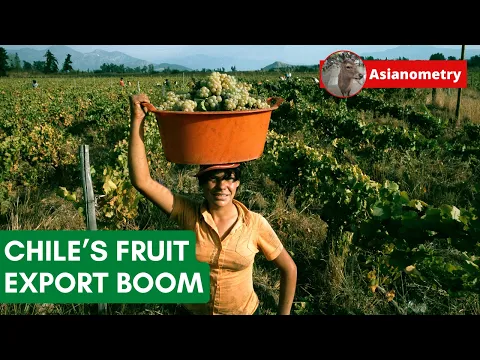
From the warehouses, the products proceed to specialized port terminals, also equipped with large refrigerated structures. Reefer containers maintain controlled temperature and atmosphere during the entire maritime transport, which can last 20 to 40 days, depending on the destination.
This thermal continuity is essential to avoid losses and ensure standardization, especially in demanding markets such as China, the United States, Japan, and the European Union.
Fruits As Strategic Export Commodity
Thanks to this infrastructure, Chile has solidified its position as one of the largest global exporters of fresh fruits, even being a relatively small country.
Apples, grapes, cherries, kiwis, and blueberries have come to be treated not just as agricultural products, but as strategic commodities, with global calendars, advance contracts, and strict quality control.
In recent years, Chilean fruit exports have generated billion-dollar revenues, directly supported by the capacity to store, scale, and distribute production throughout the year. Without the cold network, the country would be limited to short export windows, with volatile prices and a high risk of losses.
Energy, Engineering, And Operational Costs At Industrial Scale
Maintaining over 10 million m³ of refrigerated storage continuously requires a robust energy infrastructure. Industrial compressors, redundant refrigeration systems, digital monitoring, and constant maintenance are part of the daily routine of the Cold Storage Network for Fruit Exports.

Sensors monitor temperature, gases, pressure, and energy consumption in real-time. Any failure could compromise loads valued in millions of dollars. Therefore, the operation works with standards close to those of critical infrastructure, comparable to data centers or large hospital facilities.
A System That Gives Market Power To The Producer
By controlling time, Chile has also gained control over the timing of sales. Producers and exporters are not compelled to offload large volumes into the market immediately after harvest. They can wait for more favorable price windows, balance supply and demand, and meet international contracts precisely.
This logistical power alters the dynamics of the global fruit trade. Countries without equivalent infrastructure are held hostage to the natural calendar, while Chile operates in industrial time, shaped by engineering and logistics.
Invisible Infrastructure That Supports The Country’s Reputation
Much of the end consumers never sees this infrastructure. What reaches supermarkets are visually perfect, fresh fruits available out of season. Behind this lies one of the largest continuous undertakings of the global agribusiness, spread across warehouses, tunnels, chambers, and refrigerated ports.
The Cold Storage Network for Fruit Exports is, in practice, an invisible backbone of the Chilean economy, responsible for sustaining reputation, competitiveness, and global presence.
When Cold Becomes A Geopolitical Advantage
With over 10 million m³ of refrigerated capacity, advanced atmospheric control, and total logistical integration, Chile has shown that in modern agribusiness, producing alone is not enough. It is essential to store, preserve, control, and distribute with industrial precision.
By transforming fruits into strategic commodities supported by heavy engineering, the country has built not just a cold system, but a permanent structural advantage in the global food trade.










Seja o primeiro a reagir!