





 Portuguese
  English
  Spanish
  5 min of reading
  0 comments


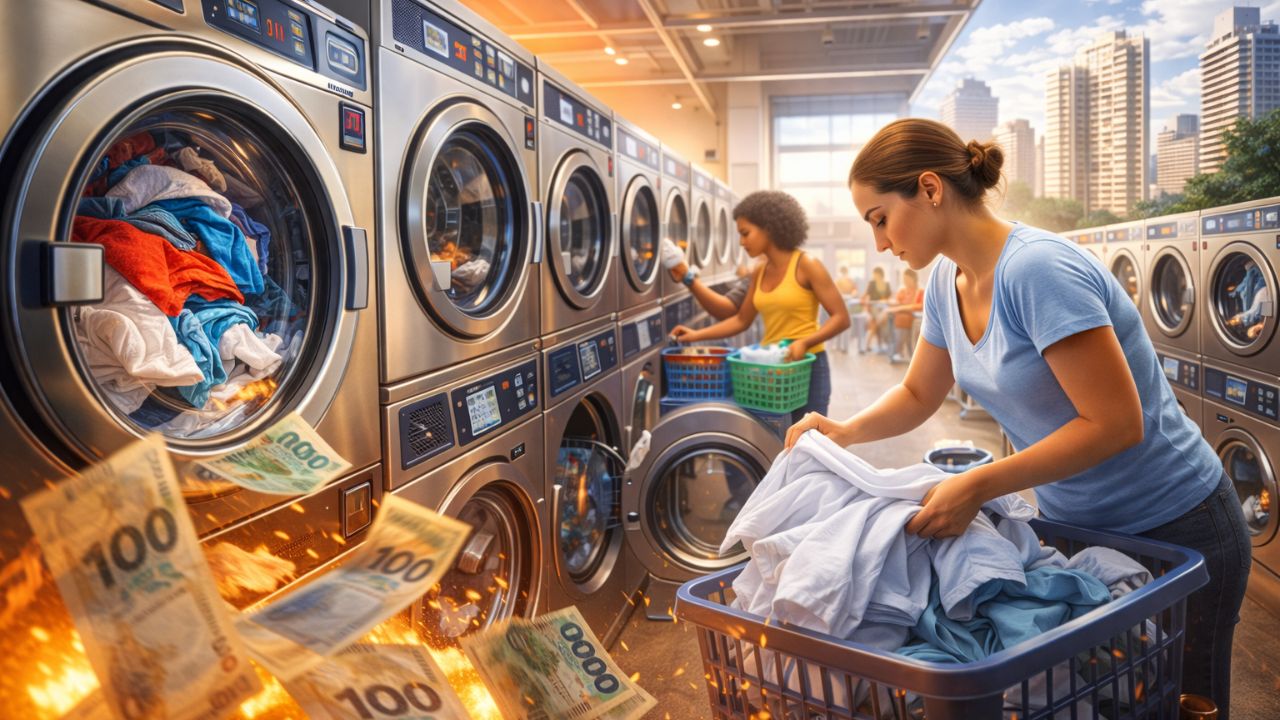
Self-Service Laundries Have Been Growing Since 2019, Attracting Consumers with No Time, Operating with Fast Industrial Machines, Low Prices, and an Automated Model That Also Attracts Investors.
Self-service laundries are no longer “niche” and have become a sign of change in urban lifestyle. They appear as a practical solution for those living in smaller apartments, who do not have a machine at home, or simply do not want to spend hours on accumulated laundry.
The growth is significant. The sector has been expanding since 2019, generating billions annually and now totals more than 27,000 laundries in the country, with about 3,000 in the self-service model, where the customer does everything themselves. It is a habit that became a market and a market that became routine.
Why Self-Service Laundries Have Grown So Much in Brazil, and Why Now
In countries like the United States, Europe, and Asia, self-service laundries have been part of the landscape for decades. The model was born when families began living in smaller spaces and time became a scarce commodity.
-
IPTU exemption for seniors in 2026: see how to secure the benefit.

-
The institute that trained the greatest aerospace engineers in Brazil has just opened its first campus outside São Paulo after 75 years: ITA Ceará will have R$ 445 million, new courses in energy and systems, and classes are expected to start in 2027.
-
Luciano Hang, owner of Havan, goes to Juiz de Fora after the tragedy in February, brings R$ 1 million, hands out R$ 2,000 cards, and donates up to R$ 15,000 to victims in the region.

-
The Brazilian passport allows legal residence in dozens of countries without the need for a prior visa, and most Brazilians are unaware that they can apply for residency directly upon arriving in nations in South America, Africa, and even Europe.

In Brazil, the culture of washing clothes at home held back this shift for a long time. Larger service areas, a warm climate, and accessible domestic labor helped maintain the domestic habit.
However, this scenario is changing, and self-service laundries have entered exactly into this “gap” of routine and space.
The Push from 2019 Onward and the Post-Pandemic Acceleration

According to data mentioned in the source material, the sector grew by 44% between 2019 and 2024. The pandemic played a significant role: it reinforced hygiene concerns and increased interest in automated services with less human contact.
Even with life returning to normal, the trend has not declined. Self-service laundries have become a direct response to the same urban problem: less available time and more tasks concentrated in daily life.
Less Space at Home, More Service Outside: The Effect of Smaller Apartments
The rise of self-service laundries is accompanied by a very concrete factor: the shrinking of internal space.
The text points out that, in São Paulo, the average area of two-bedroom apartments in Minha Casa, Minha Vida decreased from 58 m² in 2004 to 37 m² in 2024.
Less area means less service area. And when the house doesn’t “accommodate” the routine, the routine migrates outside. The laundry becomes a necessity, not a luxury.
Low Prices and Fast Industrial Machines Change the Consumer Equation
The appeal is also financial and time-related. The material points out that it is possible to wash and dry up to 10 kg for about R$ 15, already including soap and softener.
For those living alone, this may be more advantageous than investing in a washer and dryer, in addition to reducing costs with products.
There is also the speed gain. Domestic machines can take 3 to 4 hours for a complete cycle, while in self-service laundries, the process can take a maximum of 1.5 hours with more powerful machines. The price is good, but time is what really convinces.
Who Uses It Most and What Has Changed in the Laundry Habit
The source text presents a clear picture of the audience: 70% are female, with an average age of 43 years, and 59% have completed higher education.
It also reflects that the laundry is no longer “for special clothes” but has started receiving everyday garments, like jeans and t-shirts, mostly from those living alone.
Still, the potential for expansion is huge: only 4% of the economically active population uses laundries regularly.
The sector’s expectation is that, by 2030, the number of users will double in the country. In other words, self-service laundries have grown significantly, but are still far from saturation.
Why the Model Interests Investors and Franchises
The operation is simple: the customer chooses the machine, pays, and does everything. This reduces the need for employees and allows for long hours, including Sundays, with some locations operating 24 hours.
Payment can be made via app or kiosks, and the operation is described as fully automated.
It didn’t take long for franchises to accelerate. The material mentions brands like Omo Lavanderia and Maria Express expanding, along with traditional chains growing.
It also states that, just in the state of São Paulo, the market generates over R$ 6 billion annually.
In mentioned estimates, a franchise can reach break-even in up to 18 months, with average margins exceeding 20%. It’s the type of business that combines recurring demand with standardized operation.
Sustainability Enters the Conversation but Requires Caution
The source text associates the sector with more efficient equipment, water and energy savings, and the use of biodegradable products.
In condominiums, savings can reach 65% compared to domestic use. For a family of four, this may represent savings of up to 3,240 liters of water per month.
However, there is an important “but”: this gain depends on the proper machines and correct use of products. Sustainability is not automatic; it requires standards and control.
Not Everything is Perfect: Hygiene, Environmental Control, and “Natural Selection” in the Sector
Rapid growth has also exposed weaknesses. The material indicates that about 80% of laundries are small businesses, many without formal management or environmental control, and that this control can be expensive.
Another point is the dependency on imported equipment, which increases maintenance costs and can lead small entrepreneurs to improvise with domestic machines that do not comply with standards.
Additionally, there is a perception of hygiene: part of the audience is wary of shared machines, especially in high-traffic areas.
The described consequence is a “natural selection”: those who do not deliver quality, practicality, and fair price tend to exit the market.
Do you think that self-service laundries will become as common as bakeries in neighborhoods, or will Brazilians still prefer to wash everything at home whenever they can?







Seja o primeiro a reagir!