





 Portuguese
  English
  Spanish
  4 min of reading
  0 comments


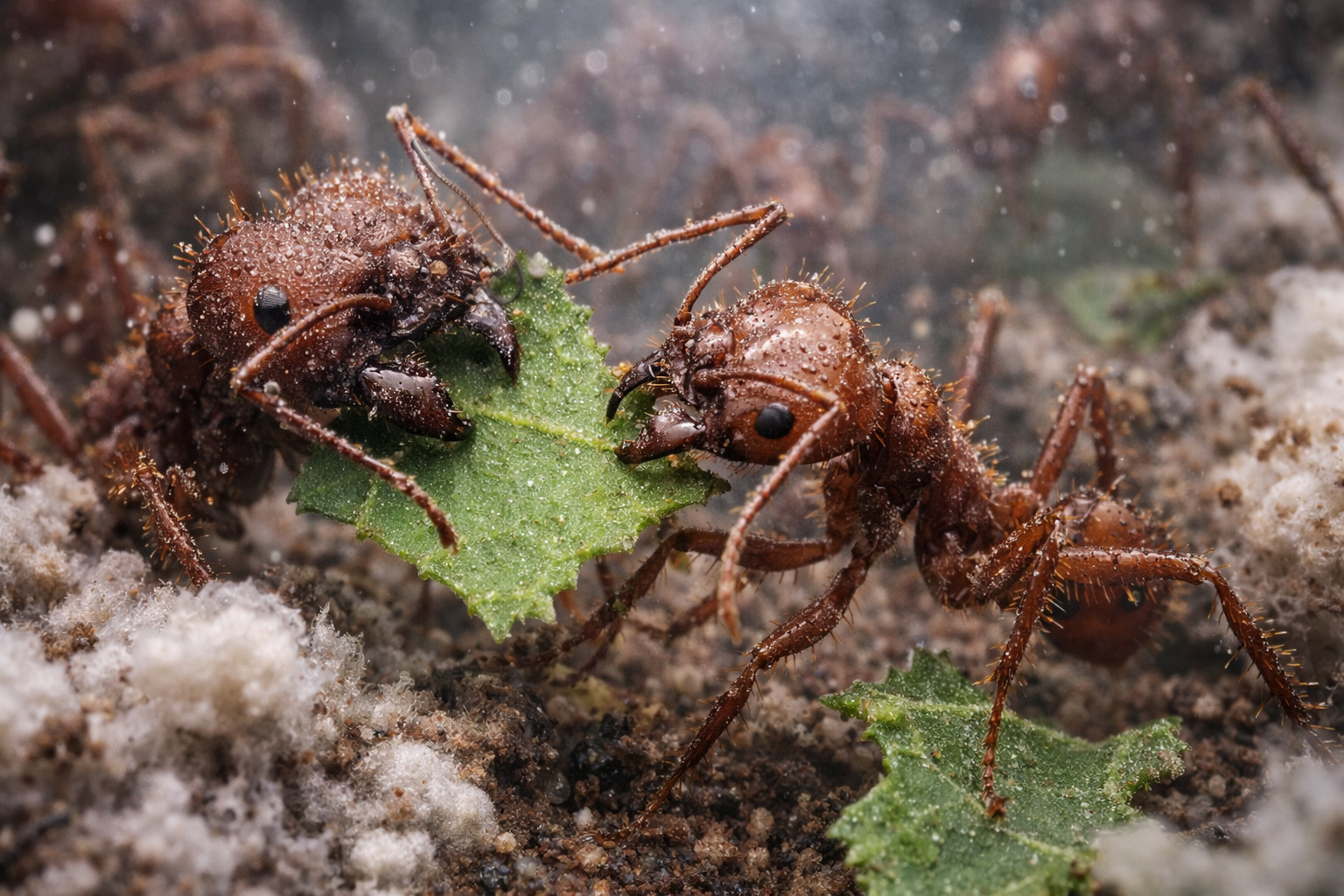
Cutting Ants (Atta and Acromyrmex) Cultivate Fungi in Subterranean Chambers, Regulate Microclimate, and Practice Agriculture for Millions of Years.
Few people imagine that one of the oldest food production technologies on the planet was not born with humans, but with insects. Long before the first wheat crops in the Fertile Crescent, the first agricultural villages in Asia, or the first maize cultivations in the Americas, ants of the genera Atta and Acromyrmex were already conducting a complete agricultural system — with planting, pest control, fungus management, transportation logistics, and environmental engineering — within precisely designed subterranean chambers.
These cutting ants are native to the Americas and have become one of the most complex animal societies ever described by science. Each colony houses millions of individuals, and the anthill can reach several meters deep and tens of meters long, with tunnels, ventilation ducts, and specialized chambers. Inside, under conditions reminiscent of agricultural greenhouses, they cultivate mutualistic fungi of the genus Leucoagaricus, their only source of solid food.
How the Agriculture of Atta and Acromyrmex Works
The foundation of the system begins with leaf collection. While, for us, the leaves seem just like plant matter, for the ants, they are “agricultural substrate.” They do not eat the leaf: they chew, process, and transform it into a nutritious bed that feeds the cultivated fungus. This fungus grows in structures called “gongylidia,” which are then consumed by the ants.
-
From space, Buenos Aires appears as a colossal spot of light surrounded by kilometers of darkness, revealing at a single glance the exact boundary between the metropolis and the countryside, seen from 400 km altitude.

-
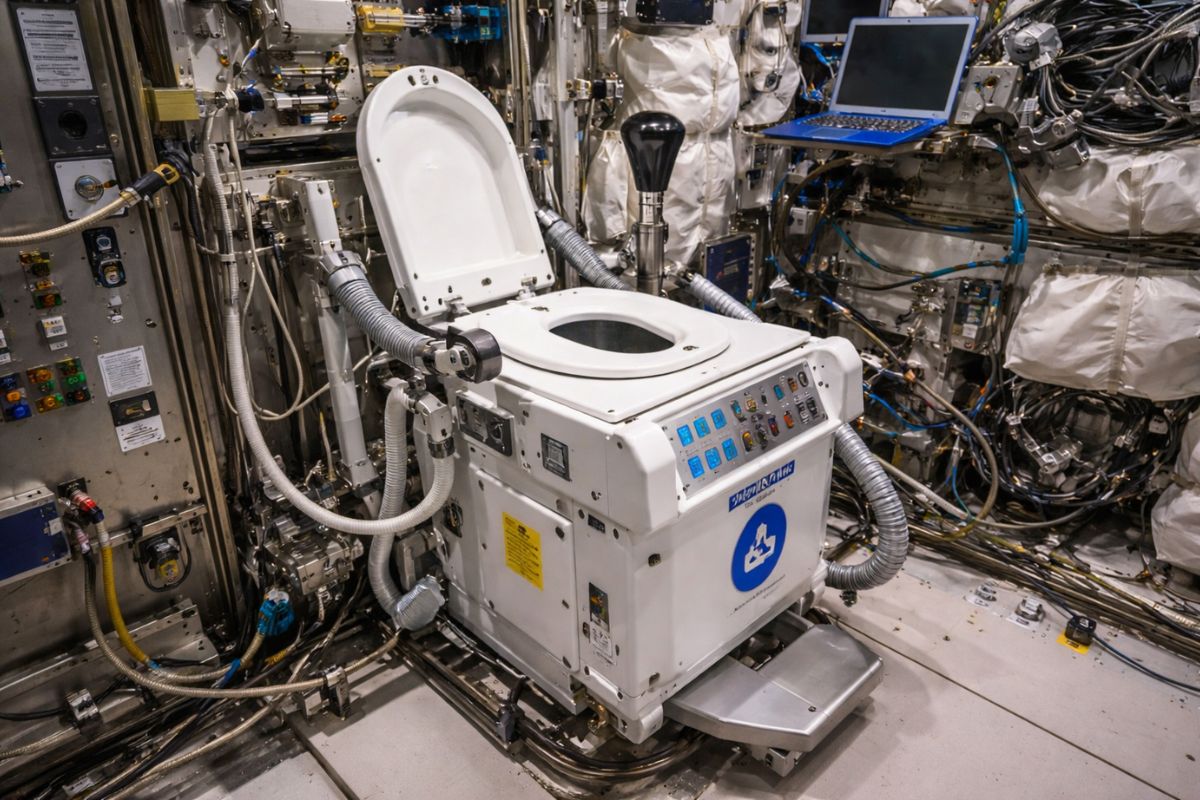
NASA spent over 118 million reais to build a single bathroom that works in zero gravity, and it has just gone to space on the first crewed mission to the Moon in more than 50 years.
-
Man never set foot on the Moon? 5 scientific proofs confirm that humanity has been there and definitively dismantle conspiracy theories.

-
The Brazilian Army will adopt humanoid robots to test the concept of future combat, says a website, surprising everyone, but later revealing that it was all just an allusion to April Fool’s Day.



Research published in journals such as Science, PNAS, and Myrmecological News describes this process as a case of obligate mutualism: the fungus does not survive in nature without the ants, and the ants do not survive without the fungus. In other words, it is a symbiosis that evolved over 10 to 15 million years, long before human agriculture, which is just over 10 thousand years.
Subterranean Engineering and Environmental Control
The most impressive part is not just the cultivation, but the environment constructed for it. The Atta and Acromyrmex dig complex systems of chambers and corridors capable of:
- Controlling humidity, essential for fungal development
- Renewing air, through ventilation ducts and pressure differences
- Regulating temperature, preventing excessive heat and dehydration
- Managing CO₂, preventing buildup resulting from the fungus’s respiration
Biomechanical and soil ecology studies demonstrate that some chambers reach 1 to 3 meters deep, leveraging the thermal stability of the subsoil. In large anthills, sensors have recorded networks with horizontal spans of dozens of meters and structures that function as a “biological air conditioner,” adjusting the microclimate internally without electricity, motors, or fuels — just physics and architecture.
Pest Control and Biological Defenses
Like all monocultures, cultivated fungi are also subject to diseases. The cutting ants face a historical enemy: the parasitic fungus Escovopsis. To combat it, the colonies rely on:
- Symbiotic bacteria of the genus Actinobacteria, which live on the ants’ cuticle and produce antibiotic compounds
- Specialized workers to clean the fungal garden
- Selective removal of contaminated parts of the substrate
The use of natural antibiotics is one of the most fascinating aspects of this system. Papers published in PNAS describe compounds produced by bacteria in the ants with effects similar to penicillin on a microscopic scale — a remarkable case of natural biotechnology millions of years before modern medicine.
Ecological Impact and Industrial Scale
In forest regions, savannas, and tropical environments, the cutting ants move massive amounts of biomass. Ecological estimates suggest that:
- A single colony can cut hundreds of kilograms of leaves per year
- Large colonies can reach up to 8 million individuals
- Fungal gardens can occupy hundreds of liters of internal volume

In addition to transforming plant matter into fungal biomass, the Atta and Acromyrmex:
- Till the soil, increasing its porosity
- Alter nutrient cycling, transporting nutrients from the canopy to the subsoil
- Increase water infiltration, thanks to the tunnels
- Influence ecological succession, modifying landscapes over decades
This impact is so significant that some research considers cutting ants to be “ecosystem engineers,” a category shared with beavers, termites, and organisms that literally reshape the environment.
An Agriculture That Precedes Human Agriculture
While human agriculture emerged just over 10 thousand years ago, with the domestication of cereals and grasses, the Atta and Acromyrmex were already practicing agriculture during the time of the last mastodons, giant sloths, and saber-toothed tigers. Their biological technology is stable, enduring, and resilient to climate. Without tools, fuels, or industrial storage — just symbiosis, chemistry, and subterranean architecture.
In the end, the question shifts from “how do the ants do this?” to “how many other natural technologies are we still unaware of?” In a world seeking sustainable solutions for food production, antibiotics, and environmental control, perhaps the greatest secrets lie hidden in biological systems that have existed for millions of years, silently beneath our feet.








-

-

-

3 pessoas reagiram a isso.