





 Português
  Inglês
  Espanhol
  4 min de leitura
  3 comentários


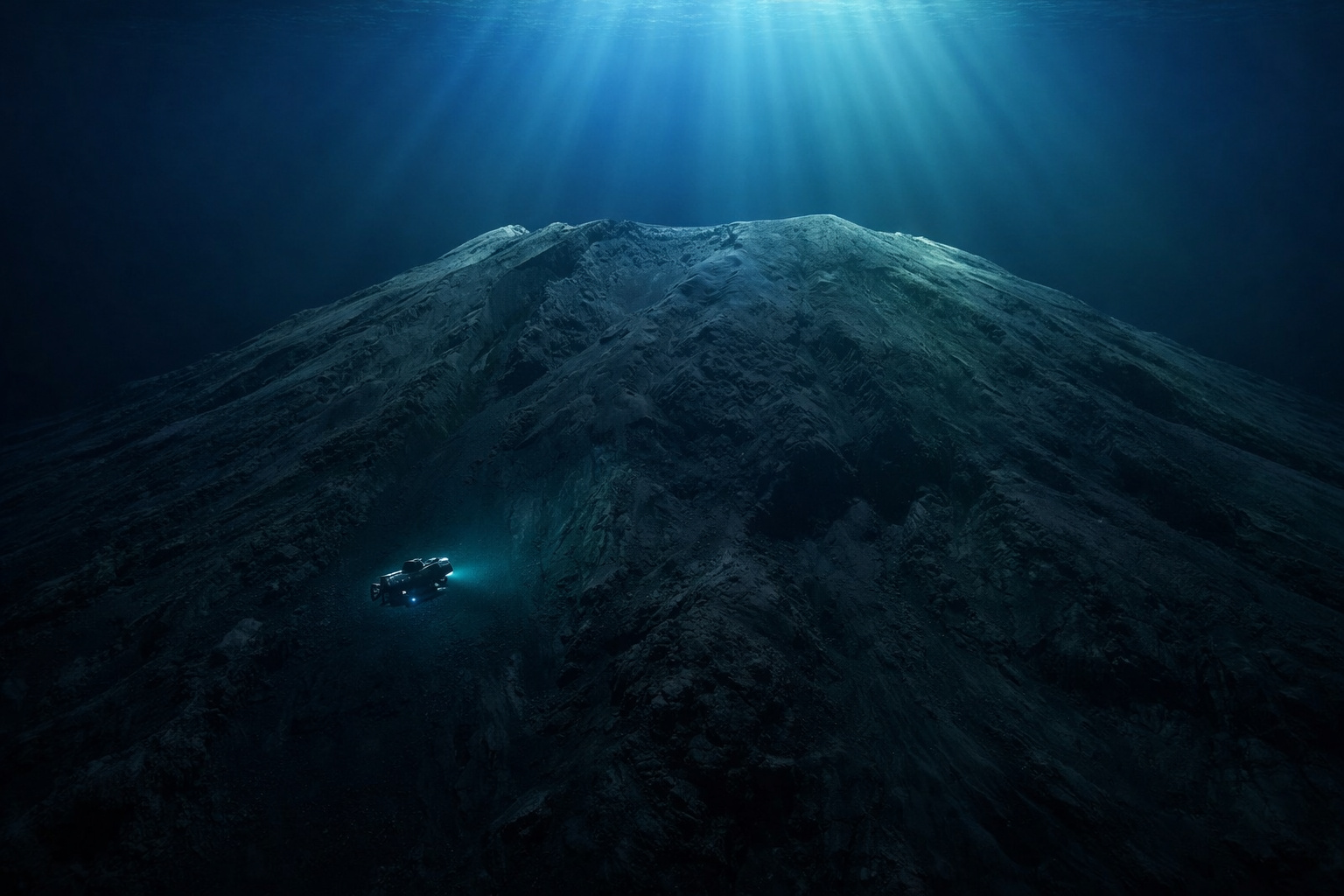


A Colossal Formation Hidden Beneath the Pacific Ocean Revealed Dimensions Comparable to Entire Countries and Forced Scientists to Revise Concepts About Volcanism and Seafloor Expansion
A geological discovery of great scientific impact has garnered the attention of the international community in recent years.
The Tamu Massif, located in the northwest of the Pacific Ocean, near the Shatsky Rise and east of Japan, revealed extraordinary dimensions that transformed the understanding of Earth’s tectonics.
With approximately 310,000 square kilometers of area, this submerged structure has dimensions comparable to the combined land area of Great Britain and Ireland.
Furthermore, its summit rests about 1,980 meters below the sea surface, while its base plunges down to 6.4 kilometers into the Earth’s crust.
-
Found in one of the most radioactive places on Earth, this Chernobyl fungus may be doing something with radiation that no one has been able to explain to this day.

-
A bright yellow mushroom imported from Asia escaped from a cultivation farm in the United States in 2010 and is now aggressively spreading across 25 states, destroying entire communities of native fungi in American forests.

-
Buried under China, a colossal machine weighing 20,000 tons began operating as the largest neutrino detector on the planet and, in just 59 days, surpassed results that science took half a century to achieve.

-
Iran enters the center of a climate alert after the war emitted 5.6 million tons of CO2 in two weeks, surpassing the annual pollution of entire countries.


This set of impressive proportions has led to Tamu Massif being considered one of the largest volcanic structures ever identified on the planet.
Colossal Dimensions Reveal the Scale of Tamu Massif
Firstly, geophysical studies showed that Tamu Massif dominates a large part of the Shatsky Rise, an extensive geological region of the Pacific.
Additionally, its structure stands approximately 4,460 meters tall, measured from the base to the summit of the formation.
Consequently, when compared to known volcanoes, the contrast is striking.
Tamu Massif is about 60 times larger than Mauna Loa volcano in Hawaii, considered one of the largest active volcanoes on Earth.
Among the main features recorded by geological studies are:
- Coverage area: about 310,000 km²
- Extent of the volcanic dome: approximately 450 by 650 kilometers
- Total height of the structure: about 4,460 meters
- Depth of the summit: approximately 1,980 meters below the ocean surface
These measurements highlight the exceptional size of this underwater mountain.
Scientific Discovery Surprises Geology in 2013
For many years, scientists believed that the Shatsky Rise area was made up of various small grouped volcanoes.
However, new research led by geophysicist William Sager from Texas A&M University changed this understanding.
In September 2013, a study published in the scientific journal Nature Geoscience presented a new interpretation.
The researchers concluded that the structure could be a single giant volcano formed by central effusive eruptions.
At that time, the discovery generated significant scientific impact.
In fact, some experts even compared the scale of Tamu Massif to Olympus Mons, the largest known volcano on Mars.
New Magnetic Analysis Redefines the Origin of the Structure
Later, however, new investigations broadened the understanding of the formation of Tamu Massif.
In 2019, a scientific expedition aboard the Falkor ship from the Schmidt Ocean Institute conducted a detailed mapping of the seafloor.
During this mission, researchers collected nearly two million magnetic measurements in the region.
The results revealed blocks of crust with opposite magnetic polarities organized in linear patterns.
This behavior indicated that the structure is likely not an isolated volcano.
Instead, the data suggest that Tamu Massif was formed by the expansion of the oceanic crust at an active tectonic ridge in Earth’s geological past.
Drillings Reveal Massive Eruptions in the Jurassic
In addition to magnetic analyses, scientific drillings provided new evidence regarding the origin of the formation.
During the Expedition 324 of the International Ocean Discovery Program, scientists extracted basalt flows up to 23 meters thick.
These rocks confirmed the occurrence of extremely effusive eruptions during the Late Jurassic, approximately 145 million years ago.
According to the geological studies, the formation occurred in a complex tectonic environment known as a triple junction, where three tectonic plates were simultaneously separating.
Several factors contributed to the formation of the structure:
- Simultaneous separation of three tectonic plates in the Pacific
- Crustal fractures that allowed the rise of large volumes of magma
- Interaction between a mantle plume and an oceanic ridge
- Formation of deep crustal roots due to Airy isostasy
This set of geological processes transformed the region into an important natural laboratory for studies of submarine volcanism.
Scientific Review Broadens the Understanding of Tectonics
With the advancement of research, Tamu Massif has begun to play a fundamental role in modern geophysics.
The seismic and magnetic data demonstrate that large volcanic plateaus can form from the simple expansion of the ocean floor.
This finding weakens old geological analogies that attributed giant formations solely to the action of isolated mantle plumes.
Consequently, the study of Tamu Massif directly contributes to the revision of classic models of plate tectonics.
The Scientific Legacy of the Submerged Giant
Currently, scientific expeditions continue to investigate the depths of the region.
Each new rock sample collected helps researchers to understand how large oceanic igneous provinces formed throughout Earth’s geological history.
Meanwhile, Tamu Massif remains silent almost two kilometers below the surface of the Pacific.
Even so, its existence continues to enhance scientific knowledge about the processes that shaped the planet.
How many other geological giants remain hidden in the depths of Earth’s oceans?






Sería deseable que este volcán siga dormido definitivamente.
Que países afectaría si el volcán Tamu hiciera erupción ???
Artículos interesantes, pero sin una rigurosa revisión de redacción y cifras antes de publicar.