





 Portuguese
  English
  Spanish
  6 min of reading
  2 comments


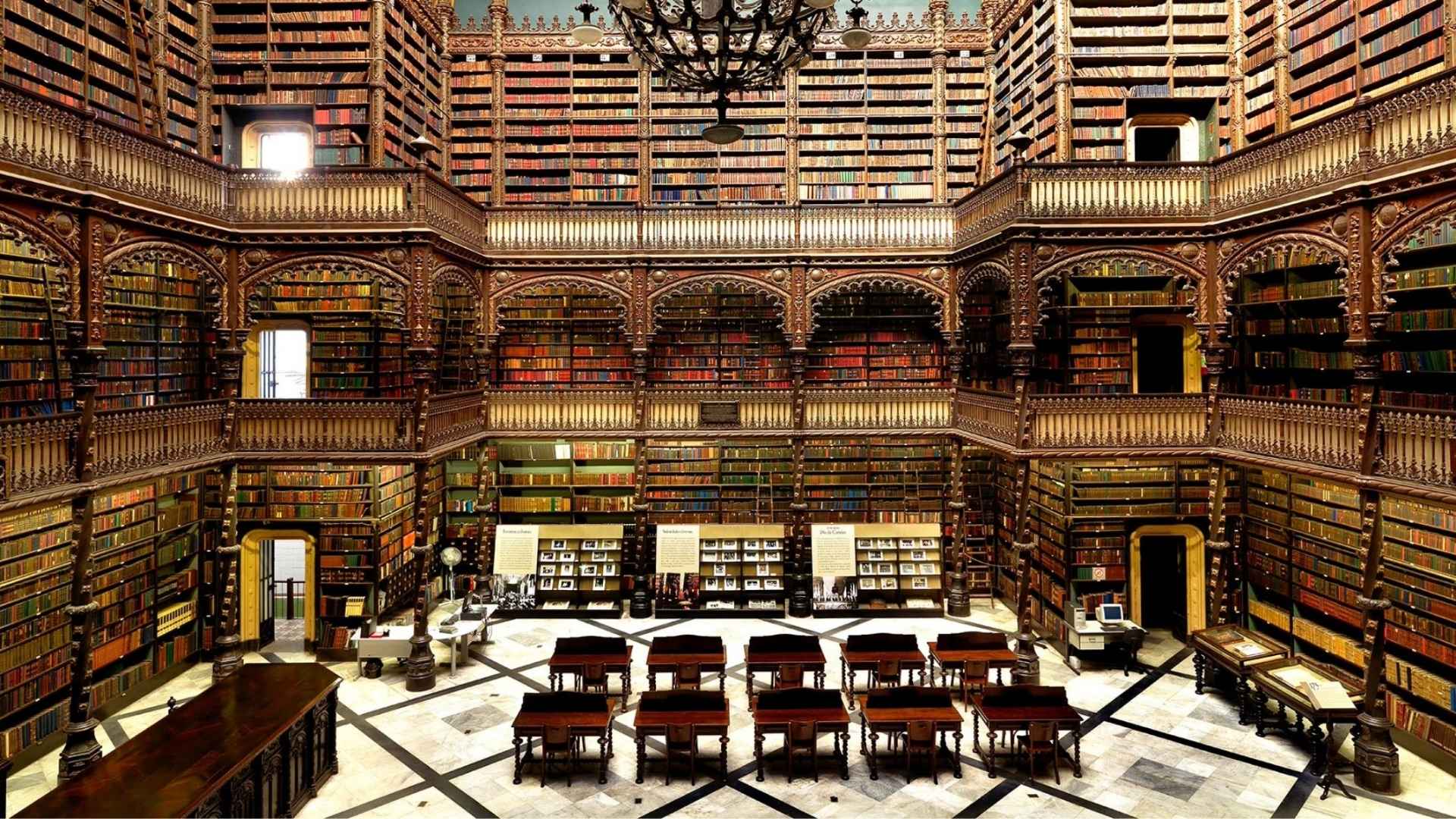


Documentary Vault In Downtown Rio Brings Together Millions Of Works, Grows Due To Law And Operates With Little Visible Technical Routines Responsible For Preserving Books, Maps, Scores And Historical Records That Document Brazilian Intellectual Production Over More Than Two Centuries.
In downtown Rio de Janeiro, just a few meters from Cinelândia, a building designed to store paper, ink, scores, maps, and images houses one of the largest documentary collections in the world.
The National Library Foundation, the institution responsible for the National Library of Brazil, reports maintaining a collection estimated at around 10 million items and being the largest library in Latin America.
This scale is not only apparent in shelves and reading rooms.
-
Man never set foot on the Moon? 5 scientific proofs confirm that humanity has been there and definitively dismantle conspiracy theories.
-
The Brazilian Army will adopt humanoid robots to test the concept of future combat, says a website, surprising everyone, but later revealing that it was all just an allusion to April Fool’s Day.

-
There is a city in China right next to Hong Kong where people speak Portuguese, the streets have names in Portuguese, and the architecture looks like it came straight out of a historic city in Brazil.

-
Rare frog thought to be extinct after only appearing in fossils reappears, becoming a ‘living relic’ of evolution and gaining a real path to spread after combating introduced predators.


It translates into routines of receiving, recording, preserving, and controlling access that function as a “vault” for Brazilian intellectual production, with rules established by law and technical procedures aimed at keeping documents legible for decades and, in some cases, for centuries.
Legal Deposit Guarantees Continuous Growth Of The Collection
The permanent engine of this growth is the legal deposit, a mechanism that requires the submission of copies of publications made in the country for the custody of the National Library.
The Law No. 10,994, of December 14, 2004, regulates the legal deposit of publications at the National Library with the aim of ensuring the registration and custody of national intellectual production.
In public guidelines released by the institution, the legal deposit is described as the mandatory sending of at least one copy of all publications produced in Brazilian territory, by any means or process, for free distribution or sale, within the time frame defined after publication.
In practice, this means that books, brochures, periodicals, and other materials continuously enter the receiving and processing circuit, regardless of whether the title becomes a bestseller or disappears from shelves within a few weeks.
Technical Backstage Before Arriving On The Shelves

What arrives at the National Library does not go directly to an open shelf for the public.
Instead, it goes through triages, checks, and registrations that have a direct impact on the material’s location and preservation capacity.
The institution itself describes as part of its duties the capture, preservation, custody, and dissemination of Brazil’s intellectual production, which involves cataloging, classification, and defining storage conditions.
The work is, in many cases, done in specialized sectors by type of collection.
The requirements for preserving a newspaper from the early 20th century are not the same as those for maintaining a score, a photograph, or a map on moisture-sensitive paper.
Historical Origins Of The National Library In Brazil
The National Library is also a historical organism.
The institution records the founding date as October 29, 1810, when the Royal Library was officially established in Brazil, still in the Joanine period.
Widespread access, however, did not begin immediately.
Chronologies and institutional texts inform that the opening to the public for consultations occurred in 1814, after a period when consultations were restricted and depended on consent.
The initial collection is linked to the transfer of Portuguese collections to Rio de Janeiro in the context of the court’s change.
The National Library has undergone various phases of growth and reorganization as the country urbanized and created new teaching, science, and administration institutions.
Historical Building And Preservation Infrastructure
The current building, on Avenida Rio Branco, is the result of another decisive stage.
Institutional information and public heritage records indicate that the cornerstone of the headquarters was laid in 1905 and that the inauguration took place on October 29, 1910.

The construction was designed to support the storage of large volumes of material while also offering consultation areas, technical services, and cultural spaces.
The National Library maintains public content about the history of the building, emphasizing that the structure has become an architectural landmark in the central region of Rio.
Moreover, the location operates daily as a continuous working space for teams dealing with highly sensitive collections.
Preservation, Restoration, And Rare Works
The “vault” mentioned in the title has less to do with secrecy and more with environmental control and conservation procedures.
The National Library Foundation describes actions for preservation and restoration aimed at rare works, manuscripts, cartography, iconography, music, and sound archives.
There is priority treatment for items degraded by time and handling.
On institutional pages, restoration appears as a set of measures designed to reverse physical and chemical damage and restore integrity to the document without erasing its historical nature.
This includes decisions regarding cleaning, recomposition of supports, stabilization of paper, and, in specific situations, interventions that allow for reading without subjecting the piece to new stress.
Digitization And Public Access To The Collection
Another backstage aspect that gained public prominence in recent years is digitization.
The Digital National Library is part of the Foundation’s structure and reports providing documents in the public domain or authorized, following copyright rules.
In the case of some sound recordings, full access remains restricted to the headquarters building.
There is public description of a digitization laboratory with equipment such as planetary scanners, used to capture images without pressing the document in a damaging way.
There are also specific solutions for microfilms and large format materials.
The Foundation itself mentions that the collection has approximately 10 million items and that millions are already in digital format, which requires technology for capturing, storing, and managing files.
Invisible Routine That Sustains National Memory

The operational routine combines what the public sees and what rarely appears in quick visits.
There is the Library as a space for consultation, exhibitions, and cultural activities.
But there is also the permanent circuit of incoming publications through legal deposit, bibliographic registration, decisions regarding packaging, and maintaining suitable environments to reduce the risks of mold, pests, and chemical deterioration.
The same applies to specific collections, where consultations may require scheduling, handling rules, and restrictions to protect fragile items.
Especially when dealing with rare works and unique documents.
National Memory And Record Of Intellectual Production
The scale of this work tends to be perceived when observing the very concept of national memory present in the institutional definitions of legal deposit.
The goal is not only to offer immediate reading.
It is to ensure that the intellectual production of an era remains identifiable and accessible in the future.
In a country with rapid changes in the publishing market, expansion of digital formats, and intense circulation of ephemeral materials, the physical and digital collection becomes a record of what was published, when it was published, and under what conditions it circulated.
With about 10 million items, growth fueled by legal deposit and technical backstage that range from cataloging to restoration and digitization, the National Library operates as a true vault of Brazilian intellectual production.
Given this structure, what stands out most in the quiet work of preserving the country’s memory: the path from legal deposit to the catalog or the technical effort to recover documents that were already on the verge of being lost?





A foto não corresponde à Biblioteca Nacional, e sim ao Real Gabinete Português de Leitura.
Digo: a primeira foto, que mostra o interior do prédio.