





 Portuguese
  English
  Spanish
 5 min of reading
  4 comments


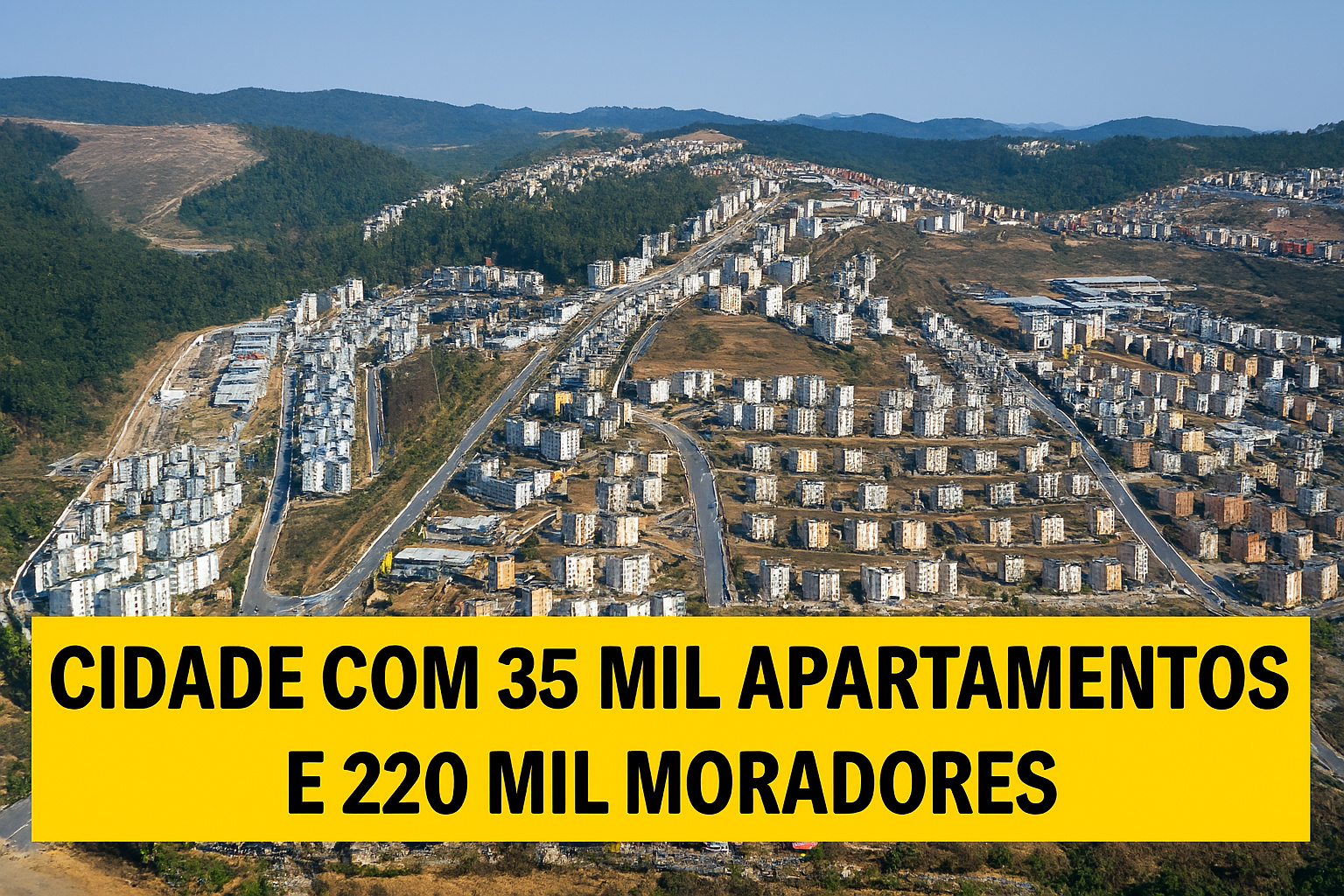


Largest Housing Complex in Latin America Has 35 Thousand Apartments and More Than 220 Thousand Residents. Cidade Tiradentes in São Paulo Functions as an Independent Municipality within the Metropolis.
In the 1980s, São Paulo faced a dilemma that seemed impossible to solve: how to house thousands of families living in risk areas, slums, or tenements scattered throughout the city. The housing deficit was immense, and municipal authorities decided to bet on a large-scale solution: the creation of a monumental housing complex that would become a global reference. Thus, Cidade Tiradentes was born in the eastern zone of the São Paulo capital. Designed by Cohab-SP (Metropolitan Housing Company of São Paulo), the area was planned to be a dormitory neighborhood. That is: a place where thousands of workers could live in standardized units, even though most jobs were concentrated dozens of kilometers away, in the city’s expanded center.
What no one imagined was that, over the decades, Cidade Tiradentes would transform into much more than that: a true independent municipality within the metropolis, with its own population, infrastructure, and culture.
Impressive Numbers: An Urban Colossus
The data from Cidade Tiradentes speak for themselves:
-
The village where two rivers run side by side without mixing in Santarém and Alter do Chão reveals some of the most beautiful freshwater beaches on the planet.
-
Brazil’s nuclear submarine with a speed 5 times greater than normal advances after nearly 50 years and R$ 40 billion spent.

-
A Brazilian island charges R$ 0.50 to receive visitors and prohibits any new residents.
-
Why was the Great Wall of China built? The truth that many are unaware of!

- Formal Housing Units: about 35 thousand apartments built by Cohab-SP, in standardized five-story blocks, distributed along large complexes.
- Population: more than 220 thousand residents, according to estimates from the São Paulo City Hall — a number greater than that of 5,000 Brazilian municipalities.
- Occupied Area: approximately 15 km², comparable to the territory of entire cities.
- Population Density: more than 14 thousand residents per km², one of the highest in Brazil.
Comparing Cidade Tiradentes to other places helps understand its magnitude. Its population is larger than that of cities like Foz do Iguaçu (PR), Vitória da Conquista (BA), or Aracaju (SE), capital of Sergipe. If it were an independent municipality, it would be among the 100 most populous in the country.
Structure That Functions Like a City
Cidade Tiradentes houses a population that surpasses that of many Brazilian capitals. To meet this demand, the region had to develop infrastructure equivalent to that of a complete municipality.
- Education: dozens of state and municipal schools, as well as daycare centers and social programs, serve thousands of children and teenagers.
- Health: it has health posts, basic units, and the Hospital Cidade Tiradentes, inaugurated in 2007, considered the largest hospital in the outskirts of Latin America.
- Commerce: supermarkets, pharmacies, banks, shopping centers, and hundreds of local small businesses ensure the movement of the internal economy.
- Transport: the neighborhood is served by important bus corridors, such as Expresso Tiradentes, which connects to the central region. Still, mobility remains one of the main challenges, with commutes of up to 3 hours for those working in other areas of the city.
- Public Services: the region has police stations, post offices, bus terminals, and a whole network of public facilities aimed at its gigantic population.
These elements make Cidade Tiradentes, in practice, a city within a city, functioning relatively independently.
The Social Side: Stories of Struggle and Resilience
While Cidade Tiradentes impresses with its numbers, it is also a portrait of the struggle of the Brazilian periphery. From the beginning, residents faced challenges of infrastructure, violence, and social inequality.
The neighborhood became known as “dormitory city”, because most of the population worked in distant regions, having to face long daily transport journeys. But over time, the neighborhood gained its own life. Today, in addition to living there, thousands of people work, study, and build their careers within the region itself.
Peripheral culture has also flourished. Cidade Tiradentes is a hub of art, rap, literary events, and social movements. Many cultural collectives have emerged in the neighborhood, turning it into a reference for São Paulo’s cultural scene.
International Comparisons
The grandeur of Cidade Tiradentes is such that, in urban studies, it has already been compared to housing megaprojects in other countries.
Kowloon Walled City (Hong Kong): although demolished in 1993, it was known for its extremely high density and self-sufficiency. Cidade Tiradentes, on a smaller scale, follows a similar logic.
Social Housing in Paris and London: in both cases, housing blocks have become symbols of social exclusion. In São Paulo, Cidade Tiradentes seeks to reinvent itself as a space of opportunities, despite the difficulties.
Mass Housing in China: although there are gigantic condominiums in Chinese cities, Cidade Tiradentes remains a unique reference in Latin America.
These comparisons show that the neighborhood is not just a Brazilian phenomenon, but part of a global discussion about mass housing and accelerated urbanization.
Current and Future Challenges
Despite its grandeur, Cidade Tiradentes faces numerous challenges:
- Mobility: the lack of rail transport is a bottleneck. Expansion projects for the subway and monorail to the region have been announced, but have never materialized.
- Urban Infrastructure: sanitation, garbage collection, and road maintenance are still areas of concern.
- Security: urban violence remains a problem, although community and cultural programs have contributed to reducing crime rates.
- Social Stigma: many residents report prejudice for living in Cidade Tiradentes, as if the neighborhood was synonymous with poverty.
Despite this, the community persists. Cultural, educational, and social projects have transformed the region into a space of community innovation, with young entrepreneurs and social impact initiatives.
Cidade Tiradentes is, at the same time, a symbol of urban exclusion and the capacity for resilience of the Brazilian periphery. If, on one hand, it was born from a project to “hide” poverty on the outskirts of the metropolis, on the other, it has flourished as a vibrant, lively neighborhood full of stories.
With its 35 thousand apartments and more than 220 thousand residents, the region is a fundamental cog in São Paulo. It shows that mass housing is a challenge, but also an opportunity to rethink urban policies and create new models of coexistence.







A matéria é falsa quanto a população de Vitória da Conquista BA e Aracaju Se.
Reciprocamente, suas populações são:
396.000 habitantes e mais de 630.000 habitantes.
Portanto, cidade Tiradentes está muito aquém dessas duas cidades como afirma erroneamente o autor do texto.
aqui se falou dos apartamentos mas esqueceu-se de falar das dezenas de favelas de madeiras e palafitas e condições sub humanas da falta de saneamento básico da falta de segurança da falta de educação em larga escala da falta de mobilidade ( metrô e avenidas com maior fluidez) e os números 220 mil habitantes nao condiz com a realidade ultrapassando em mais de 70% desse índice
Se tiver 220.000 moradores representa 6,28 pessoas por apartamento de 2 dormitórios. Não dá para acreditar nesse número. Em São Paulo a média é de 3 habitantes por moradia e 18% só tem um morador. Na Cidade Tiradentes se tiver 4 moradores por apartamento é razoável..
Ou seja, cerca de 140.000 habitantes no local.
Cidades Tiradentes não tem só COHAB. Há milhares de residências térreas, várias favelas e ocupações, e edifícios de vários andares. Trabalho na região há anos, e o último senso (2022) contabilizou 195 mil habitantes.