





 Portuguese
  English
  Spanish
  4 min of reading
  0 comments


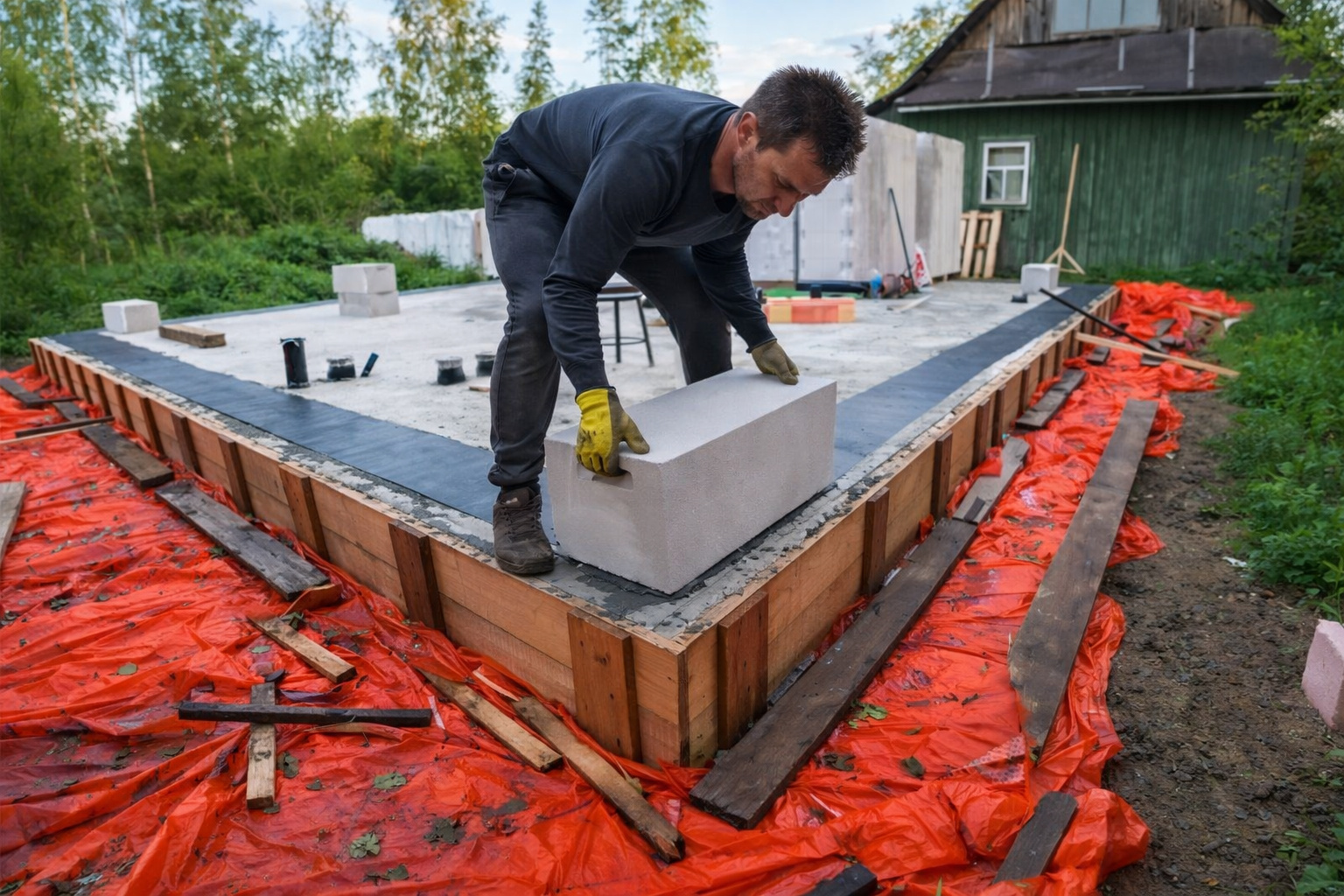
Man built house alone with soil, cement blocks with foam and wood structure in a complete and functional construction
A man built a house alone, starting from scratch on an empty lot, using only soil, blocks, and wood to transform the space into a livable environment. The result draws attention for its organized sequence and the way each step was executed with precision.
The work progresses from leveling the ground with soil, through the use of cement blocks with foam, and culminates in finishing touches with paint. The entire process shows clear evolution, where each phase supports the next.
The information was shared by Populer WrldVideo, a digital channel for sharing visual content. The material shows how a construction can go from basic to a ready-to-use space without the need for complex structures.
-
He saw a loophole in the 1967 space treaty and claims to have made millions selling lots on the Moon and other planets.

-
Researchers from Rio Grande do Sul have discovered a plant species that does not exist anywhere else on the planet within a park in the far west of Rio Grande do Sul, and it is already critically endangered.

-
More than 411 helicopters, 11.9 million inhabitants, and a trillion-dollar GDP place the largest city in Brazil and the Southern Hemisphere in a league of its own, with figures that already rival giant countries like Morocco, Hungary, and Ecuador.

-
Mysterious rock formation found in the interior of Paraná does not follow any natural erosion pattern, and now specialists are investigating whether humans carved those cavities centuries ago.

Leveling the ground with soil creates initial base for the house
The first step was to prepare the land, with manual leveling using soil. The uneven ground is adjusted until it forms a flatter and firmer surface, allowing for safe construction to begin. This process requires repetition and constant visual control.
The execution involves spreading the soil and compacting the surface, creating a uniform base. The presence of visible layers indicates care to avoid unevenness. The manual work shows continuous effort and attention to detail.
As a result, the land ceases to be just an empty space and gains a defined base. The leveling of the ground with soil is essential to support the entire construction that follows.
Use of cement blocks with foam defines walls and structure
With the base ready, the walls begin to emerge with cement blocks with foam. These blocks are positioned one by one, forming straight lines that shape the house. The foam appears between the pieces, aiding in fitting and securing.
During execution, each block is manually adjusted to maintain alignment. The application of foam between the blocks creates a continuous bond between the parts. The assembly rhythm shows repetition and precision.
The result is the formation of the main walls, which begin to delineate the internal space. The construction ceases to be just a base and gains visible volume, with defined doors and openings.
Wood structure supports the upper part of the construction
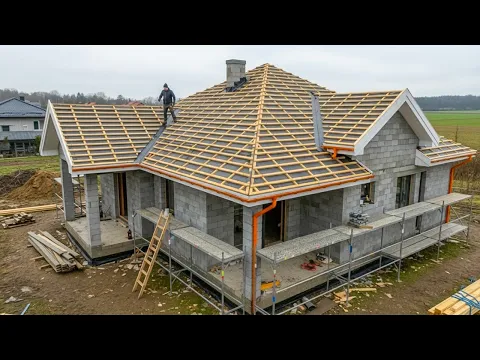
After raising the walls, the phase of the upper structure with wood begins. Beams and pieces are positioned over the blocks, creating the support for the roof. The presence of aligned wood and firm fittings shows the organization of this stage.
The execution involves positioning the pieces at an angle and securing each support point. The fitting between the beams forms a continuous structure that connects the entire upper part of the house.
As a consequence, the construction takes on a complete shape. The house ceases to be open and begins to transform into a protected space. The wood structure defines the final shape of the top.
Construction gains complete shape with roof and enclosure
With the structure ready, the upper enclosure begins to be defined. The roof line appears clearly, creating a division between the interior and exterior. The whole now has the appearance of a complete house.

The execution of this phase involves covering the wood structure and adjusting the fittings. The work requires care to maintain alignment and avoid visible flaws. Each part is connected to the rest of the structure.
The result is a more protected and organized space. The construction already presents characteristics of a dwelling, with a closed volume and defined internal areas.
Final adjustments and painting transform the house into a ready space
In the final stage, the focus shifts to finishing and details. Imperfections are corrected on the walls and base, while the surface receives paint. The presence of smooth walls and applied paint marks this transformation.
The execution involves manual adjustments, cleaning edges, and uniform application of paint. Attention to detail improves the overall appearance of the construction.
Complete transformation shows strength of individual labor
The complete process reveals how a man built a house alone, going through all the stages from the ground to the final finish. Each phase contributes directly to the result, without relying on complex structures.
The construction demonstrates that organization, repetition, and continuous effort can transform an empty space into a functional dwelling. The use of soil, cement blocks with foam, and wood shows a practical and efficient solution.
Now we want to know your opinion: do you believe that this type of construction can inspire others? Leave your comment and share this story with those interested in construction and manual work.










Seja o primeiro a reagir!